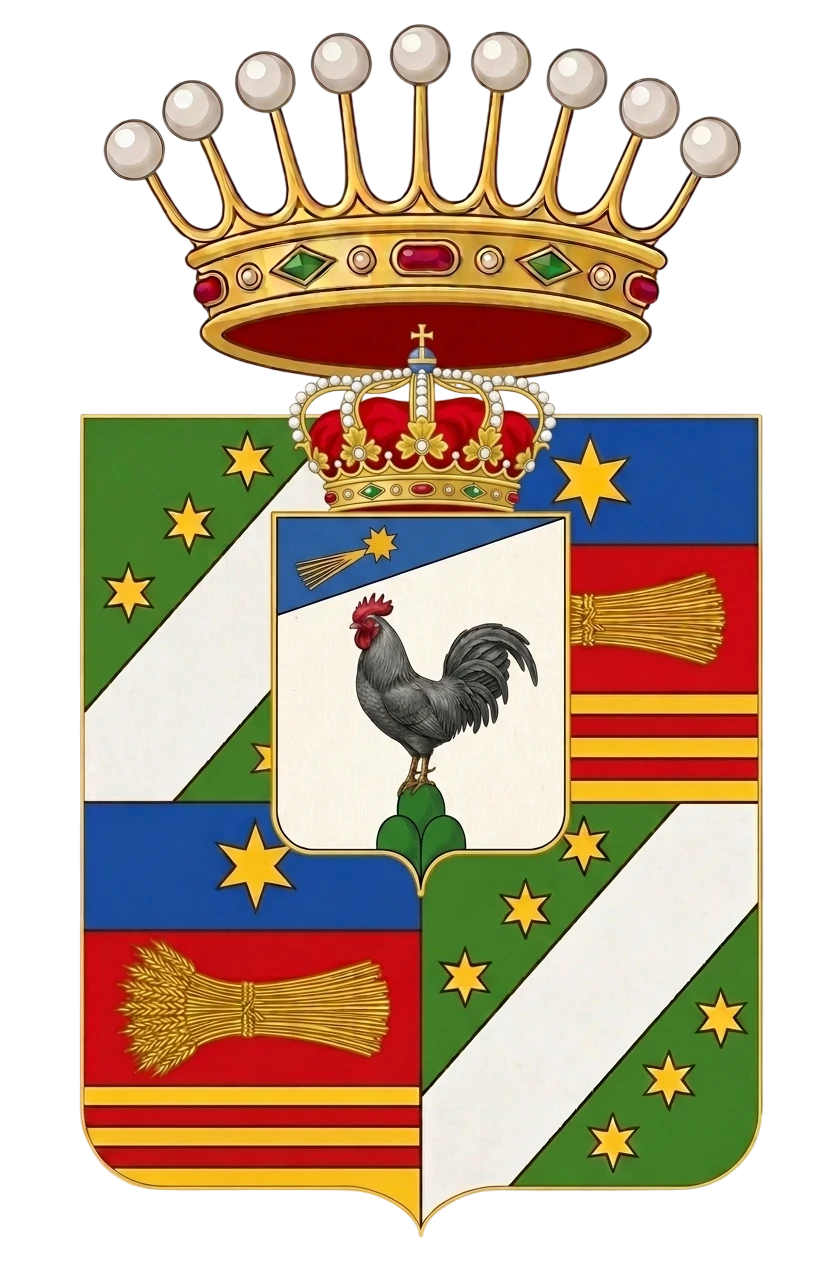

Tierced in fess — azure a mullet or; gules a sheaf of wheat or bound in a ring; barry of argent, or and gules.
Lineage · Stage 3
Dall'Oro.
Nobles of Treviso, 13th – 20th c.
An ancient patrician family of Padua (1200), then of Treviso: noble goldsmiths, Gonfaloniers of Justice and Captains of the People at Bologna. Extinct with Dejanira dall'Oro (1835–1900), whose 1862 marriage to Pietro Giovanni Guerri gave rise to the name Guerri dall'Oro.
History of the house.
The dall'Oro are originally from Padua, where they are documented from 1200 under the name «da Rio». They move to Treviso around 1300 and take the name dall'Oro from the goldsmith's art they practised.
Counted among the nobles of Treviso, they had Gonfaloniers of Justice and Captains of the People at Bologna in the 15th century. At Treviso the 16th-century house of the dall'Oro still stands, with remains of frescoes, in the street that bears their name — the Via dei dall'Oro.
The presence of the dall'Oro at Treviso is further documented in the city's Civic Museum, which preserves traces of their patrician activity between the 14th and 15th centuries.
The documented line unfolds over more than three centuries, from Stefano dall'Oro (16th century) through a series of noble Treviso «Messeri» — the Martino (1528–1623), Pietro Antonio «il Logia» (b. 1578), Silvestro (b. 1604), Domenico «da Macarelli», Carlo Antonio (b. 1674), Carlo Domenico (1704–1756) and Paolo (1795–1860) — down to the extinction of the house with Dejanira dall'Oro (1835–1900), the last of her family.
In 1862 Dejanira marries the noble Pietro Giovanni Guerri (1819–1880), an officer at the Grand-Ducal Court of Tuscany, who adds his wife's surname to his own. From this union is born the house of the Guerri dall'Oro, which continues today in the Princes of Tricase.
The shield is quartered: in the 1st and 4th the Guerri (vert a bend argent accompanied by six mullets or), in the 2nd and 3rd the dall'Oro.
Family tree of the house.
Titles and dignities of the dall'Oro
Nobles and Captains of the People.
Places and roots