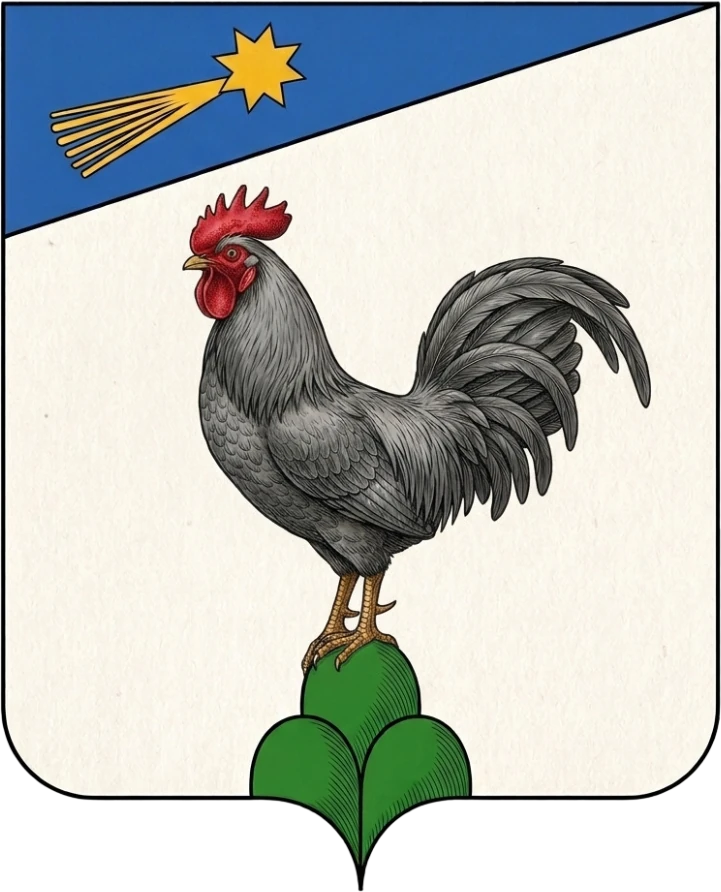
Famous descent
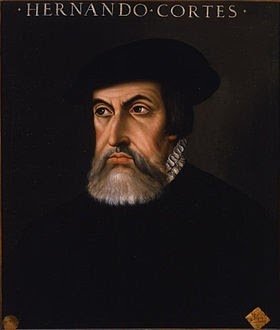
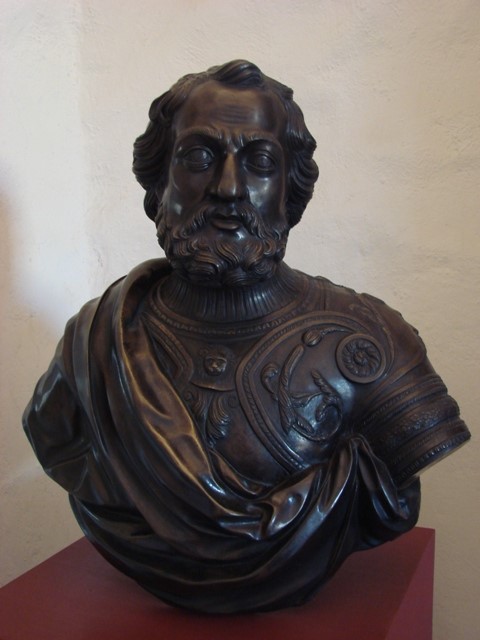
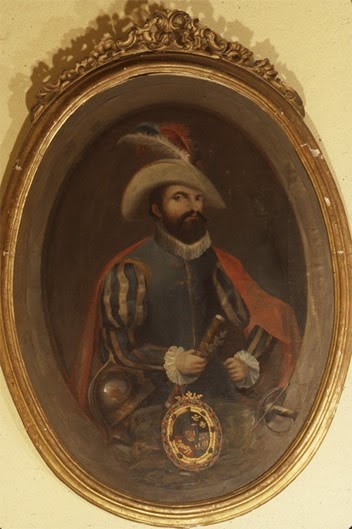
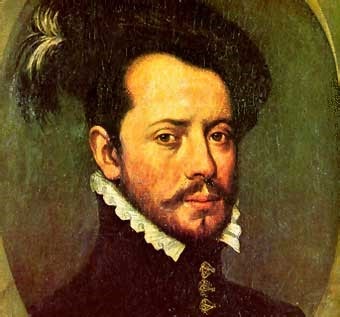
Hernán Cortés.
«EL CONQUISTADOR»
Spanish conquistador of Mexico. Rarely has history attributed to the vigour and determination of a single man the conquest of a vast territory; in this short list stands Hernán Cortés, who always preferred to burn his ships rather than retreat. With scant means, with hardly any support beyond his intelligence and his military and diplomatic intuition, he managed in only two years to reduce to Span
History.
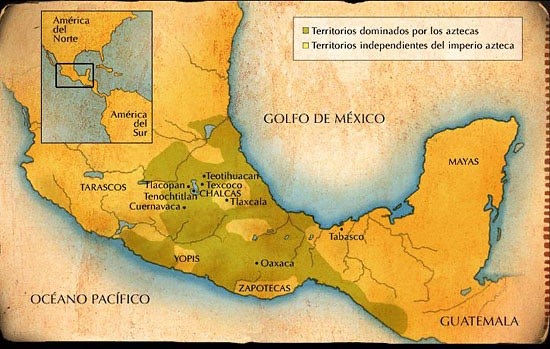
Spanish conquistador of Mexico. Rarely has history attributed to the vigour and determination of a single man the conquest of a vast territory; in this short list stands Hernán Cortés, who always preferred to burn his ships rather than retreat. With scant means, with hardly any support beyond his intelligence and his military and diplomatic intuition, he managed in only two years to reduce to Spanish domination the splendid Aztec Empire, populated, according to estimates, by some fifteen million inhabitants.
It is true that various favourable circumstances accompanied him, and that, driven by ambition and a thirst for honours and riches, he committed abuses and acts of violence, like other conquistadors. But, of all of them, Cortés was the most cultivated and most capable captain, and even if this serves as no mitigation, he was also driven by a great religious fervour; his moral conscience came to pose him the question of whether it was lawful to enslave the Indians, an unusual doubt at the dawn of the colonisation of America.
Coming from a family of hidalgos of Extremadura, only son of Martín Cortés de Monroy and of Catalina Pizarro Altamirano, Hernán Cortés studied briefly at the University of Salamanca. In 1504 he passed to the Indies, recently discovered by Christopher Columbus, and settled as a notary and landowner in La Española (Santo Domingo).
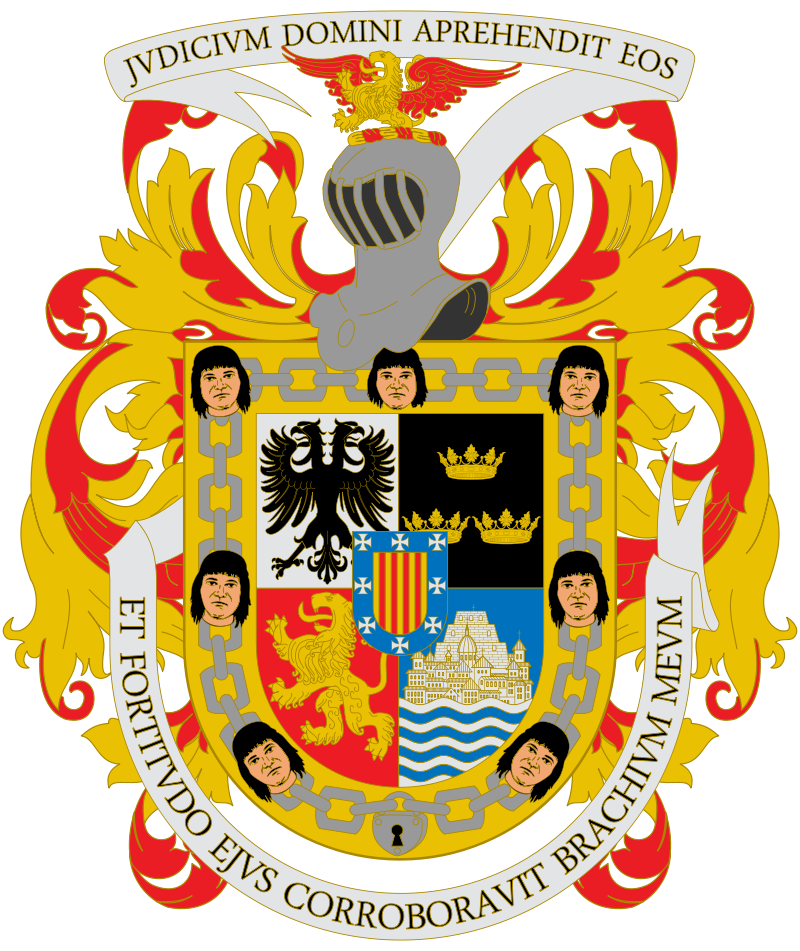
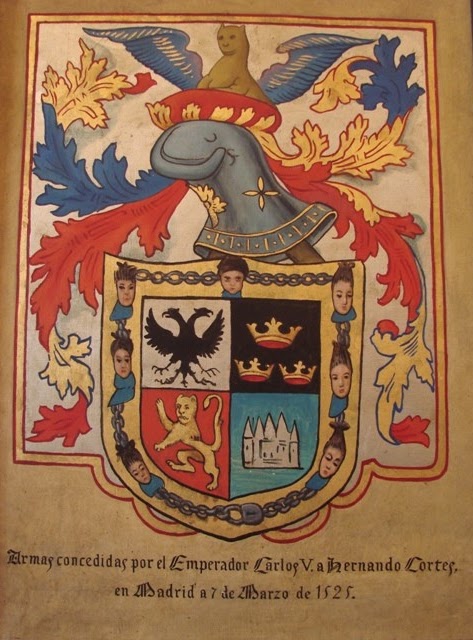
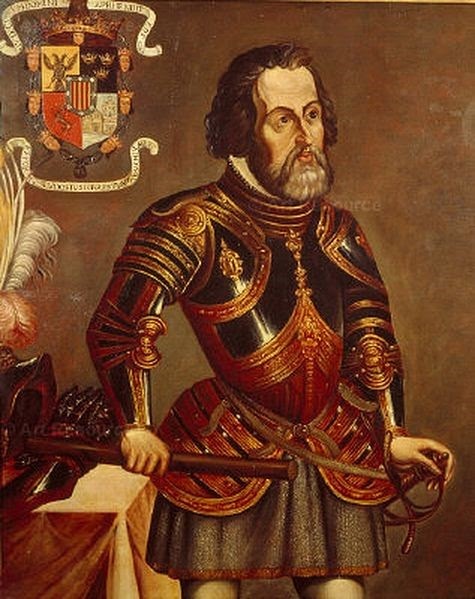
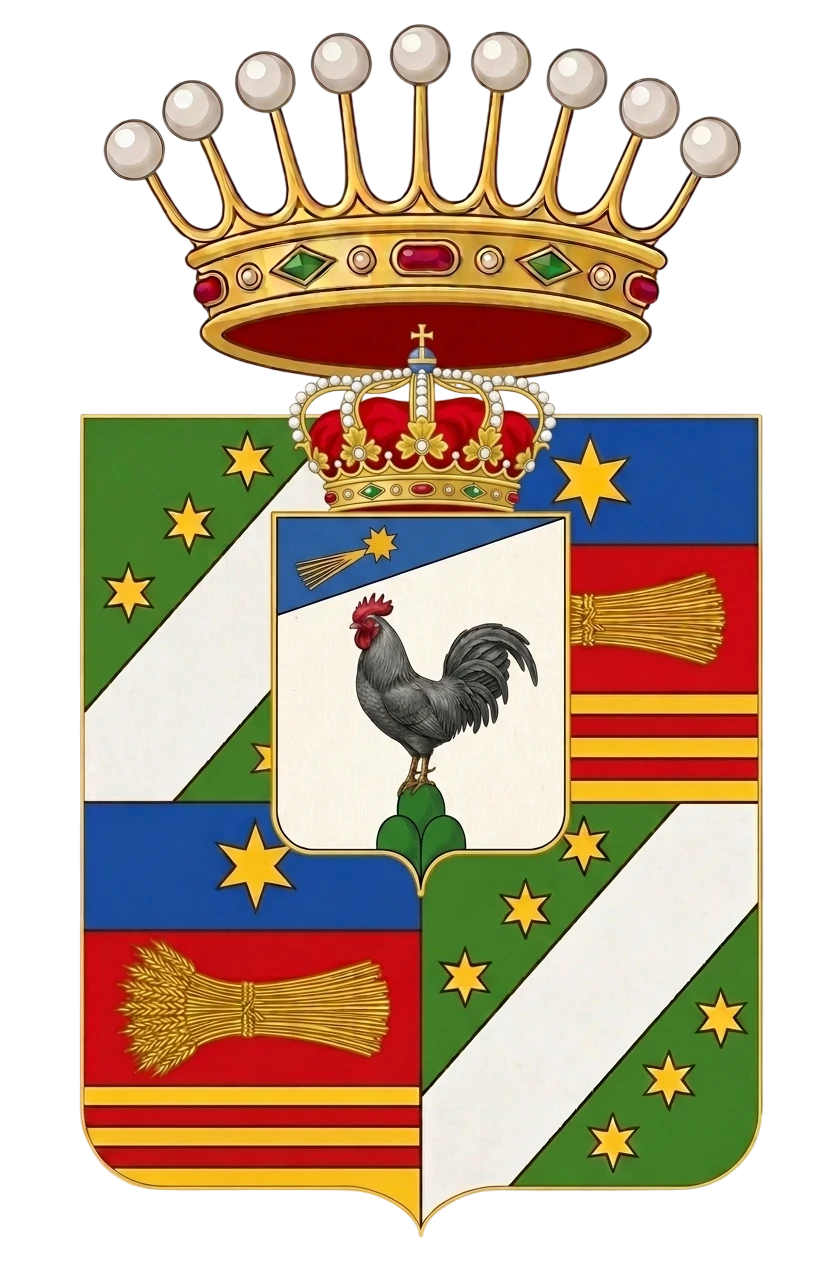
The arms contain a quartered shield with a conopial crowning at the point of the chief and the beard, framed by a bordure of chains with seven captive heads (the seven caciques subjugated in his conquest); in the field, four quarters: a double-headed eagle displayed, in the first; three crowns in the second, one above and two of lesser size below; a lion rampant, in the third quarter; a turreted castle, on the waters in the fourth.
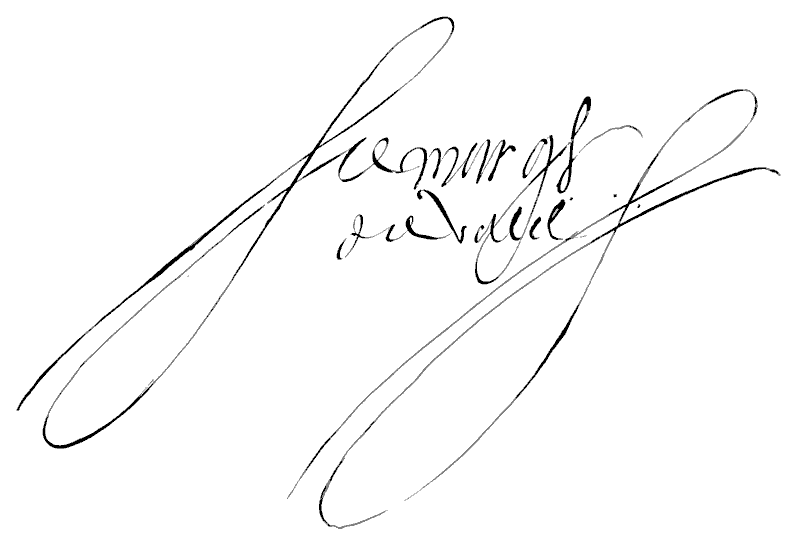
HERNÁN CORTÉS
Governor and Captain General of New Spain, 1st Marquis del Valle de Oaxaca
##
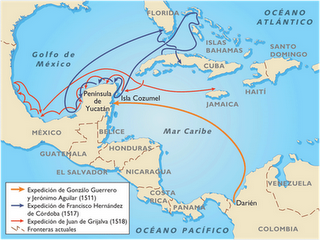
In 1511 he took part in the expedition to Cuba as secretary of the governor Diego Velázquez de Cuéllar, with whom he became related by marrying his sister-in-law, Catalina Suárez Marcaida; Velázquez appointed him mayor of the new city of Santiago de Cuba. At the end of 1518 Velázquez entrusted him with the command of the third expedition, after those of Francisco Hernández de Córdoba and Juan de Grijalva, to continue his discoveries on the coast of Yucatán.
However, the governor distrusted Cortés, whom he had already had imprisoned once on a charge of conspiracy, and decided to relieve him of his commission before departure. Forewarned, Cortés hastened his departure and put to sea on 10 February 1519, before receiving the notification. With eleven ships, about six hundred men, sixteen horses and fourteen pieces of artillery, Hernán Cortés sailed from Santiago to Cozumel and Tabasco; he defeated the Maya established there and received (among other gifts) the Indian woman doña Marina, also called Malinche, who served him as lover, counsellor and interpreter throughout the whole campaign. Her great intelligence, her mastery of the Mayan and Nahuatl languages, her knowledge of the psychology and customs of the Indians, and her fidelity to the Spaniards, made Malinche one of the most extraordinary and controversial women in the history of America.
Cortés set up his camp opposite the city of Quiahuiztlán, ancestrally inhabited by the Totonacs, and shortly after, on Good Friday of 1519, he turned it into a town, under the name of Villa Rica de la Vera Cruz. Cortés, determined to break off all relationship of obedience with Diego de Velázquez, created the cabildo of that Villa Rica, which in turn appointed him captain general and chief justice. In this way his only tie would henceforth be with the Crown and not with Velázquez, to whom he acknowledged no command over those new lands.
At Vera Cruz he had news of the existence of the Aztec Empire inland, whose capital Tenochtitlan was said to guard great treasures, and he prepared for its conquest.
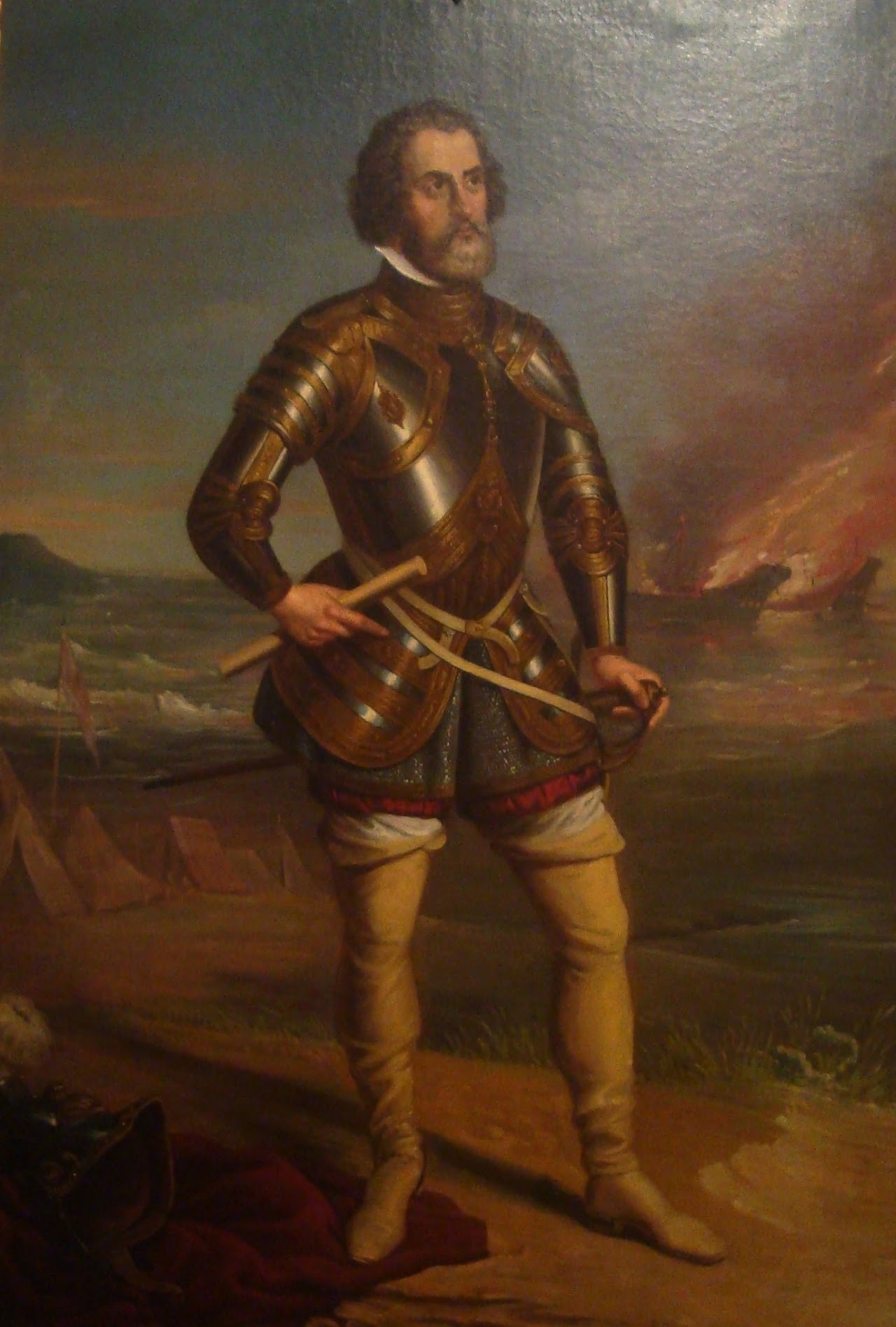
To avoid the temptation of returning that threatened many of his men in the face of the evident numerical inferiority, Hernán Cortés scuttled his ships at Veracruz; from this episode comes the phrase «to burn one's ships», an expression of irrevocable determination.
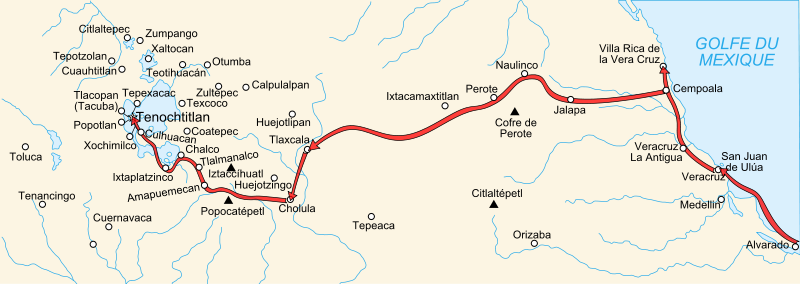
He soon obtained the alliance of some indigenous peoples subject to the Aztecs, such as the Toltecs and the Tlaxcaltecs. On 16 August 1519, Cortés abandoned the coast and began his march inland, toward the heart of the Mexica Empire, with an army of 13,000 Totonac warriors, 400 Spanish soldiers armed with firearms, and 15 horses.
At the end of August Cortés's army reached the territory of the Confederation or Republic of Tlaxcala.
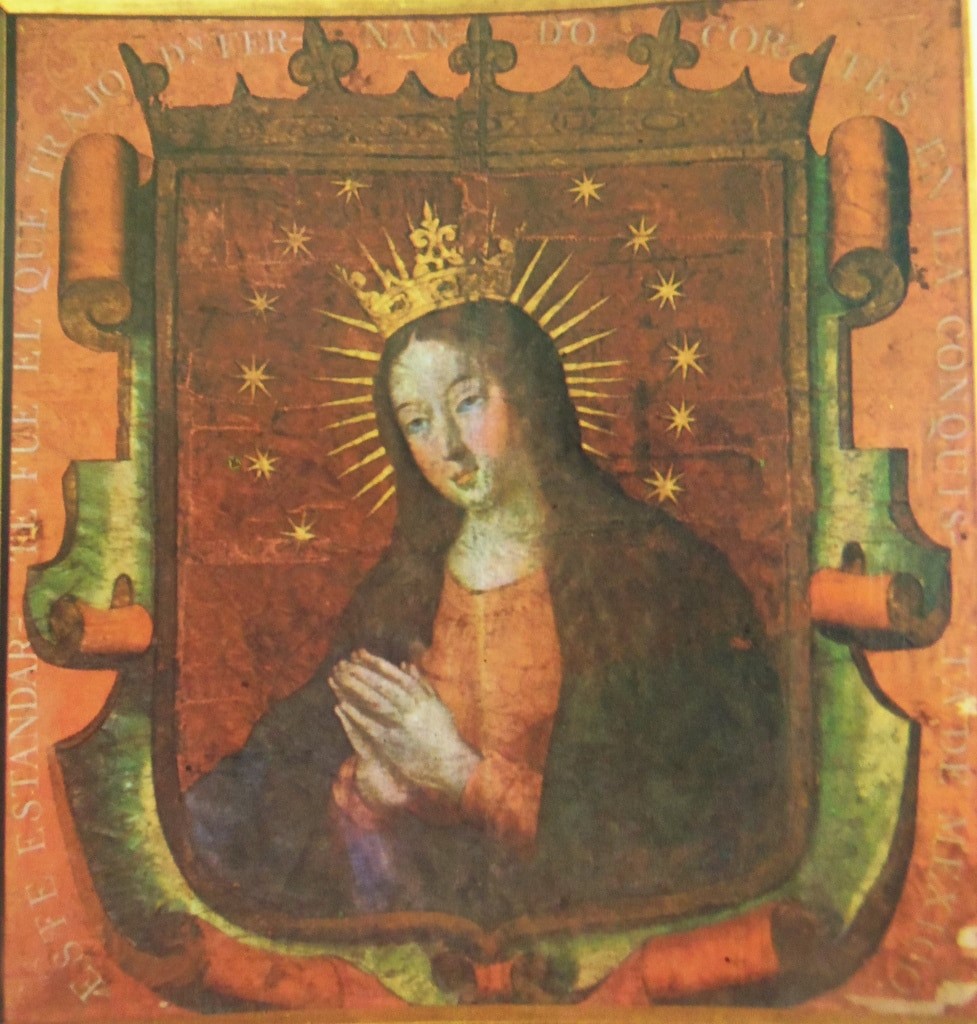
The standard of Hernán Cortés
Cortés's route toward Tenochtitlan
At that time, Tlaxcala and Tenochtitlán represented two opposed conceptions of political organisation that led them to open confrontation. Tlaxcala had organised itself as a confederation of city-states united in a republic governed by a Senate; Mexico-Tenochtitlán, on the contrary, organised itself as an empire. From 1455 onward, the Aztec Empire, formed on the basis of the Triple Alliance among Tenochtitlán, Texcoco and Tlacopan, had begun the so-called «flower wars» against Huejotzingo, Cholula and Tlaxcala, with the aim of capturing prisoners for their religious sacrifices.
Initially the Republic of Tlaxcala denied the invaders passage through its territory, but, after two defeats, it offered peace to Cortés. This agreement established the crucial alliance with the Tlaxcaltecs, bitter enemies of the Aztecs, who had never been able to conquer their territory.
On his way toward Tenochtitlan, Cortés reached Cholula, an ally of the Aztec Empire, which was the second largest city after Mexico-Tenochtitlan, with 30,000 inhabitants. After welcoming Cortés and his enormous army, the authorities of Cholula plotted to ambush him and annihilate the Spaniards. Forewarned, Cortés immediately ordered his army to attack, causing what is known as «the massacre of Cholula», in which more than 5,000 men died in five hours.
On his arrival at Mexico-Tenochtitlan, Cortés was surprised by the beauty of the place. On his passage from Cholula, with an army of about three hundred Spaniards and the support of some 3,000 Tlaxcaltecs, Cortés had travelled the road toward the Valley of Mexico, passing between two volcanoes, Popocatépetl and Iztaccíhuatl, until reaching a wooded place of splendid beauty that still today bears the name of Paso de Cortés.
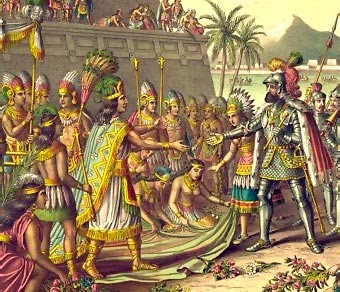
At the entry into Tenochtitlán, made on 8 November 1519, occurred the meeting of Moctezuma II and Cortés, with doña Marina acting as interpreter. The possible identification of the Spaniards with divine beings and of Cortés with the announced return of the god Quetzalcoátl perhaps favoured this peaceful reception of strangers who, nevertheless, at once began to behave as ambitious and violent invaders.
Moctezuma II receives Hernán Cortés
Owing to prior warnings from the Tlaxcaltecs, the Spaniards began to worry about the possibility of being assassinated, and four captains and twelve soldiers presented themselves to Cortés to point out the advisability of seizing the emperor, keeping him as a hostage, so that he would answer with his life for the life of the army. A piece of news precipitated the decision: the battle of Nautla, in the surroundings of Vera Cruz, between the Mexica and the Totonacs allied with the Spanish conquistadors. In the conflict the Mexica killed Juan de Escalante, chief constable, and seven Spaniards, which represented a discredit to Spanish arms, seeing that they were not demigods and that they could be defeated. Once Moctezuma had fallen into the trap of the Spaniards, Cortés kept him as a hostage under penalty of immediate death. Cortés demanded that the caciques responsible for the aggression at Veracruz be punished and also obtained that Moctezuma declare himself a vassal of Charles V. The priestly caste and the Aztec nobility conspired to free their lord and annihilate the Spaniards.
Meanwhile, to punish Cortés's rebellion and oblige him to return to Cuba, in May 1520, the governor Diego Velázquez sent against him an expedition under the command of Pánfilo de Narváez.
To make matters worse, they put Moctezuma on his guard that Cortés was a rebel to his king, and that if he could, he should kill him. So Cortés had no choice but to leave a garrison of little more than a hundred Spaniards at Tenochtitlan under the command of Pedro de Alvarado, and he, with three hundred Spaniards and several hundred Indians, went out to meet Narváez's troops. At Cempoala Cortés managed to defeat and capture Narváez, and the latter's troops went over en masse to his side.
When he returned to Tenochtitlán, on 24 June 1520, Cortés found great indigenous agitation against the Spaniards, provoked by the attacks made on their religious beliefs and symbols and by the massacre that Pedro de Alvarado had unleashed to thwart a supposed conspiracy. Cortés obtained that Moctezuma should try to appease the discontented and that they should let the Spaniards leave the city. There are two versions of the death of Moctezuma: one is that, while he was speaking to his people, he received a stone from the Aztecs themselves that wounded him fatally; the other (less probable and provided by the Aztecs) says that Hernán Cortés ordered him killed when he saw that he could not calm the people.
The only way out was retreat: Hernán Cortés then found himself forced to abandon Tenochtitlán in the rainy night of 30 June to 1 July 1520, known as the Noche Triste. In that retreat fell the majority of the Castilians, especially those who had arrived with Narváez, who, carrying many pieces of gold with them despite Cortés's warnings, drowned in the lake. A great quantity of artillery pieces and horses was also lost, as well as a great part of the treasure being transported. Pursued by the Aztecs (now under the command of Cuauhtémoc), on 7 July, near Otumba, the Spaniards faced their pursuers in a battle in which the Aztecs were defeated and fled in rout. The conquistadors marched in search of the help of their Tlaxcaltec allies, and it was not until almost a year later, that is to say on 30 May 1521, that they gave the beginning to the formal siege of the city of Mexico-Tenochtitlán.
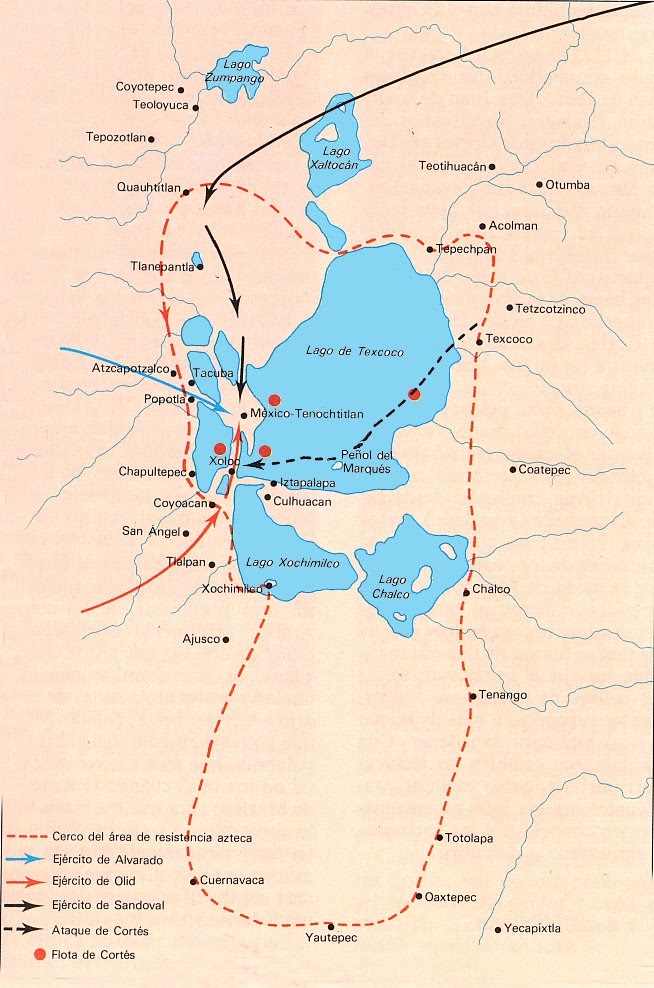
To this end Cortés concentrated more than 80,000 Tlaxcaltecs and reinforced his own troops with the arrival of several other expeditions at Veracruz. Since the end of April of that same year, he had launched on the lake thirteen brigantines that played a very important role in the siege of the island on which the city rose.
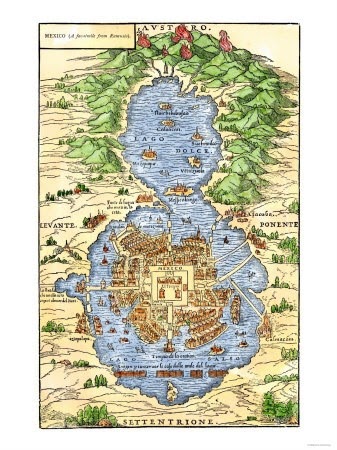
Both, the Spanish and the indigenous chroniclers, then report what the siege and the indigenous resistance were over nearly eighty days of siege. On 13 August 1521 the city of Tenochtitlán fell into the hands of Hernán Cortés, who imprisoned the young Cuauhtémoc and tortured him to force him to tell where they kept their treasures. The Aztec capital destroyed, he built on the same spot (an island at the centre of a lake) the Spanish city of Mexico.
The siege of Tenochtitlan in 1521
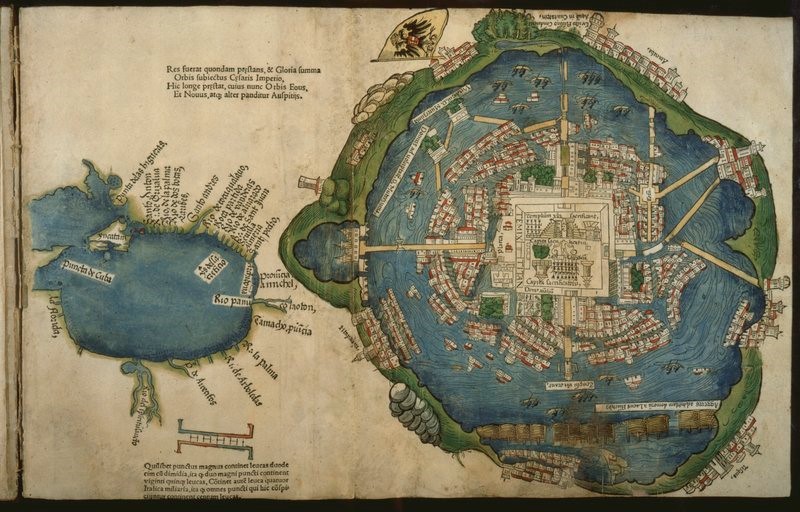
«The map of Tenochtitlan of Cortés (1524)»
in Praeclara Ferdinā di Cortesii de Noua maris Oceani Hyspania narratio, Nuremberg, Friedrich Peypus, 1524
The former Aztec Empire now dominated, Cortés launched expeditions southward to annex the territories of Yucatán, Honduras and Guatemala. The details of the conquest of Mexico, as well as the arguments that justified Hernán Cortés's decisions, were set out in the four Cartas de relación that he sent to the king. In 1522 he was appointed governor and captain general of New Spain (the name the conquistadors gave to the Mexican territory).
However, his enemies intrigued at the court of the emperor Charles V, accusing him of withholding gold from the royal fifth and from the distribution to the conquistadors and suspecting that he had given the order to poison his wife Catalina Juárez and several of the envoys carrying royal provisions.
In 1524, obeying the instructions of Charles V, Cortés undertook a journey to Spain and conferred with the emperor at Toledo. Although he did not recover the government of New Spain, he obtained at least the title of Marquis del Valle de Oaxaca, as well as 22 towns and 23,000 vassals, besides keeping the honorary office of captain general, though without functions of government.
Hernán Cortés, 1st Marquis del Valle de Oaxaca
Married to doña Juana Ramírez de Arellano y Zúñiga, daughter of the count of Aguilar, Hernán Cortés returned to Mexico around the middle of 1530 and, from 1532, undertakes a series of expeditions in the South Sea (Pacific Ocean). After sponsoring two voyages of exploration in the South Sea and without having obtained material results, Hernán Cortés decided to lead the third voyage of exploration, toward the north-west, and on 3 May 1535 he landed at the bay he named Bahía de la Santa Cruz, presently La Paz (Baja California Sur), and decided to establish a colony. However, faced with the problem of supplying the population, Cortés returned to New Spain and ordered the abandonment of the colony and the return of the colonists to New Spain.
In 1539 Hernán Cortés dispatched his fourth expedition to the South Sea. He entrusted this enterprise to the captain Francisco de Ulloa, who penetrated as far as the mouth of the Colorado river and, returning to the extreme south of the peninsula, went up along the Pacific beyond the island of Cedros. On 5 April 1540, Francisco de Ulloa addressed to Cortés, from the Island of Cedros, an account of the events of the exploration. Nothing was ever heard again of Francisco de Ulloa nor of his companions of navigation.
To make defence of his rights, Cortés undertook a new journey to Spain. The remaining years of his life, which all passed in Spain, were for Cortés a difficult time in which he found himself involved in a series of lawsuits and in which his claims never obtained full satisfaction.
Hernán Cortés died on Friday 2 December of the year 1547, at the age of 62, at Castilleja de la Cuesta, near Seville.
His first burial was in the church of San Isidoro del Campo, in Seville. In 1566 his mortal remains were transferred to New Spain and buried in the church adjoining the convent of San Francisco, at Texcoco. From there, in 1629, they passed to the high chapel of the convent of San Francisco, in the city of Mexico. His final rest he reached in 1794, in the church of Jesús Nazareno, contiguous to the hospital of Jesús that he had founded.
The Spanish crown was wont to reward the conquistadors for their efforts and battles in America and the Philippines by granting them heraldic arms and encomiendas of natives; and only exceptionally did it grant them lordships, for example, the Duchy of Veragua to the descendants of Christopher Columbus, the Duchy of Atlixco to José Sarmiento de Valladares, count of Moctezuma, and the Marquisate del Valle de Oaxaca to Hernán Cortés.
By Real Cédula of 6 July 1529, in recognition of his services to the Crown «and especially in the discovery and settlement of New Spain», the emperor Charles V granted Hernán Cortés the title of Marquis del Valle de Oaxaca; he gave him 23,000 vassals in perpetuity, with civil and criminal jurisdiction, in accordance with the mero y mixto imperio of the Castilian type with Indian modalities, since the vassals were Spaniards and Indians; and the rank of Captain General of New Spain.
Hernán Cortés, 1st Marquis del Valle de Oaxaca
Hernán Cortés, 1st Marquis del Valle de Oaxaca
(1485–1547)
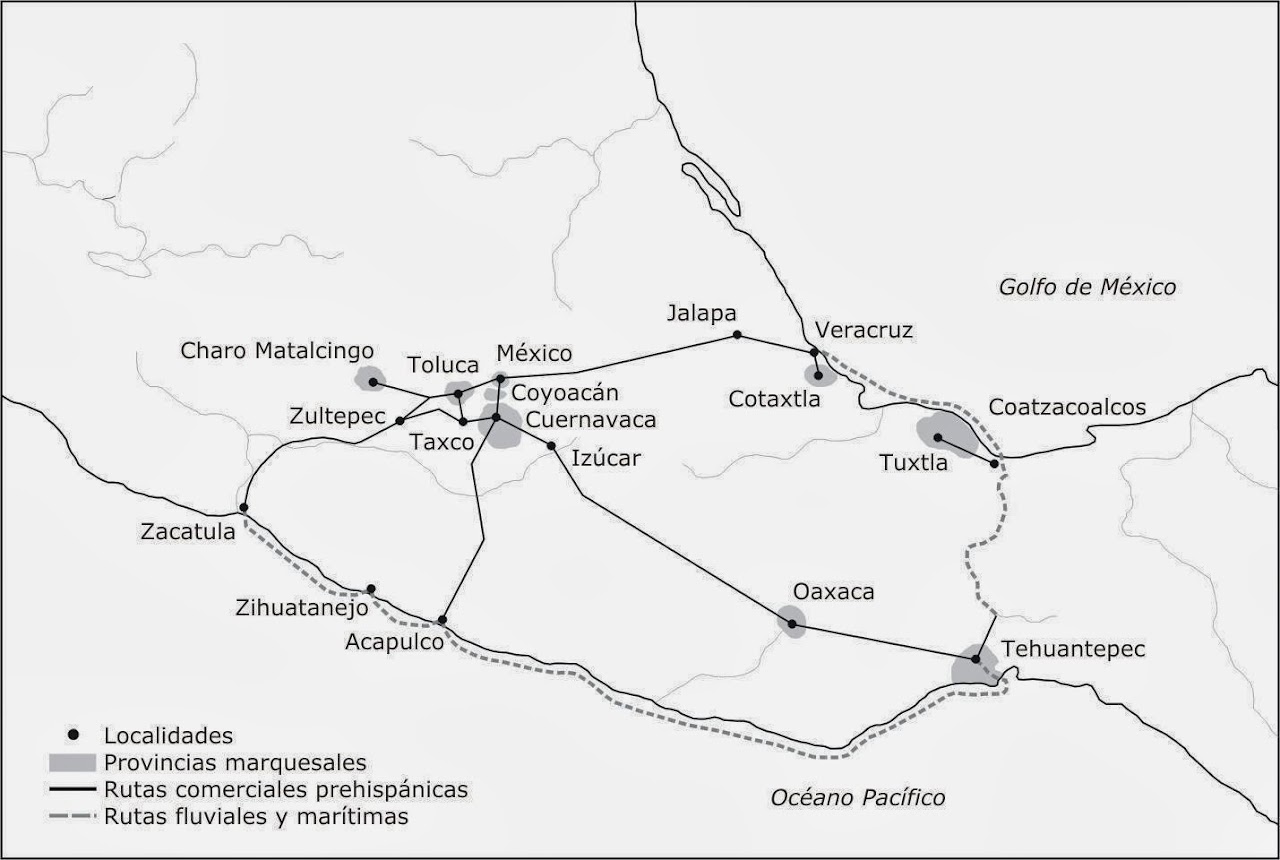
The total area of the Marquisate was 11,550 km², although it was far from constituting a geographical unit, for its territories were separated from one another:
Corregimiento of Coyoacán, of 550 km², with the town of that name and which comprised 34 villages plus five haciendas. The Alcaldía Mayor of Cuernavaca, of 4,100 km², with the town of that name and which encompassed the former corregimientos of Acapixtla and Oaxtepec and all the present state of Morelos except the eastern and sub-eastern parts, and which consisted of eighty villages, as well as eight haciendas and two sugar-cane mills. The Alcaldía mayor of the Cuatro Villas Marquesanas, of 1,500 km², with Santa María de Oaxaca and which corresponded to the Valley of Ayotla, from Etla in the north to Tlapacoya in the south, excluding the Spanish city of Antequera (Oaxaca), but including 34 villages, a sugar-cane trapiche and two haciendas. The Alcaldía mayor of Tuxtla and Cotaxtla, with Santiago Tuxtla and in the south of Veracruz, within which there were 51 villages. Corregimiento of Toluca, with San José de Toluca, 12 villages and a hacienda and which measured 450 km². Corregimiento of Charo Matlazinco, of 100 km², with San Miguel Charo, two villages and a hacienda. The corregimiento of Jalapa de Tehuantepec, of 550 km², with Santa María Asunción Jalapa and seven haciendas. Before 1560 the port of Tehuantepec was a possession of the Marquisate; but in 1680 the crown took that anchorage for itself and gave in exchange 11,000 pesos annually and tributes of maize from Chalco and Xochimilco.
On 27 July 1529 a new Cédula Real was issued, allowing Cortés to establish a mayorazgo. The institution of the mayorazgo, in 1535, guaranteed the permanence of the Marquisate, for it involved the greater part of Cortés's properties, making them heritable, together with the dignity of the Marquisate. The mayorazgo also established the succession to the title, which is by preference by male primogeniture, that is to say, a woman is allowed to accede only if she is without living brothers and if her deceased brothers left no legitimate male descendants. It is also specified that the Marquis or Marchioness must be Catholic, loyal to the king, and bear the name and arms of Cortés.
Martín Cortés, 2nd Marquis del Valle de Oaxaca
Son of the conquistador Hernán Cortés and of Juana Ramírez de Arellano y Zúñiga, Martín accompanied his father on his last journey to Spain (1540) and Philip II in the Netherlands, in England and at the battle of Saint-Quentin.
In 1562 the king left him all the towns granted to his father. In Spain the 2nd Marquis del Valle de Oaxaca married Ana Ramírez de Arellano, his niece, and maintained close relations with aristocrats and writers, such as López de Gómara, who dedicated to him his work on the life of Hernán Cortés.
In 1563, he returned to Mexico, where he had not been since the age of eight, and a sumptuous welcome was made for him, an indicator of the glory and popularity his father had attained; with him arrived his bastard half-brothers Luis and Martín «el Mestizo», the latter the son of doña Marina. By his lineage and properties, Martín Cortés was the richest and most powerful lord of New Spain.
As had happened with his father, Martín began to clash with the viceroy of the time, Luis de Velasco. On the latter's death (1564), the Ayuntamiento of Mexico requested that no new viceroy be appointed and that the office of captain general pass directly to Martín Cortés. Here began a long confrontation between the Audiencia and the son of the Conquistador.
In 1566, the vice-regal authorities discovered the so-called «Conspiracy of the Marquis del Valle», of Don Martín Cortés, 2nd Marquis, and his brother Martín Cortés «el Mestizo», to repudiate the king of Spain, with the support of the sons of the conquistadors, who were discontented with the Leyes Nuevas that restricted the inheritance of encomiendas.
The Audiencia had no choice but to arrest the conspirators, among them Martín himself, on 16 July 1566. When many of the rebels had already been executed and it was the turn of the Cortés brothers, a new viceroy arrived in Mexico, Gastón de Peralta, marquis of Falces, who reviewed the proceedings and freed, finally, Martín, sending him to Spain.
In the metropolis, Cortés's son was absolved of the grave accusations imputed to him, but he was forbidden ever to return to the Indies.
However the king ordered the confiscation of the Marquisate, which meant that the Crown took control of the property and of all its revenues; the Cortés brothers were expelled from New Spain and forbidden to return.
Don Martín, the 2nd Marquis, obtained from Philip II the royal pardon in 1574, which allowed him to return to Spain from his exile at Oran, in the north-west of Algeria, and to recover part of his properties confiscated in Mexico. However, the prohibition of his return to New Spain was maintained.
In 1589 he was succeeded in the title by his eldest son, Don Hernando Cortés, 3rd Marquis, to whom the rest of his patrimony was reinstated in 1593. However, although the confiscation was lifted in 1593, the Marquises lost direct control of the administration of the property, for they had to maintain the structure through which the Crown had been working, which deprived them of the autonomy of government they were wont to exercise.
The 3rd Marquis left no legitimate children, so that on his death, in 1602, the title passed to his brother, Don Pedro Cortés, 4th Marquis, who was able to settle in New Spain and personally assume the management of the property, which had been controlled by administrators since 1567. The 4th Marquis also died without descendants, so that, in 1629, the direct line of Hernán Cortés came to an end. The Marquisate was inherited by the sister of Hernando and Pedro, Doña Juana Cortés, 5th Marchioness, wife of Don Pedro Carrillo de Mendoza, 9th Count of Priego.
On her death, her eldest daughter, Doña Estefanía Carrillo de Mendoza y Cortés, married to the duke of Terranova, Diego Tagliavia Aragona, inherited the title, which made her 6th Marchioness. After the inheritance of the title, in accordance with the mayorazgo or entail, the family adopted the name of Tagliavia Aragona Cortés.
Doña Estefanía and Don Diego had a single daughter, Juana (Giovanna), 7th Marchioness, one of the richest heiresses of her time, who married Héctor (Ettore) Pignatelli, 5th Duke of Monteleone, giving birth to a dynasty that united the immense wealth of the Aragon, the Tagliavia, the Pignatelli and the Cortés, with their titles and fiefs, among which the Mexican Marquisate was the jewel of the crown. After the marriage, the husband took the name of Pignatelli Aragona Cortés for himself and all his descendants.
The Pignatelli Aragona Cortés continued to receive from the Spanish Monarchy the favours granted by Charles V to Hernán Cortés on a regular basis, even after the independence of Mexico, since at first the public debts of the viceroyalty were recognised in full by the new country.
In the first half of the nineteenth century, the Pignatelli designated Lucas Alamán as their attorney in Mexico, who defended the continuity of the payment of the rents of the Marquisate, but the liberals cancelled the said payments. The economic ties broken, the Pignatelli sold their properties in Mexico.
The noble title was rehabilitated by king Alfonso XIII in 1916 in favour of José Pignatelli Aragón Cortés y Fardella. In 1984, on the death without descendants of the marquis Giuseppe Aragón Tagliavia Pignatelli Cortés, the male branch of the Pignatelli Aragón Cortés was extinguished. The marquis was also prince of Noia, duke of Monteleone and of Terranova. Those titles passed to his first cousin Nicolò Pignatelli Aragón Cortés, Prince of the Holy Roman Empire.
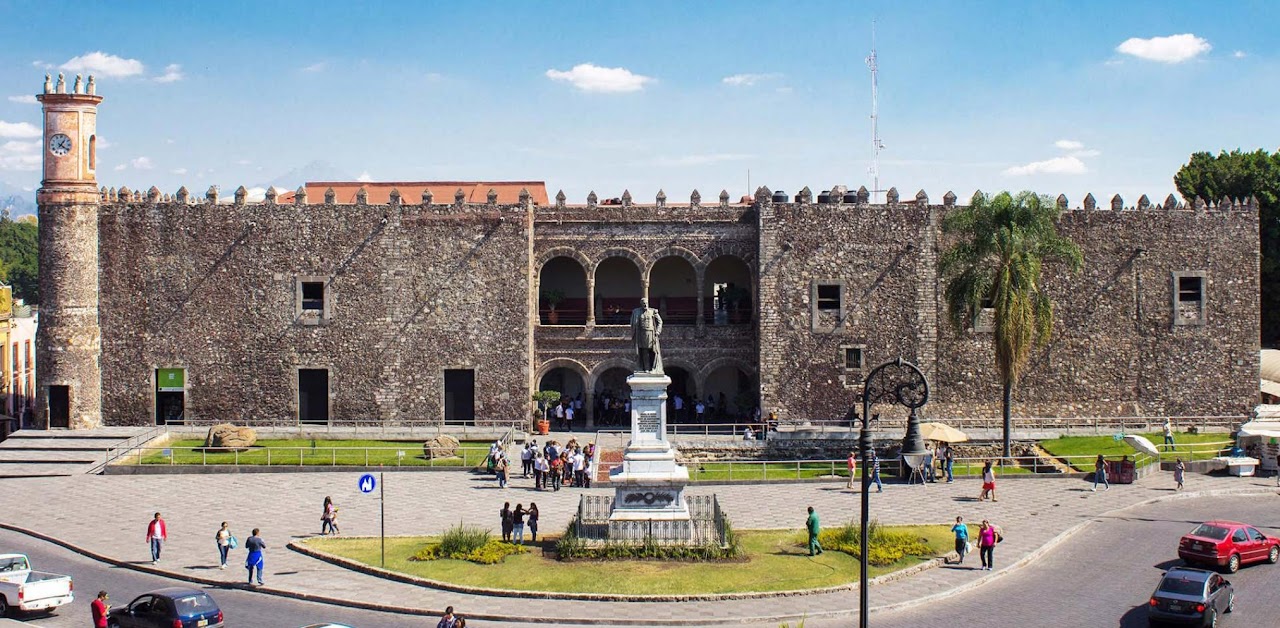
Palace of Cortés at Cuernavaca, capital of the Marquisate del Valle de Oaxaca
The chains of descent.
- 1Martín Cortés de Monroyb. 1455, † 1525 · Hidalgo, of the Lords of Monroy, Captain of cavalry& 1483Catalina Pizarro (Altamirano), b. c. 1465, † 1535
- ★Hernán Cortés «El Conquistador»b. 1485, † 1547 · Conquistador of Mexico 1519–1524, 1st Marquis del Valle de Oaxaca 1529–1547& 1529Juana Ramírez de Arellano y Zúñiga, b. c. 1505, † 1578 · of the Counts of Aguilar de Inestrillas
- 3Martín Cortésb. 1532, † 1589 · 2nd Marquis del Valle de Oaxaca& 1548Ana Ramírez de Arellano, b. 1533, † 1578 · 7th Countess of Aguilar de Inestrillas
- 4Juana Cortésb. c. 1560, † 1628 · 5th Marchioness del Valle de Oaxaca& 1592Pedro II Carrillo de Mendoza, b. c. 1550, † 1619 · 9th Count of Priego
- 5Estefanía Carrillo de Mendozab. 1595, † 1635 · 6th Marchioness del Valle de Oaxaca& 1617Diego I Tagliavia Aragona, b. 1596, † 1663 · 4th Duke of Terranova, Knight of the Order of the Golden Fleece, Grand Admiral and Grand Constable of Sicily
- 6Giovanna I Tagliavia Aragona Cortésb. 1619, † 1692 · 5th Duchess of Terranova, 7th Marchioness del Valle de Oaxaca& 1639Ettore IV Pignatelli, b. 1620, † 1674 · 4th Prince of Noja, 6th Duke of Monteleone, Knight of the Order of the Golden Fleece, Viceroy of Aragon
- 7Andrea Fabrizio Pignatelli Aragona Cortésb. 1640, † 1677 · 5th Prince of Noja, 7th Duke of Monteleone, 8th Marquis del Valle de Oaxaca, Knight of the Order of the Golden Fleece& 1665Teresa Pimentel, b. 1646, † 1707 · of the Counts / Dukes of Benavente
- 8Giovanna II Pignatelli Aragona Cortésb. 1666, † 1723 · 6th Princess of Noja, 8th Duchess of Monteleone, 9th Marchioness del Valle de Oaxaca& 1679Nicola Pignatelli, b. 1648, † 1730 · of the Princes of Noja, Knight of the Order of the Golden Fleece, Grand Admiral and Grand Constable of Sicily, Viceroy of Sardinia, Viceroy of Sicily
- 9Diego I Pignatelli Aragona Cortésb. 1687, † 1750 · 7th Prince of Noja, 9th Duke of Monteleone, 10th Marquis del Valle de Oaxaca, Knight of the Order of the Golden Fleece, Grand Admiral and Grand Constable of Sicily& 1717Margherita Pignatelli, b. 1698, † 1774 · 4th Duchess of Bellosguardo
- 10Maria Francesca Pignatelli Aragona Cortésb. 1721, † 1788 · of the Princes of Noja, Dukes of Terranova, Marquises del Valle de Oaxaca& 1739Girolamo II Pignatelli, b. 1721, † 1771 · 1st Prince of Moliterno, 3rd Prince of Marsiconovo
- 11Giovanni Battista III Pignatellib. 1740, † 1805 · 2nd Prince of Moliterno, 4th Prince of Marsiconovo, 6th Prince of Montecorvino& 1772Maria Luisa d'Avalos, b. 1748, † 1781 · of the Princes of Montesarchio, Marquises del Vasto and of Pescara
- 12b. 1775, † 1818 · Princess of Moliterno and of Marsiconovo (heiress)& 1796Giuseppe Gerardo Gallone, b. 1766, † 1806 · 6th Prince of Tricase
- ★Sancho I Ramírez of Aragonb. c. 1042, † 1094 · 2nd King of Aragon
- 2Vela of Aragonb. c. 1080 · Count
- 3Rodrigo (Ruy) Gómez of Aragonb. c. 1100 · Count of Salamanca
- 4Rodrigo (Ruy) Gómez of Aragonb. c. 1130 · of the Counts of Salamanca
- 5Fernando Rodríguez de Varela / de las Varillasb. c. 1160 · Lord of San Ramón
- 6Pedro Rodríguez de las Varillasb. c. 1200 · Ricohombre of Navarre& c. 1225Estefanía Juró
- 7Sancho Pérez de las Varillasb. c. 1225 · Ricohombre and Grand Chancellor of Castile
- 8Rodrigo de las Varillasb. c. 1245&Inés Teresa Godíñez
- 9Gonzalo Rodríguez de las Varillasb. c. 1270, † c. 1345 · Lord of Canillas de Tornellos& c. 1289Teresa Martínez Nieto, † 1308 · of the Lords of Ledesma
- 10Juan Rodríguez de las Varillasb. c. 1290 · Knight of the Order of the Band, 1st Lord of Cempron and of Bernuy&María Hernández de Monroy, b. c. 1295 · 3rd Lady of Monroy
- 11Hernán (Fernando) de Monroy4th Lord of Monroy&Isabel (Catalina) de Almaraz, b. c. 1385 · Lady of Deleitosa
- 12Rodrigo (Ruy) de Monroyb. c. 1400, † > 1461 · 5th Lord of Monroy& 1428Mencía Alfonso de Orellana la Vieja (Altamirano), b. c. 1418 · of the Lords of Orellana la Vieja
- 13Rodrigo (Ruy) Fernández de Monroyb. c. 1435 · of the Lords of Monroy&María la Cueva — Cortés, b. c. 1420
- 14Martín Cortés de Monroyb. 1455, † 1525 · Hidalgo, of the Lords of Monroy, Captain of cavalry& 1483Catalina Pizarro (Altamirano), b. c. 1465, † 1535
- ★Hernán Cortés «El Conquistador»b. 1485, † 1547
- ★Lope Cortés de Parres&Eulalia de Abamia
- 2Nuño Cortés
- 3Martín «el Viejo» Cortés&F de Monroy
- 4Martín Cortés de Monroyb. 1455, † 1525 · Hidalgo, of the Lords of Monroy, Captain of cavalry& 1483Catalina Pizarro (Altamirano), b. c. 1465, † 1535
- ★Hernán Cortés «El Conquistador»b. 1485, † 1547
Timeline
Famous descent
Gallery.