Lineage · Stage 1
Conti Guidi.
Counts of Modigliana and Porciano, 10th – 14th c.
One of the greatest feudal houses of medieval Tuscany, Counts of Modigliana, of Porciano and Counts Palatine. Linked in the 12th century to Matilda of Canossa, it is the distant origin of the House of Guerri dall'Oro Gallone: from the Val d'Ambra branch descends, after five centuries, the present family.
History of the house.
The comital house of the Conti Guidi was one of the greatest Tuscan feudal houses of the Middle Ages, attested from the 10th to the 15th century. Its origins are lost in the Lombard and Carolingian period, and its domains gradually extended from Tuscany to Romagna.
The founder of the house is Tegrimo I († circa 930), Count of Modigliana in 925, probably the son of a Theudelgrimus living at Pistoia as early as 887. With Count Guido I († circa 963), son of Tegrimo I, the dynasty of the Conti Guidi officially begins.
Among the most celebrated descendants is the series of the «Guido Guerra». Boccaccio writes of Guido Guerra, observing that the nickname «is believed to come from an innate desire for arms».
Count Guido Guerra I (Guido V, † 1124) frequented the court of Countess Matilda of Canossa at Florence, and followed her to Lucca and into Lombardy, as far as her castle of Brescello, where he was declared her adopted son in 1099, thus taking the title of Marquess.
In 1164, Count Guido Guerra II (Guido VI, † 1157) obtains from Emperor Frederick I Barbarossa a diploma confirming the title of comes Tusciae, imperial protection for himself and all his goods, the grant of the regalia and jurisdictional rights over all his lands — which now extend from Romagna to Tuscany.
In 1217, on the death of Count Guido Guerra III (Guido VII), his five sons — Guido Guerra IV, Ruggiero, Marcovaldo, Aghinolfo and Tegrimo VI — obtain from Emperor Frederick II a famous diploma of confirmation, with a list of about two hundred fiefs.
Ruggiero having died without heirs, the four other brothers, through a new division of goods, become heads of as many branches of the same family. The great domain of the Conti Guidi is thus fragmented into four lordships, doomed to a slow decline under the constant pressure of the Communes of Florence and Pistoia.
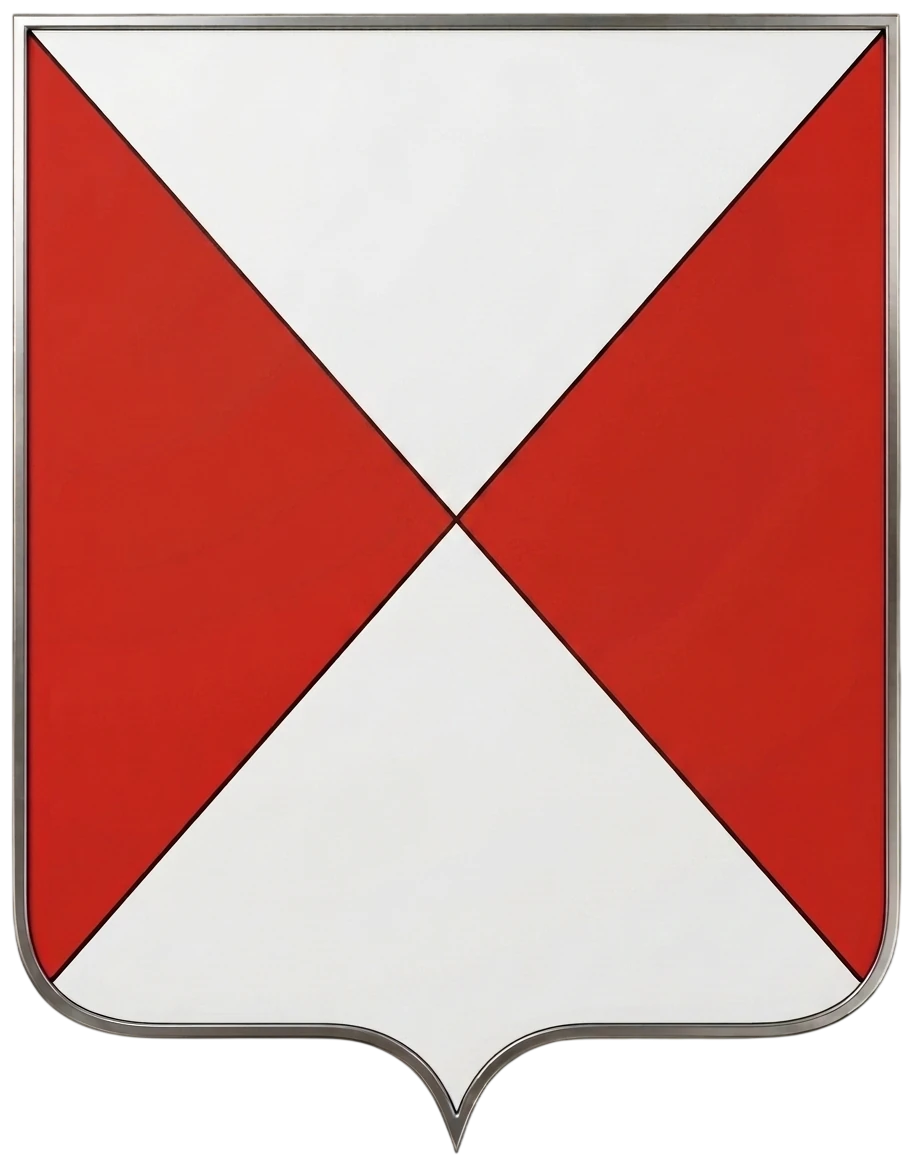
Count Guido Guerra IV forms the branch of the Counts of Modigliana and of Poppi/Battifolle; Marcovaldo gives rise to the Counts of Dovadola; Aghinolfo to that of Romena; Tegrimo VI to the branch of the Counts of Porciano, from which descends the line leading to the present House. Each branch, while keeping the original partition of the shield, adopts a particular bichromy.
Count Tegrimo VI (c. 1175 – c. 1234) gives rise to the branch of the Counts of Porciano, one of the four lordships born of the 1217 division. It is from this branch that, through Guido dei Conti Guidi (1221–1293), descends the line leading to the present House.
It is moreover in the Porciano branch that green enters the family shield: the white-and-green bichromy, with a typically Ghibelline partition (vert a bend argent), will accompany the line through Val d'Ambra down to the Guerri of Siena. Discover the full evolution of the coat of arms →
Among the descendants of Tegrimo VI are Corrado, Amerigo, Guido Zeffiro, Count of Val d'Ambra († circa 1348), and his son Giovanni († 1363), who lose all their goods in 1336, to the benefit of the Republic of Florence. The white-and-green bichromy of the shield is preserved, with a typically Ghibelline partition (a bend argent on a field vert).
Giovanni's son, Pietro, moves to Siena, where he loses his noble rank and must take a surname to be counted among the citizens of Siena: in the documents he uses Guerra, Guerrae, de Guerris, Guerri. From him springs the branch of the Guerri of Siena, from which descends, after five centuries, the House of Guerri dall'Oro Gallone of Tricase and Moliterno.
The division into four branches.
Ruggiero having died without heirs, the four other brothers — sons of Guido Guerra III — become, through a new division of goods in 1217, heads of as many branches. The great domain of the Conti Guidi is thus fragmented into four lordships, doomed to a slow decline under the pressure of the Communes of Florence and Pistoia. From one of them — Porciano — descends the present House.
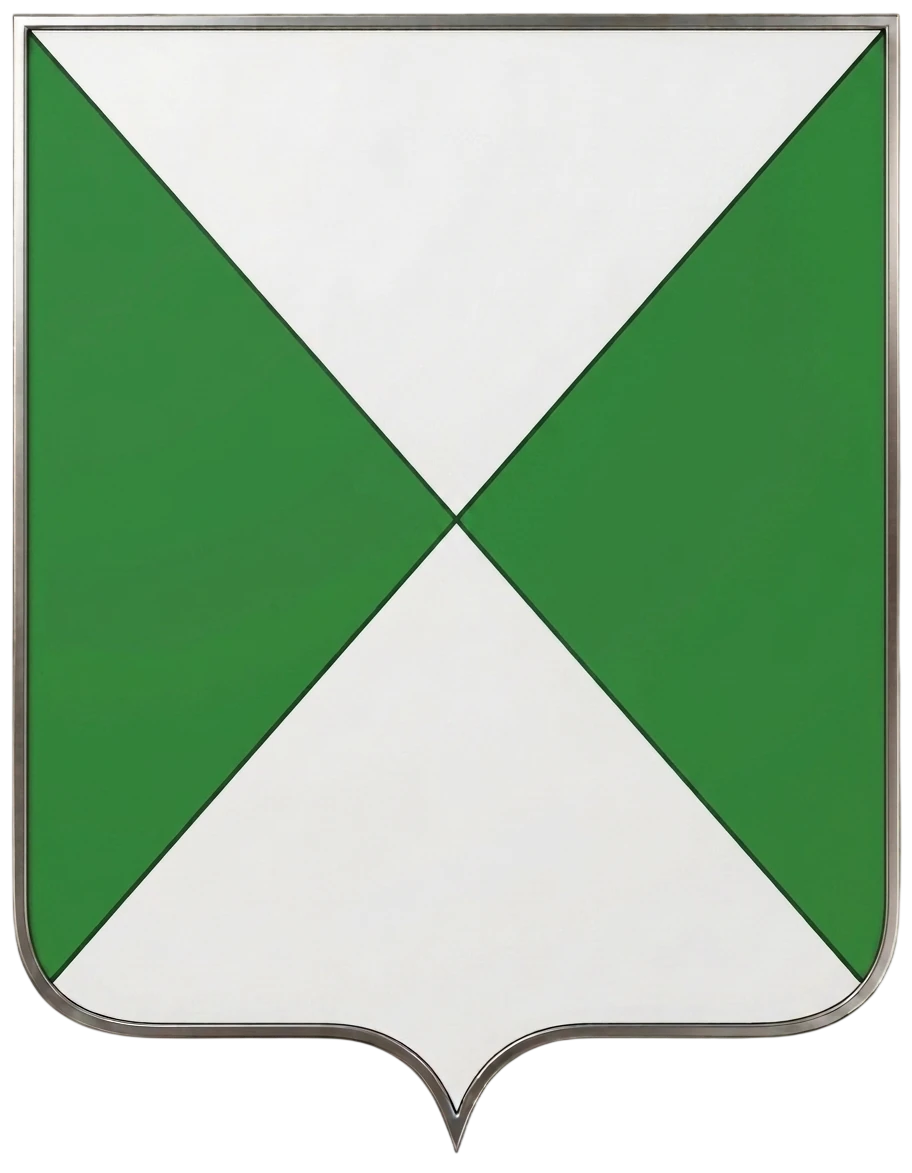
Each branch, while keeping the original partition of the shield, adopts a particular bichromy. It is in the Porciano branch that green enters the family shield: the white-and-green bichromy, with a typically Ghibelline partition (a bend argent on a field vert), will accompany the line down to the Guerri of Siena. Discover the full evolution of the coat of arms →
Family tree of the house.
Noble titles of the Conti Guidi
Counts and Counts Palatine.
Possessions and fiefs