Famous descent
The Etichonids.
ALSACE.
The descent from the Etichonids, dukes of Alsace: from Duke Etichon I to Saint Odile and Pope Leo IX, down to the Princes of Tricase.
History.
Under Roman rule, Alsace belonged to two different provinces: Lower Alsace was the territory of the "Mediomatrici" and was part of Germania Prima; Upper Alsace was included in the great "Sequania". Its name, in Latin "Elisacia", in German "Elsass", probably derives from the river Ill or Ell that crosses it. It first appears in Fredegar, a historian contemporary with Clovis II.
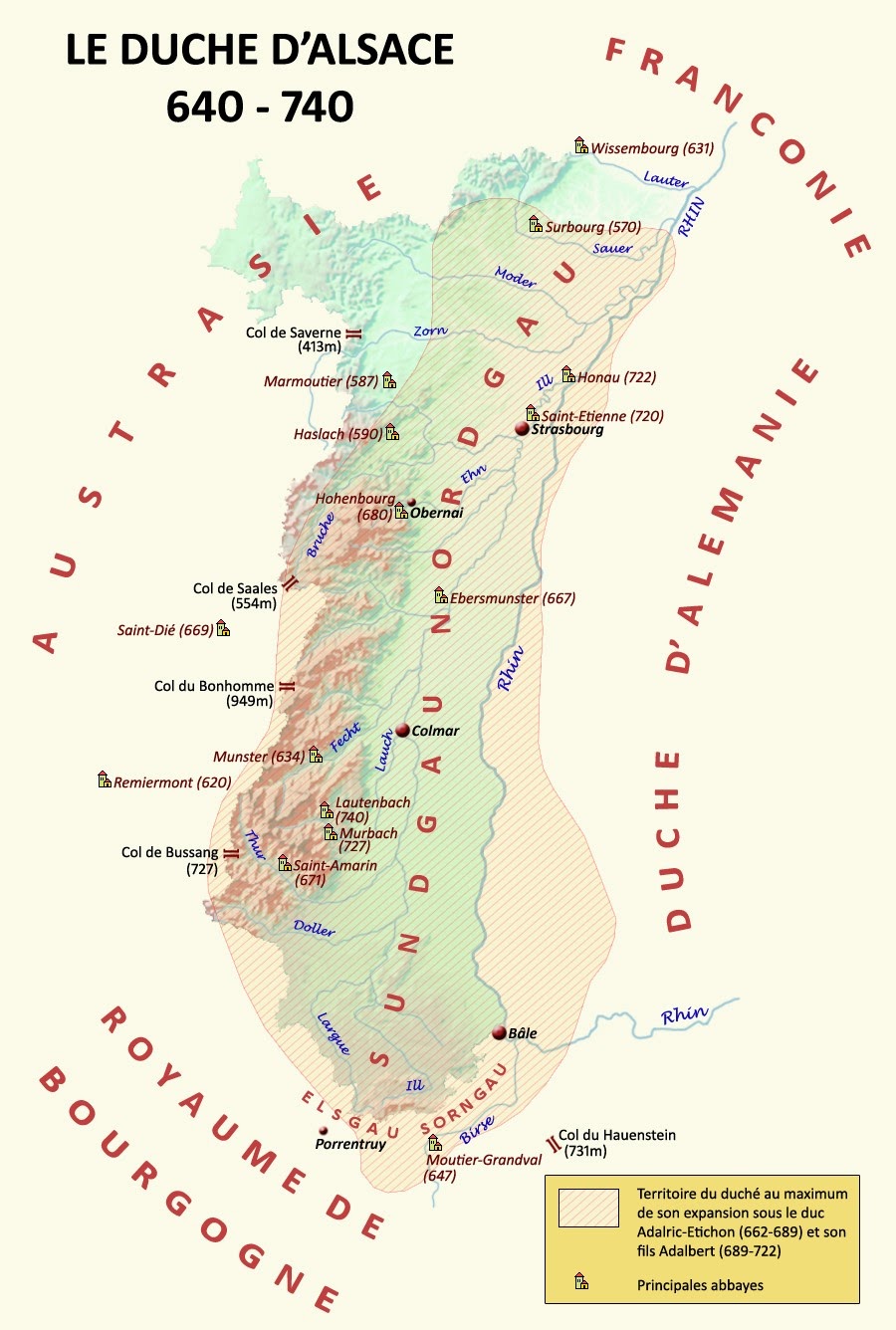
The Duchy of Alsace ("ducatus Helisatiorum") was created by the kings of Austrasia in 640. It was suppressed in 754 and replaced by two counties: the Sundgau (the southern country, roughly the Haut-Rhin) and the Nordgau (the northern country, roughly the Bas-Rhin). Two sons of Etichon I, 1st Duke of Alsace, would then receive the two counties: Adalbert and his descendants would be Counts of Sundgau; Etichon II and his descendants would be Counts of Nordgau.
From Etichon I (Adalric), 1st Duke of Alsace, descend therefore two distinct branches — that of the Sundgau (through Adalbert) and that of the Nordgau (through Etichon II) — which, after having separated, would reunite around 1130 with the marriage of Aigeline of Burgundy and Hugh I of Lorraine-Vaudémont, giving rise to a common continuation. Etichon I, the single progenitor, thus appears at the head of both branches below: it is always the same person. A third child of Etichon I, Odile of Alsace (b. c. 662, † 720), Saint and Abbess of Hohenburg, has no documented descent in this line: her story is told further below (see Saint Odile).
The branch descended from Adalbert having died out, the descendants of Etichon II take up again the title of counts of Alsace.
After the death of Louis IV, king of Austrasia, in 954, Alsace became part of the empire and was, from 1080 to 1254, the appanage of the house of Hohenstaufen. Two provincial counts, or hereditary landgraves, governed the country under ducal authority. The county or landgraviate of the Sundgau belonged to the house of Habsburg, which later became the house of Austria. The county of the Nordgau, after having its lay landgraves until 1359, passed under the domination of the bishops of Strasbourg.
By the Treaty of Westphalia (1648), Alsace was ceded to France, except for the bishopric of Strasbourg, which Louis XIV seized in 1681, and the Republic of Mulhouse, which kept its status as an independent city. Alsace would be entirely French in 1798, when Mulhouse, then allied with the Swiss Confederation, voted for its union with the French Republic.
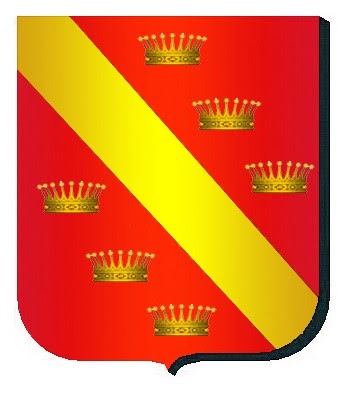
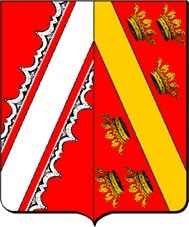
The landgraviate of the Sundgau, or Upper Alsace, bore for its particular arms: gules, a bend or, accompanied by six crowns of the same, set in orle, those of the chief opposed to those of the base.
The arms of the landgraviate of the Nordgau, or Lower Alsace, were: gules, a bend sinister indented argent.
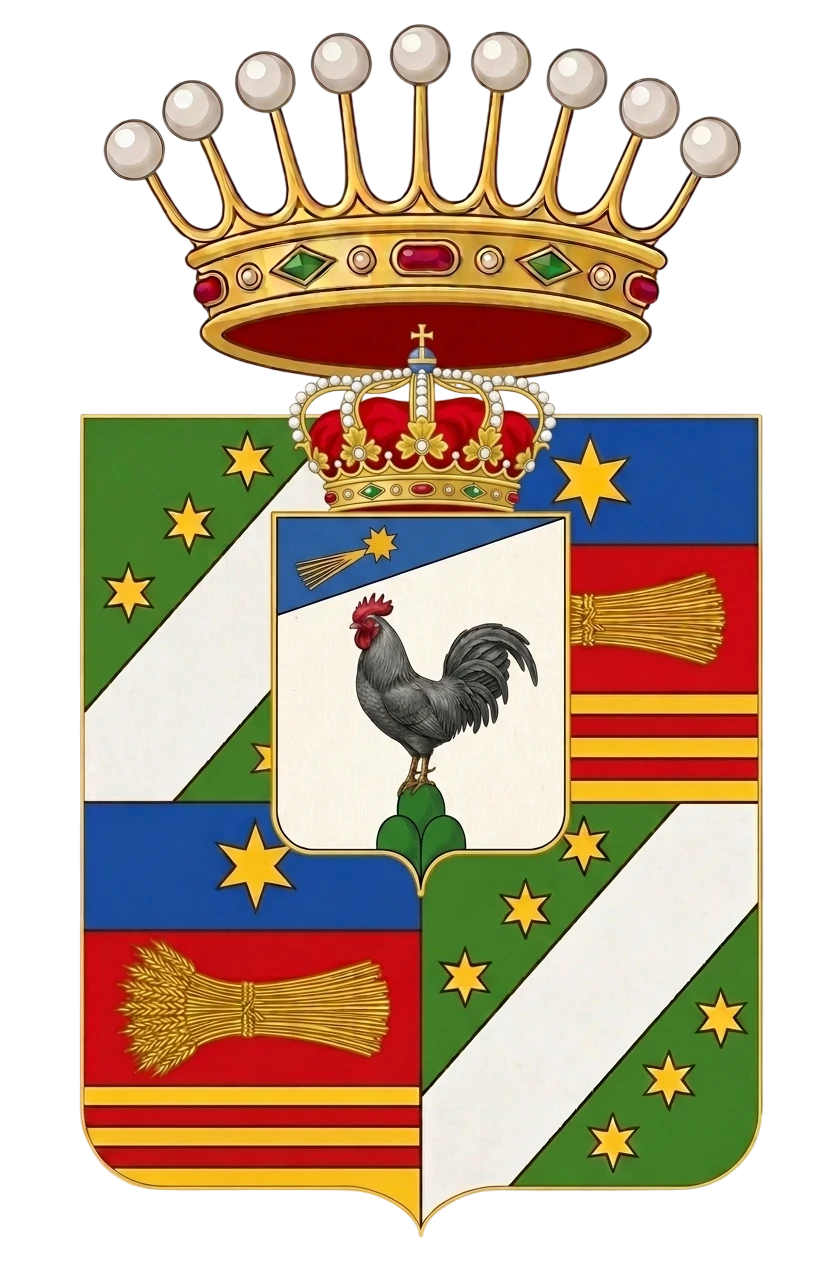
With the marriage of Hugh I of Lorraine-Vaudémont and Aigeline of Burgundy (c. 1130), the two Etichonid branches — Sundgau and Nordgau — flow back together into a single line, which continues with the Counts of Vaudémont, the Sanseverino Counts of Marsico and finally the Moncada.
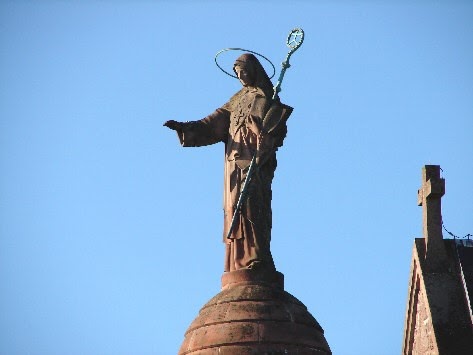
Odile (born around 662 in Obernai and died around 720 at Hohenburg) was the daughter of the duke of Alsace Etichon I (Adalric) and of Bereswinde.
Duke Etichon I (Adalric), who lived in his castle of Hohenburg, was a rough and violent man. He was married to a gentle and pious woman who was expecting a child, and that child could only be a boy destined to succeed his father. But Bereswinde gave birth to a girl who, moreover, was blind! Since tradition held that disabled children should be eliminated, Etichon I (Adalric) ordered the child to be abandoned in the forest. Bereswinde took pity on her and entrusted the child to a servant so that she might bring her to safety without the father's knowledge. The nurse raised the child for twelve years, before sending her to the monastery of Balme (now Baume-les-Dames).
The child was not yet baptised, and Saint Erhard, an Irish monk travelling in Bavaria, had a vision in which God commanded him to go to Balme to carry out that baptism. He did so a few days later and, at the moment when the holy oil touched Odile's eyes, she recovered her sight. That miracle led Odile to consecrate herself to God, and she expressed the wish to meet her father. Meanwhile, Duke Etichon I (Adalric) had had two other children, among them Hugh, with whom Odile came into contact. He announced to his father the existence of Odile and her wish to come to the castle. Seized with violent anger, when he learned that he had been deceived, the duke killed his own son. Later Etichon I (Adalric) repented and, struck with remorse, finally agreed to see his daughter. He could not, however, accept that she should consecrate herself to God, and wished to give her in marriage to a rich lord in order to have heirs. Odile refused and fled under her father's threats. The duke then set off in pursuit but, before she was overtaken, cornered before a rock, Odile implored the Lord who, in a second miracle, made the rock open to let the young woman pass.
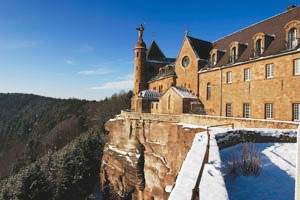
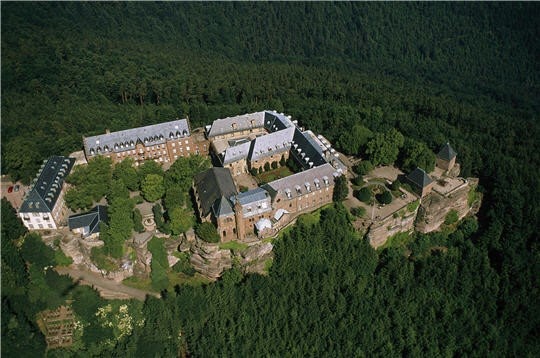
Etichon I (Adalric) was finally convinced of his daughter's holiness and agreed to forgive her. He returned with her to Hohenburg and, at the insistence of the bishop of Autun, Saint Leodegar, even handed her the keys of his castle so that she might build a monastery there. The site of Hohenburg is better known by the name of "Mont Sainte-Odile", and Odile became its first abbess. But since the castle was built on a mountain, many of the faithful, especially the sick, could reach it only with difficulty. Odile then had a second building constructed for them, called "Niedermünster", that is, the lower monastery.
Odile was canonised in the 11th century by Pope Leo IX and proclaimed "patron saint of Alsace" by Pope Pius XII in 1946.
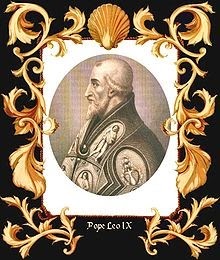
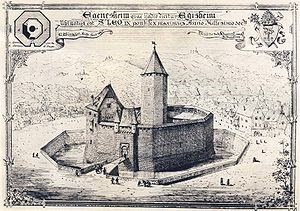
Bruno of Eguisheim-Dagsburg (Dabo) was born on 21 June 1002 in the castle of Eguisheim, in Alsace. Son of Hugh IV, count of Nordgau and count of Eguisheim, and of Heilwig of Dagsburg (Dabo), Bruno is a member of the highest aristocracy: his family is connected on his mother's side to the Carolingians of West Francia and on his father's side to the kings of Germany. Among Bruno's relatives are both counts of Reims and bishops of Langres and of Metz; he is a cousin of the emperors Conrad II the Salian and Henry III.
At the age of five he is entrusted to bishop Berthold of Toul to be educated at the cathedral school. After the death of his tutor, he is called to the court of his cousin Conrad II the Salian (1024-1039), who supports monastic reform. He is a deacon in 1025, then bishop of Toul, with Conrad's support, on 9 September 1027. Like many Lotharingian aristocrats, he is a man influenced by the ideas of the reform movement promoted by Cluny. He recruits his collaborators among the representatives of this current. It is in 1048 that he notices Hildebrand and binds the future Gregory VII to his person.
He imposes on his entourage and on himself a humble and pious way of life, behaving as a Benedictine monk and thus setting an example to the abbots of his bishopric. His fame spreads far beyond the borders of Lorraine.
The emperor's authority is weak over his vassals and, during the reign of Henry III, the counts of Tusculum, from a powerful Roman family accustomed to having the pope elected, attempt to reclaim their prerogatives. Criticising the poor morality of the popes appointed by the emperor, they have a rival pope elected, which forces the emperor to intervene militarily and to convene a great council, on 20 December 1046, to depose the usurping popes. But this is not enough: one after another, two popes appointed by the emperor are assassinated (Clement II and Damasus II).
Henry III absolutely must appoint a pope whose morality cannot be doubted and who is skilful enough to win the trust of the Romans. Bruno, after his brilliant ministry at Toul, is the ideal candidate but, in order to be accepted, he must nevertheless not be the candidate appointed by the emperor. He then goes on pilgrimage to the Holy City and humbly asks the Romans to elect him only if it suits them.
He is then enthroned under the name of Leo IX (in memory of Leo the Great, who had affirmed the primacy of the bishop of Rome as successor of Peter) on 1 February 1049.
Leo IX holds that the temporal sovereign must not intervene in religious life. As at Toul, he surrounds himself with reformers. Many indeed follow him, such as the monk Humbert of Moyenmoutier, of penetrating intelligence but whose brusque character does not predispose him to diplomacy, Hugh Candidus, Frederick of Lorraine (the future Stephen IX) or Peter Damian. He appoints a Cluniac, Hildebrand (the future Gregory VII), subdeacon and entrusts him with the administration of the revenues of the Holy See, close to bankruptcy.
The government is reorganised; the chancery services, now very active, follow the imperial model and the role of the cardinals, to whom key posts of the administration are entrusted, grows very markedly; these functions, once reserved for the representatives of the Roman families, are opened to "foreigners", which underlines the universal character of the Holy See and shows that such appointments must no longer depend on patronage.
Hildebrand, very energetic, has a great influence on the acts of his pontificate and on those of his successors (Victor II (1055-1057), Stephen IX (1057-1058), Nicholas II (1058-1061), Alexander II (1061-1073)). In fact Hildebrand initiates the Gregorian reform twenty-five years before becoming pope himself.
A doctrine is elaborated which tends to give the Holy See the power necessary for the accomplishment of the reform. The Dictatus papae reveal its fundamental ideas: in Christian society, cemented by faith, "the lay order" has for its function the execution of the commandments "of the priestly order" of which the pope is the absolute master. Vicar of Christ, he is the only legitimate holder of the Empire, for he is the vicar of Christ, "the supreme emperor". He may delegate this power and revoke his delegation. The emperor is no longer the collaborator of the pope, but his subordinate. The Church was to carry out the programme of reform defined by the pope. Now, that programme called into question the "imperial" Church.
From the very beginning of his pontificate, in April 1049, Leo IX convenes a council in Rome which condemns simony and part of Nicolaism. But the German and French prelates do not attend. He then decides to travel through Christendom to defend his reform energetically: from July 1050 until the spring of 1051, from June 1052 to March 1053, he crosses Europe from Benevento in the south, to Cologne in the north, to Reims in the west, to Bratislava in the east.
His principal struggles are:
against the buying or selling of ecclesiastical offices (simony); against the concubinage of priests (he was in favour of marriage) (Nicolaism); bishops were not to be prefects of the Empire but theologians; the return to "more Christian" values.
He excommunicates and deposes the bishops found guilty. During his pontificate he convenes twelve councils. In 1050 he institutes the Truce of God and the churches are decreed places of asylum. In 1049 he attempts to forbid the marriage of the duke of Normandy William the Conqueror with Matilda of Flanders. This union is flawed by consanguinity, but the political motive of this decision is the Church's fear of seeing two great powers united: Flanders and Normandy (the Normans settled in Sicily having already threatened the papacy). The marriage nevertheless takes place in 1050.
The moral disorders from which the Church suffers favour the propagation of heresies. In particular, in France, Berengar, the scholastic of Tours, asserts that there is only a spiritual presence of Christ in the eucharist. Already condemned at the councils of Rome and Vercelli in 1050, then at the synod of Paris in 1054, Berengar is referred in 1054 to the council of Tours presided over by Hildebrand. There he acknowledges that after consecration the bread and wine are the body of Christ.
The Muslims having just settled in Sardinia, he sends a legate to the Pisans to offer them the perpetual concession of the island on condition of paying him a tribute. They fully accomplish the mission, seizing even Corsica along the way.
From 1016, bands of Norman younger sons try their fortune in southern Italy. Indeed, the system of direct feudalism established by the dukes of Normandy, with hereditary rules that favour above all the eldest, obliges the younger sons to seek fortune elsewhere. Many sell their military talents as mercenaries. Southern Italy is disputed among Byzantines, Saracens and Lombards, who employ numerous Norman mercenaries renowned for their effectiveness (they win many battles when outnumbered).
However, poorly regarded by their employers, the Normans soon take to warring on their own account and conquer the counties of Aversa and Apulia in southern Italy. Henry III recognises them as vassals of the Empire. Now, in 1051 the duchy of Benevento submits to the pope, and the latter, seeing his latest acquisition threatened by the Norman raiders, goes to war against them. But the help of Henry III and of the Byzantines is insufficient and the pope is defeated in 1053 at the battle of Civitate, in Apulia.
It is a major setback: he is taken prisoner by the Normans in 1053 and definitively spoils the relations of the papacy with Byzantium. Finally the pope is freed after nine months of captivity at Benevento, after having recognised the Norman possessions in Apulia and Calabria.
The patriarch of Constantinople, Michael Cerularius (Keroularios), an opponent of the filioque (double procession of the Holy Spirit), of ecclesiastical celibacy and of unleavened bread, having attacked the Latin religious established in the East and conducting a harsh campaign against the Latin churches of his own city, which he sometimes has closed, Leo IX sends an embassy composed of 3 cardinals (Humbert of Moyenmoutier, the archbishop of Amalfi and Frederick of Lorraine) to attempt to smooth over the controversy and even to obtain the help of the Greeks against the Normans.
On 19 April 1054, in Rome, Leo IX, ill, dies, and on 16 July 1054, without knowing that their mandate was no longer valid because of the pope's death, the intransigent cardinal Humbert lays, on the altar of Hagia Sophia in Constantinople, a sentence of excommunication against the patriarch, who refuses to meet the legates.
On 24 July 1054, the permanent Byzantine Synod draws up the list of the errors of Rome and casts the anathema on the Roman accusers: it is the schism between East and West, called the "Eastern Schism" or "Great Schism".
The reciprocal anathemas cast between the patriarch of Constantinople and the pope of Rome would be lifted only on 7 December 1965 by Pope Paul VI and the patriarch of Constantinople Athenagoras.
The chains of descent.
- ★Etichon I (Adalric) of Alsaceb. c. 644, † 690 · 1st Duke of Alsace 673-690
- 2Adalbert of Alsace (Sundgau)b. c. 670, † c. 722 · 2nd Duke of Alsace 690-722, 1st Count of Sundgau
- 3Liutfrid I of Alsace (Sundgau)† c. 767 · 3rd Duke of Alsace 722-731, 3rd Count of Sundgau 747-c. 767
- 4Liutfrid II of Alsace (Sundgau)† 802 · 4th Count of Sundgau c. 767-802
- 5Hugh «of Tours», «the Distrustful», of Alsace (Sundgau)b. c. 775, † 837 · 5th Count of Sundgau 802-837, 1st Count of Tours
- 6b. c. 810, † c. 866 · of the Counts of Tours& 864Robert I «the Strong» of the Robertians, b. c. 820, † 866 · Duke of the Franks 861-866
- 7Robert I of the Robertiansb. 866, † 923 · 13th King of France 922-923
- 8Hugh I «the Great» of the Robertiansb. 895, † 956 · 1st Duke of the Franks 923-956, 4th Duke of Burgundy 936-956
- 9Hugh «Capet» of the Capetiansb. 941, † 996 · 2nd Duke of the Franks 956-987, 18th King of France 987-996
- 10Robert II «the Pious» of the Capetiansb. 972, † 1031 · 19th King of France 996-1031, 8th Duke of Burgundy 1002-1017
- 11Robert I «the Old» of Burgundy (Capetians)b. c. 1011, † 1076 · 10th Duke of Burgundy 1032-1076
- 12Henry «Donzel» of Burgundy (Capetians)b. c. 1035, † 1066 · of the Dukes of Burgundy
- 13Odo I «Borel» of Burgundy (Capetians)b. 1058, † 1103 · 12th Duke of Burgundy 1079-1103
- 14Hugh II «Borel» of Burgundy (Capetians)b. c. 1084, † 1142 · 13th Duke of Burgundy 1103-1142
- ★Aigeline of Burgundy (Capetians)b. 1116, † 1163 · of the Dukes of Burgundy& c. 1130Hugh I of Lorraine-Vaudémont, b. c. 1095, † 1155 · 2nd Count of Vaudémont 1108-1155
- ★Etichon I (Adalric) of Alsaceb. c. 644, † 690 · 1st Duke of Alsace 673-690
- 2Etichon II of Alsace (Nordgau)b. c. 690, † c. 723 · 1st Count of Nordgau 690-723
- 3Alberic I of Alsace (Nordgau)b. c. 698, † 747 · 2nd Count of Nordgau 723-747
- 4Eberhard I of Alsace (Nordgau)b. c. 730, † 800 · 4th Count of Nordgau 765-800 (after Ruthard of Alsace (Sundgau), 3rd Count of Nordgau 747-765)
- 5Alberic II of Alsace (Nordgau)† 816 · 5th Count of Nordgau 800-816
- 6Eberhard II of Alsace (Nordgau)b. c. 798, † 864 · 6th Count of Nordgau 816-864
- 7Eberhard III of Alsace (Nordgau)b. c. 853, † 900 · 7th Count of Nordgau 864-900
- 8Hugh I «of Hohenberg» of Alsace (Nordgau)b. c. 880, † 940 · 8th Count of Nordgau 900-940, Count of Alsace
- 9Eberhard IV of Alsace (Nordgau)b. c. 910, † 972 · 9th Count of Nordgau 940-951 (abdicates), 1st Count of Eguisheim
- 10Hugh II «Raucus» of Alsace (Nordgau)b. c. 945, † 986 · 11th Count of Nordgau 951-986, 2nd Count of Eguisheim 972-986
- 11Hugh IV of Eguisheimb. c. 970, † c. 1047 · 15th Count of Nordgau 1027-1047, 3rd Count of Eguisheim 986-1047
- 12Hugh VII of Eguisheimb. c. 1000, † c. 1049 · of the Counts of Eguisheim, 1st Count of Dagsburg
- 13Henry I of Eguisheimb. c. 1018, † c. 1065 · 5th Count of Eguisheim 1049-1065, 2nd Count of Dagsburg 1049-1065
- 14Gerard II of Eguisheim† c. 1074 · 6th Count of Eguisheim 1065-1074, 3rd Count of Dagsburg 1065-1074
- 15Hedwig of Eguisheimb. c. 1065, † c. 1126 · of the Counts of Eguisheim& c. 1080Gerard I of Lorraine-Vaudémont, b. c. 1057, † 1108 · 1st Count of Vaudémont 1070-1108
- ★Hugh I of Lorraine-Vaudémontb. c. 1095, † 1155 · 2nd Count of Vaudémont 1108-1155& c. 1130Aigeline of Burgundy (Capetians), b. 1116, † 1163 · of the Dukes of Burgundy
- ★Hugh I of Lorraine-Vaudémontb. c. 1095, † 1155 · 2nd Count of Vaudémont 1108-1155& c. 1130Aigeline of Burgundy (Capetians), b. 1116, † 1163 · of the Dukes of Burgundy
- 2Gerard II of Lorraine-Vaudémontb. c. 1135, † 1188 · 3rd Count of Vaudémont 1155-1188
- 3Hugh II of Lorraine-Vaudémontb. c. 1167, † 1242 · 4th Count of Vaudémont 1188-1242
- 4Hugh III of Lorraine-Vaudémontb. c. 1205, † 1243 · 5th Count of Vaudémont 1242-1243
- 5Henry I of Lorraine-Vaudémontb. 1232, † 1278 · 6th Count of Vaudémont 1243-1278
- 6Margaret of Lorraine-Vaudémontb. c. 1252, † c. 1303 · of the Counts of Vaudémont& 1271Thomas II Sanseverino, b. c. 1252, † 1324 · 3rd Count of Marsico 1285-1324
- 7Henry Sanseverinob. c. 1271, † 1314 · 4th Count of Marsico 1308-1314
- 8Thomas III Sanseverinob. c. 1310, † 1358 · 5th Count of Marsico 1324-1358
- 9Antonino Sanseverinob. c. 1328, † 1384 · 6th Count of Marsico 1358-1384
- 10Thomas IV Sanseverinob. c. 1360, † 1387 · 7th Count of Marsico 1384-1387
- 11Louis Sanseverino† 1400 · 8th Count of Marsico 1387-1400
- 12Thomas V Sanseverino† c. 1417 · 9th Count of Marsico 1400-c. 1417
- ★† 1464 · of the Counts of Marsico&William Raymond V Moncada, † 1466 · 7th Count of Adernò 1453-1466
Timeline
Famous descent
Gallery.