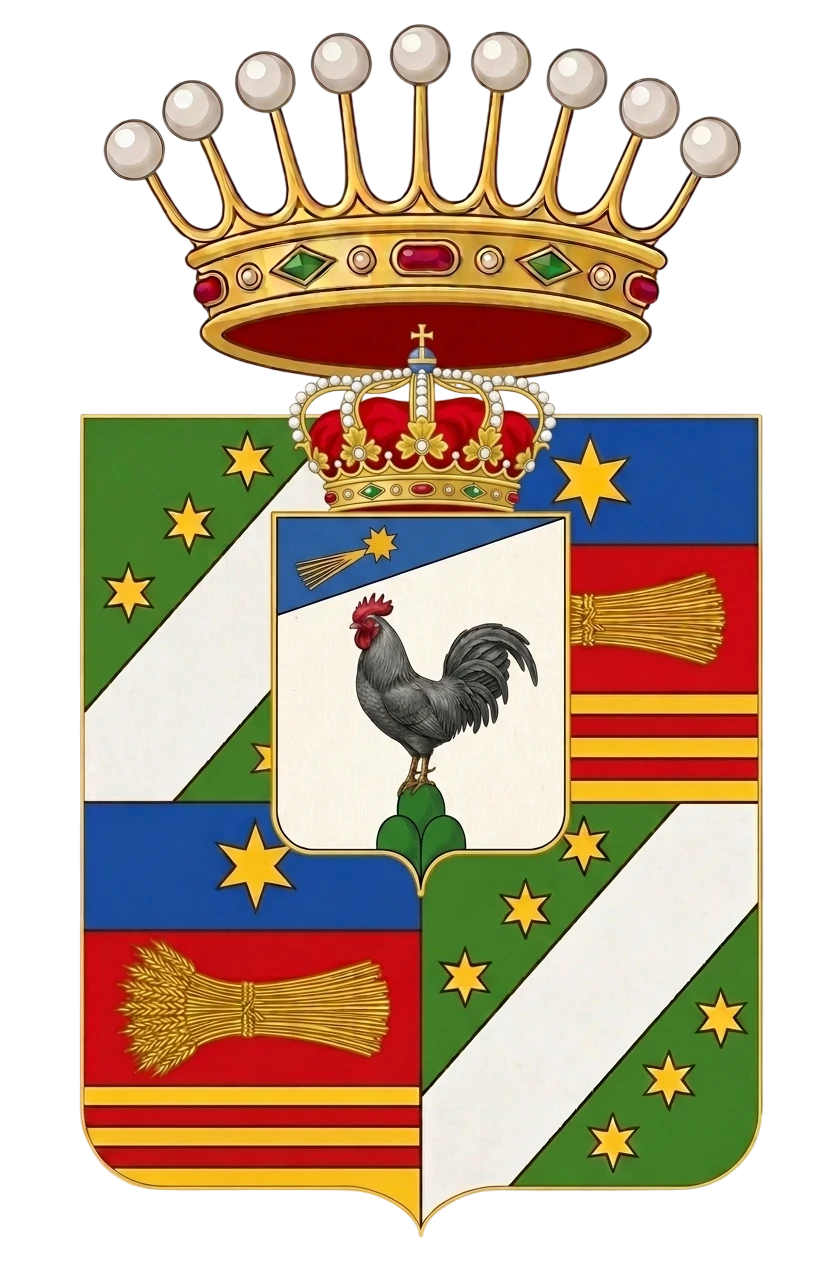
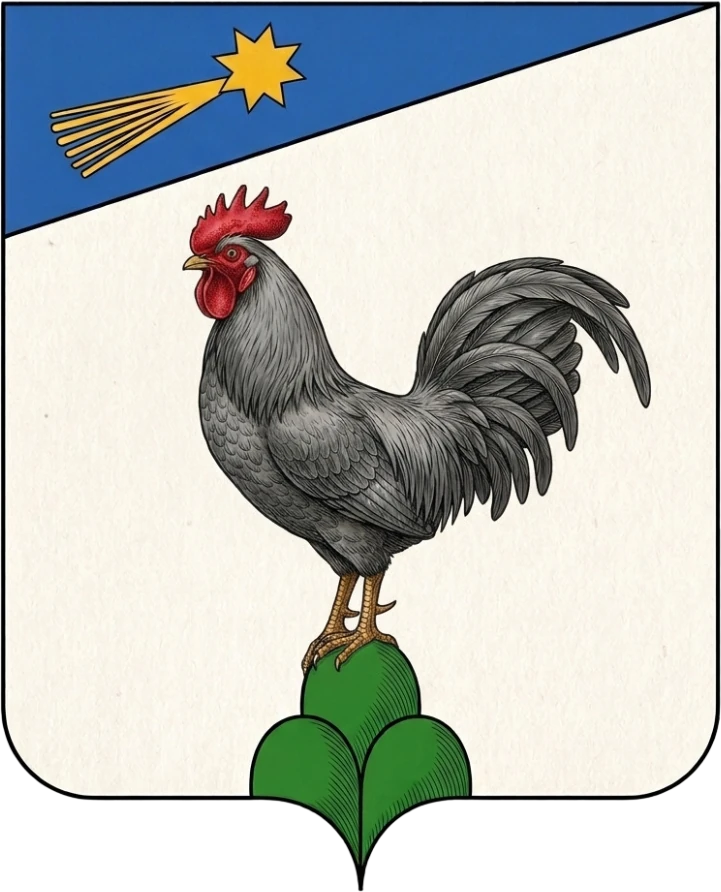
Quarterly argent and gules, a bend or charged with three mullets.
Lineage · Stage 5
Gallone.
Princes of Tricase, 1651 – 1982.
A family probably of Cypriot origin, arrived in the Terra d'Otranto around 1240 in the train of Hugh III of Brienne. From wealthy oil merchants in the 16th century to Princes of Tricase, a title granted by Philip IV of Spain in 1651.
History of the house.
A handwritten «Genealogy of the Gallone Family» of 1765 mentions three Greek priests — Don Clemente, father of Don Cesario, in turn father of Don Mariano — arrived in the Terra d'Otranto around 1240. The same document cites two deeds from the Archives of Naples, destroyed in 1943.
In the Register of Charles I (1291) a «dominus Johannes Gallonus de Ciplo, miles» is recorded as holding fiefs in Summa; in the Register of King Robert (1339–1340) other Gallone appear, « persons much honoured ». The Gallone are probably of Cypriot origin, come to Italy in the train of Hugh III of Brienne, who had inherited goods on the island from his mother, Mary of Lusignan.
Don Mariano is said to be the father of Angelo I († 1546), the first proven figure and founder of the family, married to Graziosa Mecchi, of a well-off Tricase family.
From the mid-16th century the Gallone appear firmly settled at Tricase with the sons of Angelo I, the Barons Stefano I († 1586) and Alessandro I († 1589): wealthy oil merchants, they manage to acquire the fief of Specchia Minervino — later Specchia Gallone — then structured as a large agricultural estate.
Their activities are manifold: oil production, agrarian investment, financial credit and the increase of capital, all governed by a shrewd hereditary and patrimonial policy. Their possessions expand with the fiefs of Tiggiano and Caprarica del Capo, then of Depressa and part of Tutino, acquired by Giovanni Angelo II (1572–1616), 3rd Baron of Tricase, through his marriage to Silvia Trane of the Barons of Tutino.
On the premature death of the 4th Baron, Alessandro II (1598–1623), his brother Stefano II (1601–1662) succeeds, a central figure in the history of the Gallone. In twenty-five years he obtains the baronies and hamlets of Tiggiano (1627), Supersano with the Belvedere Wood — 12,000 hectares — Caprarica del Capo (1644), Salve, Tutino, Miggiano and part of Nociglia, and in 1661 he builds the central body of the Palazzo Gallone, the princely castle of Tricase.
His masterpiece, however, is the «status» of Prince, a title granted in 1651 by Philip IV, King of Spain. How does this leap occur, from Baron — albeit very rich — directly to Prince? Most likely thanks to a profitable financial operation within the policy of the Viceroy of Naples: the needs of provisioning, military expenditure and the lavish court life pushed the rulers to lean on the merchant class and to reward barons loyal to the Crown. Stefano II possessed every requisite: a loyal feudatory, with merchant agencies in Naples and solid capital.
Stefano II is succeeded by his son Alessandro III (1638–1675), 2nd Prince, who completes the acquisition of the barony of Nociglia; then Stefano III (1666–1733), 3rd Prince, orphaned and a minor under the guardianship of his uncle Carlo, Abbot of Caprarica. Raised in Naples, in 1681 he marries Giovanna Teresa Colmenero y Arborio, of the very wealthy Piedmontese aristocracy at the Court of Savoy, who soon takes the upper hand in the management of the estate.
The economic situation declines through the Neapolitan expenses and the neglect of Stefano III, a religious man devoted to letters: between 1700 and 1733 Specchia Gallone, Andrano, Tricase, Caprarica and Nociglia are lost. The 4th Prince Francesco Alessandro (1684–1753) partly restores the fortunes; he is succeeded by his half-brother Giuseppe Domenico (1706–1766), 5th Prince, then by Giuseppe Gerardo (1766–1806), 6th Prince, who in 1796 marries Maria Emanuela Pignatelli, recovering the fiefs of Moliterno and Marsiconovo with the attached princely title.
Giovanni Battista (1800–1868) takes the titles of 7th Prince of Tricase, 6th of Marsiconovo and 4th of Moliterno. His son Giuseppe (1819–1898), already Count of Nociglia, becomes 8th Prince and plays an important role in Neapolitan politics, becoming Senator of the Kingdom of Italy after the fall of the Bourbons.
Despite rich alliances, the situation collapses under the effects of the French law of 1806 on the abolition of feudalism and the misgovernment of the last Princes, more attracted by Neapolitan high society than by their lands. Pietro Giovanni Battista «Gino» (1855–1931), 9th Prince and a animator of the Parthenopean fêtes, squanders the patrimony through numerous alienations and divisions of goods.
The Gallone House becomes extinct with Maria Bianca (1895–1982), 10th Princess of Tricase and 7th of Moliterno, who marries Augusto III della Posta, 7th Duke of Civitella Alfedena. Their daughter, Simonetta della Posta (1916–1986), married to Aldo Guerri dall'Oro (1913–2004), obtains from King Umberto II, on 19 November 1967, the title of Countess motu proprio.
By Decree of 21 January 1999 of the Minister of Grace and Justice, the addition of the surname Gallone di Tricase e di Moliterno is granted to her children. The firstborn, Guido Guerri dall'Oro Gallone (1941–2019), is de iure 11th Prince of Tricase; his son Simon (b. 1985) is today 12th Prince, father of Léon (b. 2018).
Family tree of the house.
Noble titles of the Gallone
Princes, and fifteen baronies.
Possessions and fiefs
15 baronies of the Capo di Leuca.
Note on nobiliary law
The question of the Regio Assenso.
According to a widespread but mistaken thesis, the Regio Assenso (royal assent) would always have been necessary in the hereditary transmission of noble titles, especially in the female line. In reality it was neither necessary nor required in the simple transmission of the title, once it had become merely honorific — emptied of its link with a feudal estate, as in cases of succession after the sale of the fief with the formula «extincto seu retinenti titulo».
Such transmission constituted a perfect right, requiring no confirmation: its legitimacy rested on the normal hereditary succession — from father to son, or to daughter, or from mother to son, according to the Neapolitan female succession — consistent with the succession laws in force at the time.
Ancient and modern nobiliary jurisprudence, including that of Republican Italy, is in agreement: in the former Neapolitan Provinces, until the law abolishing feudalism (1806), no formal measure was necessary for the transmission of the title alone, neither in the male nor in the female line.
After 1806, the titles reduced to mere honorific distinctions and simple additions to the family name, personal investiture was no longer required, in either the male or the female line.