Famous descent · Antiquity and Middle Ages
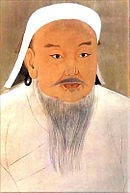
Genghis Khan.
Temüjin · 1162 – 1227.
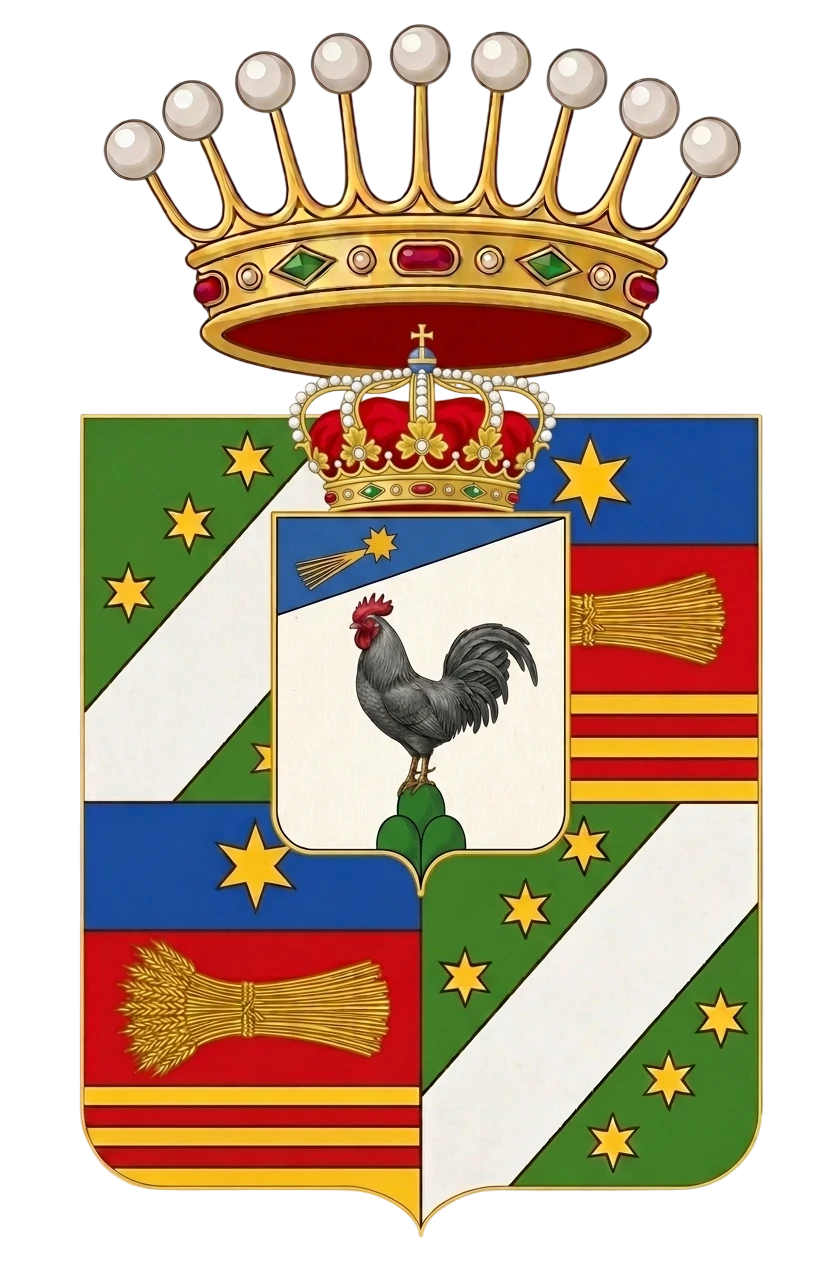
Founder of the Mongol Empire. Through his eldest son Jochi, his descent reaches — via the Voivodes of Wallachia (Basarab), the Piast, the Anhalt, the Sinzendorf and the Doria — the main line of the Guerri dall’Oro Gallone family, with the key marriage of Andrea Doria and Maria Giovanna Doria del Carretto in 1758.
Borjigin ancestry.
- 1b. c. 1100, † 1147 · of the Mongols (Borjigin) · Chief of the Qiyat / Kiyad clan (Borjigin tribe), Khan of the Mongols 1130–1147&Goa Kulkua, of the Mongols (Qongirat)
- 2Bartan «Baghatur», «the Brave»of the Mongols (Borjigin), of the Khans of the Mongols&Sayn Maral Khayak
- 3Yesugei «Baghatur», «the Brave»b. c. 1134, † 1175 · of the Mongols (Borjigin) · Chief of the Qiyat / Kiyad clan (Borjigin tribe)&Höelün, b. c. 1142 · of the Mongols (Olkhunut)
- ★Genghis Khan (Temüjin)b. 1162, † 1227 · of the Mongols (Borjigin) · 1st Khan of the Mongols 1187–1206, 1st Great Khan of the Mongols 1206–1227& c. 1181Börte Fujin, b. c. 1166, † 1224 · of the Mongols (Qongirat)
The descent of Genghis Khan.
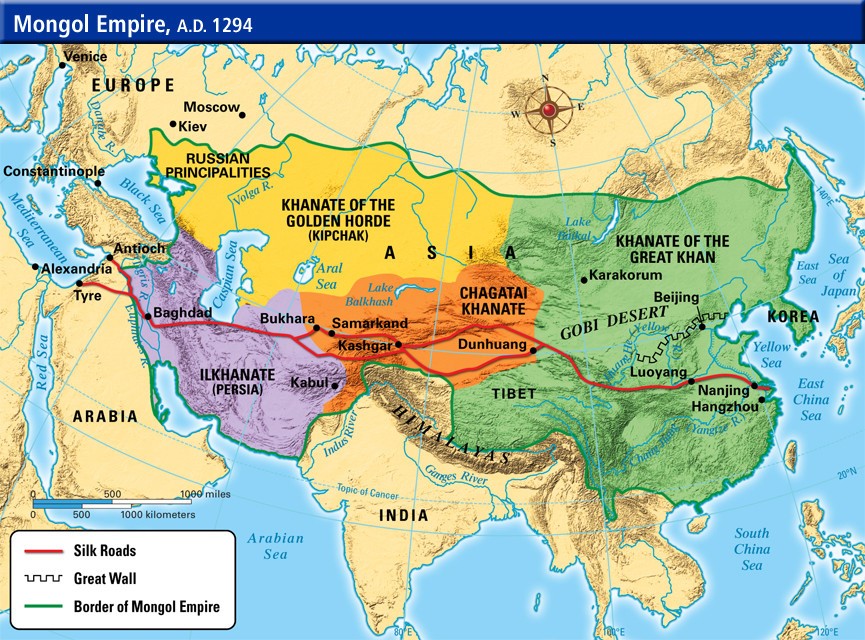
From his marriage with his chief wife Börte were born four sons, at the origin of as many dynasties that ruled from Central Asia to China and Persia:
Jochi (1182–1227), of problematic paternity, from whom descend the Khans of the Golden Horde, the Shaybanids and the Astrakhanids; Chagatai (1184–1241), from whom descend the Chagataids of the Chagatai khanate; Ögödei (1186–1241), designated heir to the imperial throne; Tolui (1190–1232), from whom descend the emperors of the Yuan dynasty in China and the Hulagids in Persia.
The first difficulty one encounters in trying to find the descendants of Genghis Khan is the origin of Jochi, the eldest son, who had far more descendants than all the other sons put together.
The name «Jochi» can be translated as «unexpected guest». The Secret History of the Mongols recounts that the boy was sent to Genghis Khan by Chilger, who had abducted and raped his favourite wife, Börte, having held her in captivity for about a year. According to this work, Jochi's brothers harboured doubts about his origins.
In one passage, Chagatai calls Jochi a bastard, although the meaning of the Mongol term is not clear. Genghis Khan answers him: «How dare you speak of Jochi in that way? Is he not the eldest of my heirs? I hope never to hear such vile words again!» The sentence «Jochi is my eldest son» is found three times in the mouth of Genghis Khan.
Historians today think that the doubts about Jochi's paternity are at the origin of his estrangement by his father and of the fact that his descendants did not ascend the imperial throne. But the failure of Jochi's succession might also be explained by his premature death, which may have favoured the sidelining of his progeny, whose principal representative is Batu, conqueror of the Russian steppes from 1237 to 1240.
Among the dynasties drawing their origins from Genghis Khan are the Yuan dynasty of China, the Hulagids of Persia, the Jochids of the Golden Horde, the Shaybanids of Siberia and the Astrakhanids of Central Asia.
Genghisid ancestry is generally crucial in Tatar politics. For example, Mamai had to reign through a series of puppet Khans because he was not himself a Genghisid.
Tamerlane, the founder of the Timurid dynasty, claimed to be a descendant of Genghis Khan. Although there is no clear source on his ancestors, he associated himself with the family of Chagatai through marriage. He never took the title of Khan but employed two members of the Chagatai clan as official heads of state.
The Mughal royal family of India descends from Tamerlane through Babur and from Genghis Khan through Babur's mother. Later one finds, among the Tatar leaders of Genghisid origin, the Khans of Kazan, Qasim (in particular a tsar, Simeon Bekbulatovich), and the Giray dynasty, which reigned over the Khanate of Crimea until 1783.
As the Russian Empire annexed Turkic states, their Genghisid chiefs often entered the service of Russia. The descendants of Kuchum, for example, became the tsareviches of Siberia. The descendants of Ablai took in Russia the name Valikhanov, and the sons of Kalmyk became the princes Dondoukov. All these families claimed a Genghisid line.
The only surviving family is the house of Giray, some members of which left the Soviet Union for the United States and the United Kingdom; they are the only ones still to have today an almost certain direct genealogical link with Genghis Khan.
After the Mongol invasion of Russia the Rurikid chiefs of the Russian principalities and the Bagratid dynasty of Georgia were eager to obtain political advantages for themselves and their countries by marrying Genghisids. Thus Alexander Nevsky was adopted by Batu and declared his son. Alexander's grandson, Yuri III of Moscow, married a sister of Öz Beg.
Minor princes of Genghisid origin also settled in Russia. For example, Berke's nephew adopted the name of Peter and founded the monastery of St Peter of Rostov, where his descendants would long be important boyars.
The descent of three marriages between Russians and Mongols can be traced down to our own day.
The most famous is that of St Fyodor the Black, later patron saint of Yaroslavl, with a daughter of Khan Mengu-Timur. Fyodor's relations with the Khan were idyllic: he spent more time with the Horde (where he was granted great possessions) than in his own capital. The male descendants of Fyodor's marriage with the Tatar princess include all the later chiefs of Yaroslavl and two dozen princely families (among them the Shakhovskoy, the Lvov, the Prozorovsky, among others) who passed the Genghisid genes to other aristocratic families of Russia.
Prince Gleb of Beloozero, a grandson of Constantine of Vladimir, is another Rurikid prince who greatly influenced the Mongol court. Gleb married the only daughter of Khan Sartaq; from this union was born the house of Belozersk, whose most famous members are the princes Dmitri Ukhtomsky and the Beloselsky-Belozersky.
More problematic is the union of Narimont, second son of Gediminas of Lithuania, with the daughter of Toqta. The oldest source that speaks of this marriage is the «Jagiellonian genealogy», compiled in the eighteenth century by Johannes Werner from the «Ruthenian chronicles». Although the marriage is not impossible (Narimont having spent several years with the Horde), there is no other source that mentions his wife. This claim is particularly interesting because the important princely families Galitzine, Khovansky and Kurakin are descendants of Narimont.
The Genghisid origins of the tsars or kings of Russia and of Georgia cannot be confirmed with the help of the few fragmentary documents that exist. The possibility of such a line for the royal families of Western Europe is even less realistic. Nevertheless, Western genealogists try to find a link between Genghis Khan and Elizabeth II of the United Kingdom.
The most widespread theory is that of the Basarab family of Wallachia, in the south of Romania. The first sure ancestor of the Basarab princes is a boyar, Thocomerius of Wallachia. There are several theories concerning his origins. Some genealogists identify Thocomerius with a Bulgarian boyar, Tikhomir (from the Slavic words for «calm», «peaceful»); another theory holds that his real name is Toq-Timur and that he is the grandson of Batu, the son of Jochi.
Several descendants of the Basarabs settle in Hungary. It has been demonstrated, convincingly, that Countess Claudine de Rhédey is a descendant of the Basarabs. This would mean that Mary of Teck and her descendants, among them Elizabeth II, are descended from the Thocomerius–Tikhomir–Toq-Timur line.
During the early years of the Qing dynasty, the Manchu Aisin Gioro clan had a tradition of diplomatic marriages between themselves and the Mongols to secure their support. The Qing nobles thus made Mongol ladies into empresses and important concubines.
As the Khorchin were the strongest family, the Manchus were eager to make alliances with the Borjigin. These marriages are at the origin of two empresses and three dowager empresses of the Qing dynasty. It is therefore not surprising that, from Nurhaci to Shunzhi, all the important empresses and concubines were of Mongol origin.
Xiao Duan Wen becomes empress in 1636; married to Hong Taiji, she is the daughter of Prince Manjusri. She is seen as a benevolent empress and the most virtuous of all. She is called «Mother Empress Dowager» (sheng mu huang tai hou) in 1643, the year of the death of her husband the emperor. She dies in 1649.
The dowager empress Xiaozhuang is traditionally seen as the mother of the Qing dynasty. She is the concubine of Hong Taiji, daughter of Prince Jaisang and niece of the empress Xiao Duan Wen. She is called «Enlightened Mother Empress Dowager» (sheng mu huang tai hou) in 1643 after the death of the emperor Hong Taiji. She died in 1688, having helped the emperor Shunzhi to take care of the country until his death, and having afterward helped Kangxi during 25 years of his reign. An excellent politician, she did not like to intervene in politics, unlike the famous dowager empress Cixi, but she did so when she judged it necessary.
The line down to the family.
- ★Genghis Khan (Temüjin)b. 1162, † 1227 · of the Mongols (Borjigin) · 1st Khan of the Mongols 1187–1206, 1st Great Khan of the Mongols 1206–1227& c. 1181Börte Fujin, b. c. 1166, † 1224 · of the Mongols (Qongirat)
- 2Jochib. 1182, † 1227 · of the Mongols (Borjigin), of the Great Khans of the Mongols&Oki Fujin Khatun, b. c. 1190 · of the Mongols (Qongirat)
- 3Batu «the Splendid»b. 1205, † 1256 · of the Mongols (Blue Horde, Golden Horde) · 1st Khan of the Blue Horde 1227–1256, 1st Khan of the Golden Horde 1235–1256&Borakchin, b. c. 1200, † 1257 · of the Mongols (Alchi Tatars)
- 4Toquqanb. 1225, † 1256 · of the Mongols (Blue Horde, Golden Horde), of the Khans of the Blue Horde and of the Golden Horde&Buka Fujin (Kochu), of the Mongols (Qongirat)
- 5Mengu-Timurb. c. 1240, † 1282 · of the Mongols (Golden Horde) · 5th Khan of the Golden Horde 1267–1282&Oljei Khatun, of the Mongols (Qongirat)
- 6Thocomerius / Tihomirb. c. 1257, † 1310 · of the Basarab · 4th Voivode of Wallachia&Anna, of the Basarab (1st House), of the Voivodes of Wallachia
- 7Basarab II «the Great»b. c. 1275, † 1352 · of the Basarab · 6th Voivode of Wallachia&Margaret of Doboka
- 8Nicolas I Alexandreb. c. 1307, † 1364 · of the Basarab · 7th Voivode of Wallachia&Maria Lakfy
- 9Elisabeth of the Basarabb. c. 1340, † c. 1368 · of the Voivodes of Wallachia& 1353Władysław II of Opole (Piast), b. c. 1332, † 1401 · 1st Duke of Opole-Wieluń, Count Palatine of Hungary
- 10Catherine of Opole (Piast)b. 1367, † 1420 · of the Dukes of Opole-Wieluń& 1382Henry VI «the Sparrow» of Sagan-Glogau (Piast), b. 1360, † 1397 · 12th Duke of Sagan, 12th Duke of Glogau
- 11John I of Sagan-Glogau (Piast)b. c. 1385, † 1439 · 13th Duke of Sagan& c. 1407Scholastica of Saxe-Wittenberg, b. c. 1393, † c. 1463 · of the Dukes of Saxe-Wittenberg, Prince-electors of Saxony
- 12Anna of Sagan-Glogau (Piast)b. c. 1412, † 1439 · of the Dukes of Sagan-Glogau&Albert of Lindow-Ruppin, b. 1405, † 1460 · Count of Lindow-Ruppin
- 13Anna of Lindow-Ruppinb. 1430, † 1511 · of the Counts of Lindow-Ruppin& 1453George I «the Old» of Anhalt-Dessau, b. c. 1390, † 1474 · 7th Prince of Anhalt-Dessau, 10th Prince of Anhalt-Bernburg
- 14Ernest of Anhalt-Dessaub. 1454, † 1516 · 11th Prince of Anhalt-Dessau, 12th Prince of Anhalt-Bernburg& 1494Margaret of Poděbrady, b. 1473, † 1551 · Duchess of Münsterberg
- 15John V of Anhalt-Dessaub. 1504, † 1551 · 12th Prince of Anhalt-Dessau, 13th Prince of Anhalt-Bernburg, Prince of Anhalt-Zerbst& 1534Margaret of Hohenzollern, b. 1511, † 1577 · of the Prince-electors of Brandenburg
- 16Maria of Anhalt-Zerbstb. 1538, † 1563 · of the Princes of Anhalt-Zerbst& 1559Albert X of Barby, b. 1534, † 1595 · Count of Barby-Mühlingen
- 17Maria of Barbyb. 1563, † 1619 · Countess of Barby-Mühlingen& 1582Josias of Waldeck, b. 1554, † 1588 · Count of Waldeck-Eisenberg
- 18Christian of Waldeckb. 1585, † 1637 · Count of Waldeck-Wildungen& 1604Elisabeth of Nassau, b. 1584, † 1661 · of the Counts of Nassau-Siegen
- 19Catherine of Waldeckb. 1612, † 1639 · of the Counts of Waldeck-Wildungen& 1643Philip Louis of Schleswig-Holstein, b. 1620, † 1689 · 1st Duke of Schleswig-Holstein-Sonderburg-Wiesenburg
- 20Dorothea Elisabeth of Schleswig-Holsteinb. 1645, † 1725 · of the Dukes of Schleswig-Holstein-Sonderburg-Wiesenburg& 1661George Louis of Sinzendorf, b. 1616, † 1681 · 5th Count of Sinzendorf, Knight of the Golden Fleece 1663
- 21Philip Louis Wenzel of Sinzendorfb. 1671, † 1742 · 7th Count of Sinzendorf, Knight of the Golden Fleece 1712, Chancellor of the Austrian Empire& 1696Regina Catherine of Waldstein, b. 1672, † 1733 · of the Counts of Waldstein
- 22John William of Sinzendorfb. 1697, † 1766 · 8th Count of Sinzendorf& 1716Bianca Maria Sforza Visconti, b. 1697, † 1717 · 9th Marchioness of Caravaggio
- 23Bianca Maria of Sinzendorfb. 1717, † 1783 · 10th Marchioness of Caravaggio& 1736Filippo Domenico Doria Landi, b. 1710, † 1768 · of the Princes of Melfi, Count of Loano
- 24Andrea Doria Sforza Viscontib. 1738, † 1771 · 11th Marquess of Caravaggio& 1758Maria Giovanna Doria del Carretto, b. 1743, † 1832 · 5th Duchess of Tursi, 6th Princess of Avella1758 · confluence of the five papal branches into the Doria
The Mongol world.
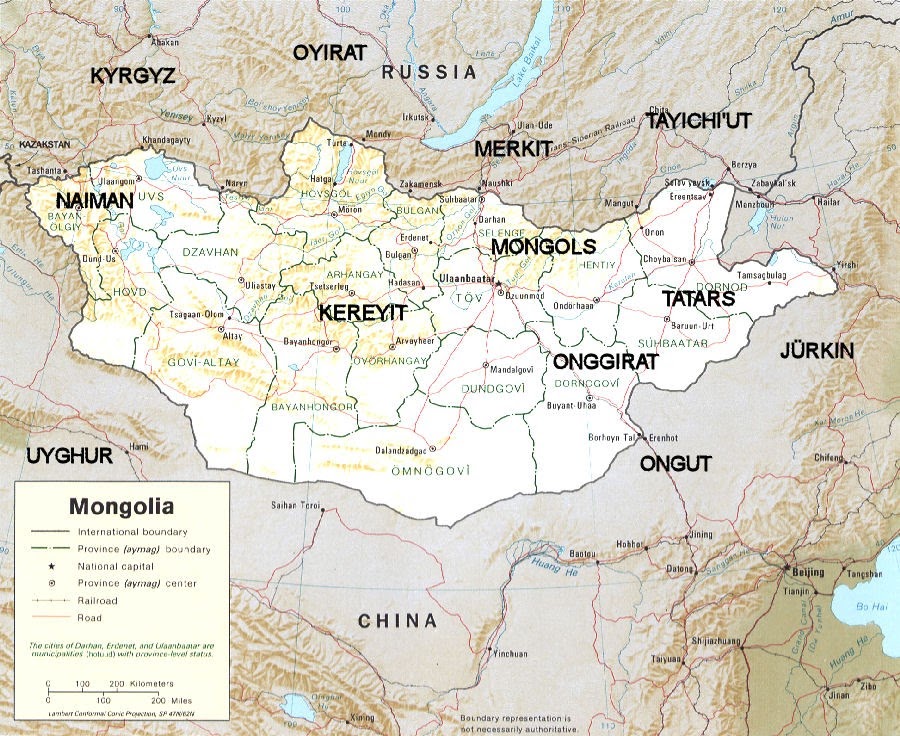
In the tenth century the Mongol people had already made themselves talked about: the Khitans / Khitai had invaded northern China and founded the Liao dynasty (907–1125). In the twelfth century it settled in the region of the upper Orkhon and the Khangai, in place of the Uyghur Turks, then of the Kyrgyz Turks, who had fled before the Khitans.
The Mongols are divided into tribes, which are subdivided into clans. The tribes are the following: Borjigin (that of Genghis Khan), Qongirat (that of Börte, wife of Genghis Khan), Jadjirat, Jalair, etc...
To the east of the Mongols are the Tatars (who are perhaps of the Tungusic branch although speaking Mongol), who will be called Tartars in the West by deformation of the word, and who will often be confused with the Mongols properly so called, to the great displeasure of the latter. One also finds the Kereyit / Keraites, the Naimans, the Merkits, of whom it is not known whether they are Turkic or Mongol and who are of Christian religion (Nestorians). One also finds the Onguts, also Christian. Finally the Tayichiud to the north.
The north of China has since 1125 passed into the hands of the Jin / Kin dynasty, which belongs to the people of the Tungus, tribe of the Jurchen. The south is in the hands of the Song Chinese and the north-east in the hands of a Tibetan people: the Xixia, also called Tanguts.
The father of Genghis Khan, Yesügei, is the chief of the Qiyat clan, a subdivision of the Borjigin tribe. He allies himself with the Kereyit and with their chief Toghrul, who is his «sworn brother» («anda»). He abducts Hö'elün, the wife of a Merkit, who becomes the mother of Genghis Khan.
Birth of Temüjin, future Genghis Khan, between 1155 and 1162, on the right bank of the Onon, at the place called Deluun Boldog according to the «Secret History of the Mongols» (or Dolo'an Boldaq or Deliun Boldaq or Dülün Boldaq). The word Temüjin means: blacksmith (the blacksmith, like the shaman, has the knowledge of iron and fire).
At 9 years old, betrothal of Temüjin to Börte, the daughter of the chief of the Qongirat clan. His father Yesügei dies shortly after, poisoned by Tatars. The mother Höelün and her children (plus the shaman Mönglik) are abandoned by the tribe with whom they had taken refuge, the Tayichiud; they wander for a long time (1 or 12 years?) in the steppe.
At 11 years old he becomes «sworn brother» («anda») of Jamuqa, a Mongol of the Jadjirat tribe.
At 16 years old Temüjin kills his half-brother Bekter who had stolen from him a lark and then a fish. His mother reproaches him harshly. Temüjin is captured by the Tayichiud (whose Khan is named Tarqudai-Kiriltuq), is put in the cangue (wooden collar gripping the neck and the wrists), but manages to flee thanks to Sorqan-shira. He finds his family again, but the family's horses are captured by thieves. He manages to recover them thanks to Boortchu, a chance friend. Temüjin returns to the Qongirat and marries Börte. He makes a new friend: Jelme. In revenge against Yesügei, Temüjin's father, the Merkit capture Börte. Temüjin takes refuge on Burqan Qaldun, the sacred mountain, then with the help of Toghrul and Jamuqa, a battle is fought against the Merkit. Börte, absent for 9 months, is freed. She gives birth to Jochi, whose paternity may be contested, but Temüjin accepts the child. She will give birth to 3 more sons (Chagatai, Ögödei and Tolui) and to unknown daughters. Temüjin and Jamuqa renew their union then part, each drawing his allies with him. Among Temüjin's: Sübötei, brother of Jelme.
Chronology of the conquests.
The kin and the faithful.
The four braves
- Muqali of the Jalair tribe
- Boroul of the Jürkin clan, foundling
- Boorcu of the Arulad clan
- Cila'un of the Jalair tribe
The four « hounds »
- Sübe'etei Sübötei, of the Uriangqai tribe, younger brother of Jelme
- Qubilai of the Barulas clan
- Jelme of the Uriangqai tribe, elder of Sübe'etei
- Jebe Jebe, «Arrow», of the Besüd clan
The four adopted sons of Höelün
- Kücü found in the Merkit camp
- Kököcü found in the Besüd camp
- Siki Quducu found in the Tatar camp
- Boroul found in the Jürkin camp, one of the four braves
The conqueror and his empire
Gallery.