Famous descent
René d'Anjou.
The Good King René.
1409 – 1480
History.
1409 – 1480
Lord then Count of Guise 1417–1425, Duke of Bar 1430–1480, Duke consort of Lorraine 1431–1453, King of Naples 1435–1442, Duke of Anjou 1434–1480, Count of Provence and Forcalquier 1434–1480, Titular King of Jerusalem 1435–1480 and of Aragon 1466–1480.
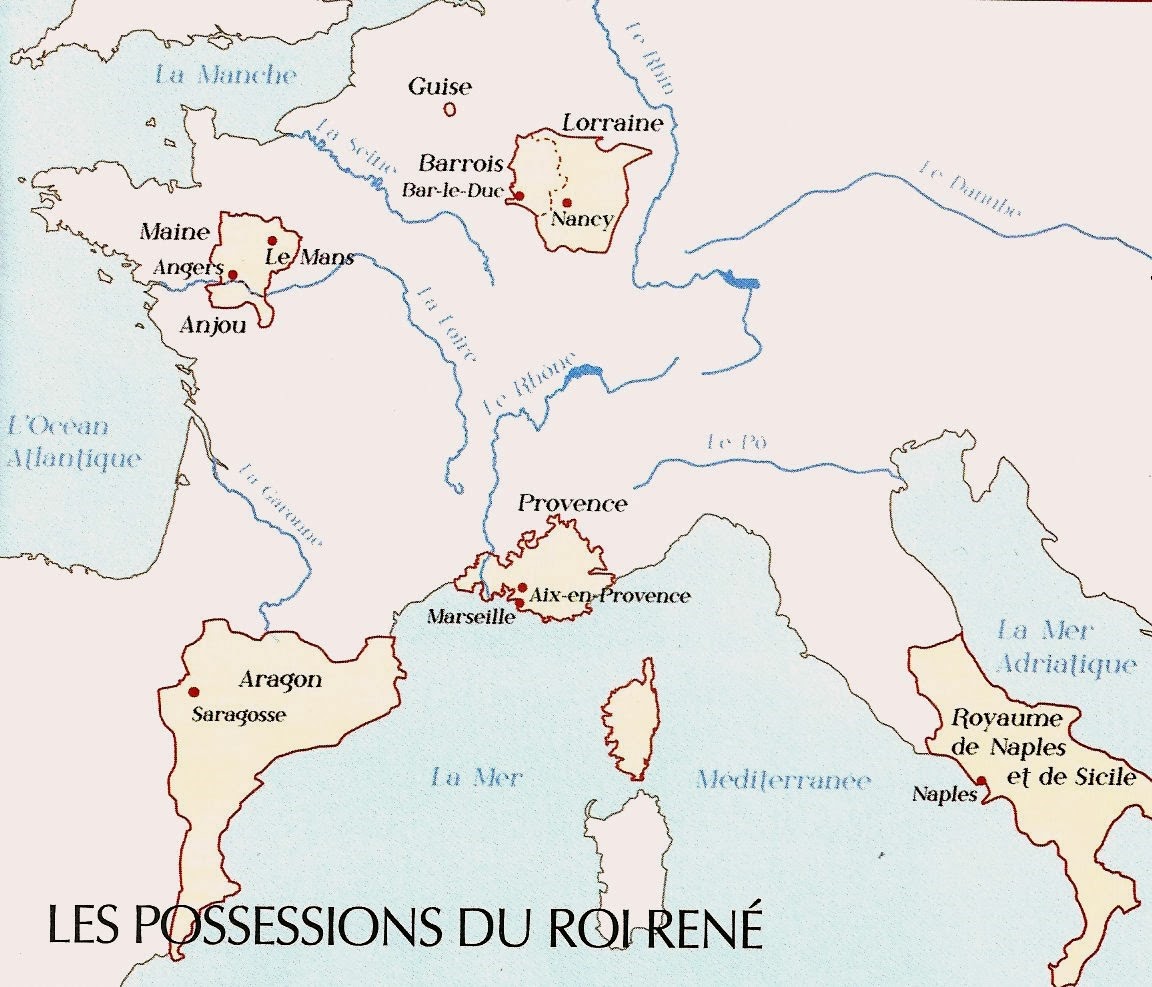
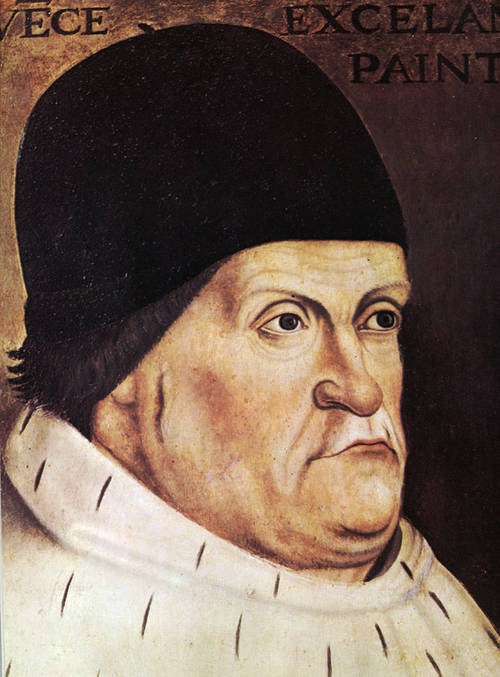
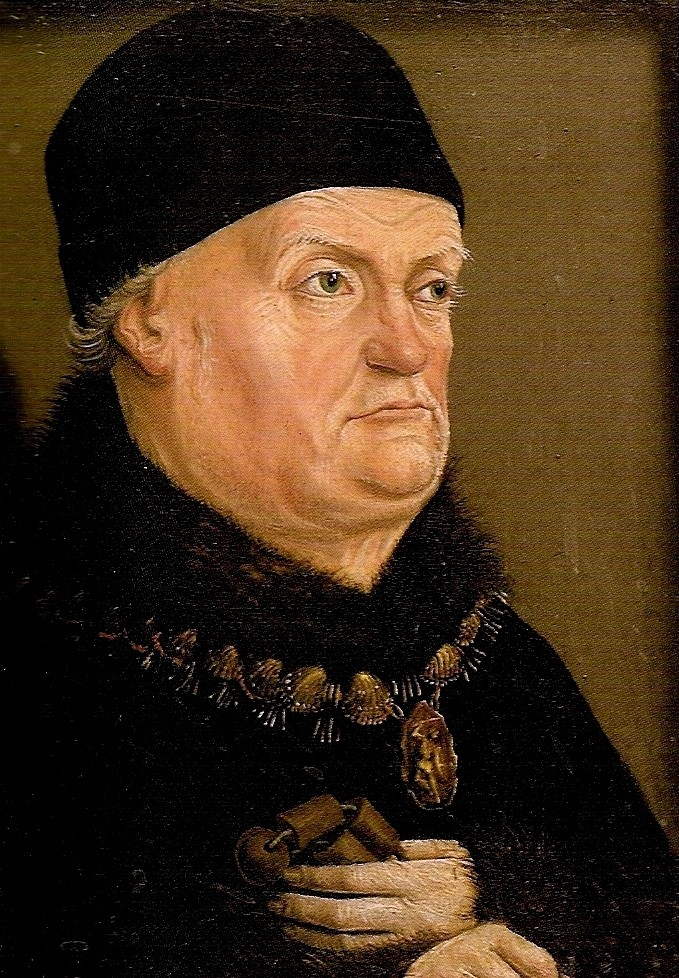
René I of Naples, or René of Anjou, or again René of Sicily, nicknamed by his Provençal subjects the «Good King René», born in 1409, is the second son of Louis II of Anjou and Yolande of Aragon. On the death of his father (1417), he receives the land of Guise, which is raised to a county by his brother-in-law, the future Charles VII. The House of Anjou supports the dauphin, and the Duke of Bedford, regent in the name of the King of England Henry VI, confiscates their possessions north of the Loire and grants Guise to John of Luxembourg, who takes Guise in 1425. René of Anjou becomes Duke consort of Lorraine in 1431 through his marriage to Isabella, daughter of Charles II of Lorraine. The marriage dates from 1420, and on that occasion Duke Louis of Bar had ceded him his duchy.
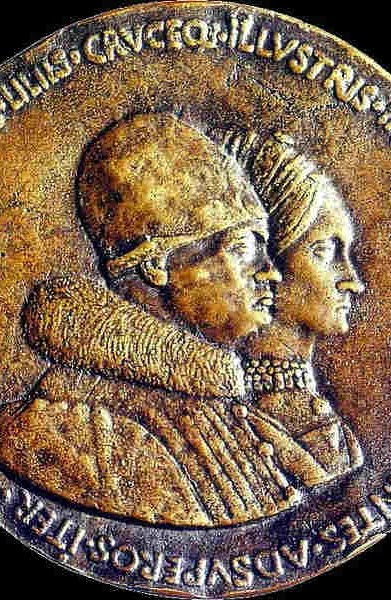
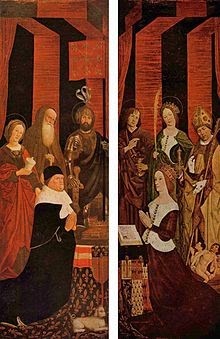
The Duchy of Lorraine, inherited from his father-in-law, was contested by Antoine of Vaudémont, supported by the Burgundian party, who defeated him in 1431 (battle of Bulgnéville). René the Good was taken prisoner by Philip III, Duke of Burgundy, called Philip the Good, who freed him only in exchange for his sons John and Louis. Supported by the Emperor Sigismund of Luxembourg in his claims to the Duchy of Lorraine, he was imprisoned once again by Philip the Good, then released for a ransom. He inherited the Kingdom of Naples in 1435 by the will of Joanna II, Queen of Naples, and fought, from 1438 to 1442, without success, against Alfonso V of Aragon to assert his rights. He returned to France in 1442, keeping of the Kingdom of Naples only the title of King of Jerusalem and of Sicily. In 1453, on the death of Isabella I of Lorraine his wife, René transmitted the Duchy of Lorraine to his son John II, Duke of Calabria, and remarried the following year with Jeanne de Laval.
During the Hundred Years' War, he supports Charles VII against the English. (Charles VII had married his sister Marie.) Faithful among the faithful, he attends the coronation at Reims in 1429.
René I died at Aix-en-Provence on 10 July 1480. The Provençals wished to keep the remains of the Good King René in their Provençal lands, but the Angevins did not see it that way. The latter organised, by night, the flight of the deceased by concealing him in a barrel. Once placed on a boat, it slipped away discreetly down the Rhône. The body of King René reached Anjou and was buried with honour and devotion in the cathedral of Angers.
Anjou thenceforth ceased to be an appanage and entered definitively into the royal domain. The Duchy of Bar passes to his daughter Yolande (already Duchess of Lorraine since 1473), the counties of Provence and Forcalquier pass to his nephew Charles (already Count of Maine since 1473), while the Duchy of Anjou is seized by Louis XI.
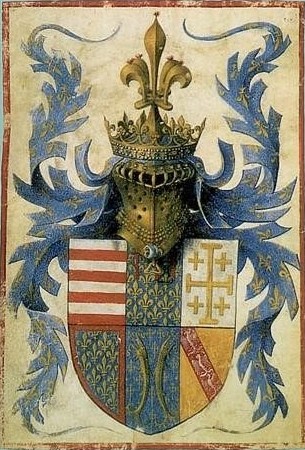
The arms of René of Anjou evolved over time according to his fortunes and misfortunes, as well as his claims.
In 1420, he marries Isabella I of Lorraine, heiress of the Duchy of Lorraine, and his uncle the Duke of Bar designates him as his successor: he adopts a quartering of Anjou and the Barrois and places Lorraine in the heart.
Quarterly, in 1 and 4 azure semé of fleurs-de-lis or and a bordure gules, in 2 and 3 azure semé of crosslets or and two barbels or. Overall, or a bend gules charged with three alérions argent.
In 1434, his brother Louis III dies, followed in 1435 by Queen Joanna II of Naples, who had designated him as heir. René then takes up their claims for himself: his shield is divided into 6 parts, each corresponding to Hungary, Sicily, Jerusalem, Anjou, Bar and Lorraine.
Per fess and tierced in pale, in 1 barry gules and argent, in 2 azure semé of fleurs-de-lis or and a label gules, in 3 argent a cross potent or cantoned with four crosslets of the same, in 4 azure semé of fleurs-de-lis or and a bordure gules, in 5 azure semé of crosslets or and two barbels or, and in 6 or a bend gules charged with three alérions argent.
In 1443, his mother Yolande of Aragon dies, bequeathing him her claims to the Kingdom of Aragon. She was the only daughter of King John I of Aragon, but the throne had passed to his younger brother, then to the son of one of John I's sisters. Yolande had then claimed the throne, without success. René then added the arms of Aragon to his blazon.
Per fess and tierced in pale, in 1 barry gules and argent, in 2 azure semé of fleurs-de-lis or and a label gules, in 3 argent a cross potent or cantoned with four crosslets of the same, in 4 azure semé of fleurs-de-lis or and a bordure gules, in 5 azure semé of crosslets or and two barbels or, and in 6 or a bend gules charged with three alérions argent. Overall, or four pallets gules.
In 1453, Isabella of Lorraine dies, and it is their son John II of Lorraine who becomes duke. René then removes Lorraine from his blazon.
Per fess, the chief tierced in pale, in 1 barry gules and argent, in 2 azure semé of fleurs-de-lis or and a label gules, in 3 argent a cross potent or cantoned with four crosslets of the same, and the base party of azure semé of fleurs-de-lis or and a bordure gules, and azure semé of crosslets or and two barbels or. Overall, or four pallets gules.
Finally, in 1470, he renounces Aragon after the death of his son John II of Lorraine, who was attempting its conquest. Moreover, the lilies of France were simplified in the fifteenth century and reduced to three fleurs-de-lis or, which was applied to Anjou but not to Naples. The shield was reorganised, with a quartering per saltire.
Quarterly per saltire, in 1 azure semé of fleurs-de-lis or and a label gules, in 2 barry gules and argent, in 3 argent a cross potent or cantoned with four crosslets of the same, in 4 azure semé of crosslets or and two barbels or. Overall, azure three fleurs-de-lis or and a bordure gules.
The line down to the family.
- ★René I of Anjou, «the Good King René»b. 1409, † 1480 · Lord then Count of Guise 1417–1425, Duke of Bar 1430–1480, Duke of Lorraine 1431–1453, King of Naples 1435–1442, Duke of Anjou 1434–1480, Count of Provence and Forcalquier 1434–1480, titular King of Jerusalem 1435–1480 and of Aragon 1466–1480& 1420Yolande of Lorraine, b. 1400, † 1453 · Duchess of Lorraine and of Bar
- 2Yolande of Anjoub. 1428, † 1483 · Heiress Duchess of Lorraine and of Bar& 1444Ferry VI of Vaudémont, b. 1417, † 1470 · Count of Vaudémont, Count of Guise
- 3Marie Marguerite of Vaudémontb. 1463, † 1521 · of the Counts of Vaudémont and Counts of Guise& 1488René of Alençon (Valois), b. 1454, † 1492 · 3rd Duke of Alençon
- 4Anne of Alençon (Valois)b. 1492, † 1562 · of the Dukes of Alençon& 1508William VIII Palaiologos, b. 1493, † 1518 · 23rd Marquess of Montferrat
- 5Margherita Palaiologosb. 1510, † 1566 · Marchioness of Montferrat& 1531Federico II Gonzaga, b. 1500, † 1540 · 1st Duke of Mantua, Marquess of Montferrat
- 6Isabella Gonzagab. 1537, † 1579 · of the Dukes of Mantua& 1566Ferrante Francesco II d'Avalos, b. 1531, † 1571 · 2nd Prince of Francavilla, 2nd Prince of Montesarchio, 3rd Marquess of Vasto, 4th Marquess of Pescara
- 7Alfonso II d'Avalosb. 1564, † 1593 · 3rd Prince of Francavilla, 3rd Prince of Montesarchio, 4th Marquess of Vasto, 5th Marquess of Pescara& 1583Lavinia Feltria della Rovere, b. 1558, † 1632 · of the Dukes of Urbino
- 8Isabella d'Avalosb. 1585, † 1648 · 4th Princess of Francavilla, 5th Marchioness of Vasto, 6th Marchioness of Pescara& 1597Iñigo III d'Avalos, b. 1578, † 1632 · 4th Prince of Francavilla
- 9Francesca d'Avalos† 1676 · of the Princes of Francavilla& 1618Marino II Caracciolo Rosso, b. 1586, † 1630 · 3rd Prince of Avellino, 4th Duke of Atripalda
- 10Francesco Marino I Caracciolo Rossob. 1631, † 1674 · 4th Prince of Avellino, 5th Duke of Atripalda& 1666Girolama Pignatelli, b. 1644, † 1711 · of the Princes of Noja and Dukes of Monteleone
- 11Giovanna Caracciolo Rossob. 1672 · of the Princes of Avellino and Dukes of Atripalda& 1690Nicola d'Avalos, b. c. 1665, † 1729 · 6th Prince of Montesarchio, 3rd Prince of Troia
- 12Diego I d'Avalosb. 1697, † 1764 · 9th Prince of Francavilla, 8th Prince of Montesarchio, 5th Prince of Troia& 1736Eleonora d'Acquaviva d'Aragona, † 1760 · of the Dukes of Nardò
- 13Maria Luisa d'Avalosb. 1748, † 1781 · of the Princes of Francavilla, Montesarchio and Troia& 1772Giovanni Battista III Pignatelli, b. 1740, † 1805 · 2nd Prince of Moliterno, 4th Prince of Marsiconovo, 6th Prince of Montecorvino
- 14b. 1775, † 1818 · Princess of Marsiconovo and of Moliterno (heiress)& 1796Giuseppe Gerardo Gallone, b. 1766, † 1806 · 6th Prince of Tricase
- 15Giovanni Battista Galloneb. 1800, † 1868 · 7th Prince of Tricase, 6th Prince of Marsiconovo, 5th Prince of Moliterno& 1818Maria Felicia Statella, b. 1801, † 1846 · of the Princes of Cassaro
- 16b. 1819, † 1898 · 8th Prince of Tricase, 7th Prince of Marsiconovo, 6th Prince of Moliterno& 1847Antonietta Melodia, b. 1829, † 1924 · of the Barons of San Pietro in Melicozza
- 17Pietro Giovanni Battista Galloneb. 1855, † 1931 · 9th Prince of Tricase, 8th Prince of Marsiconovo, 7th Prince of Moliterno& 1925Giuseppina Moncada, b. 1860, † 1946 · of the Princes of Paternò
- 18b. 1895, † 1982 · 10th Princess of Tricase, 8th Princess of Moliterno& 1915Augusto III della Posta, b. 1890, † 1970 · 7th Duke of Civitella Alfedena
- 19Simonetta della Postab. 1916, † 1986 · of the Dukes of Civitella Alfedena& 1939Aldo Guerri dall'Oro, b. 1913, † 2004 · Count Guerri dall'Oro
- 20b. 1941, † 2019 · Count Guerri dall'Oro, 11th Prince of Tricase, 8th Prince of Moliterno& 1971Jeanine Schneider, b. 1945
- 21b. 1985 · Count Guerri dall'Oro, 12th Prince of Tricase, 9th Prince of Moliterno& 2017Coline Morel, b. 1986
- 22Léon Guerri dall'Oro Galloneb. 2018 · Count Guerri dall'Oro, 13th Prince of Tricase, 10th Prince of Moliterno
Timeline
Famous descent
Gallery.