— immagine da inserire —
Spouse of the 6th Prince of Tricase
 House of Pignatelli Princes of Moliterno and Marsiconovo
 Personage · House of Pignatelli · Confluence of the Gallone
Maria Emanuela Pignatelli.
Princess of Moliterno and Marsiconovo, 1775 – 1818.
In 1796 she marries Giuseppe Gerardo Gallone, 6th Prince of Tricase: from her inheritance the Principalities of Moliterno and Marsiconovo pass to the House of Gallone, devolved in 1848 to her son Giovanni Battista. Died in Naples in 1818.
Biography.
Maria Emanuela Pignatelli is born on 21 April 1775 to Giovanni Battista, prince of Moliterno and of Marsiconovo, ambassador of Naples to the court of France, and to Luisa d'Avalos, of the princes of Aquino d'Aragona — one of the most powerful and prestigious families of the Kingdom of Naples.
In 1796 she marries the prince of Tricase, Giuseppe Gerardo Gallone (1766–1806), and from their marriage are born five children: four daughters (Beatrice, Maria Luisa, Brigida and Michela) and the only son, Giovanni Battista (1800–1868), heir of the house.
Her brother Girolamo III Pignatelli (1773–1848), 3rd Prince of Moliterno and 5th of Marsiconovo, a politically controversial figure and by then financially ruined, ceded the titles and the fiefs to his sister Maria Emanuela, while remaining prince in fact until his death, in 1848. Through her marriage to Giuseppe Gerardo Gallone, 6th Prince of Tricase, the Principalities of Moliterno and Marsiconovo thus flow into the House of Gallone — and it is from 1848 that Tricase is also Principality of Moliterno.
The inheritance then passes to the only son Giovanni Battista Gallone (1800–1868), 7th Prince, and then to the grandson Giuseppe Gallone (1819–1898), 8th Prince and Senator of the Kingdom of Italy. The direct descent will close with Maria Bianca Gallone, so that the titles will pass at last to the Guerri dall'Oro (cf. Decree of 21 January 1999).
It took eight days, in September 1817, for the Princess of Tricase, widow of Prince Giuseppe Gerardo Gallone, to travel home at summer's end from Tricase to Naples, where she resided. The note published by D. Lala De Giorgi in his L'Archivio dei Principi Gallone (Tricase 2001, p. 277) reveals how the nobility travelled in the early nineteenth century. The papers of the feudal family of Tricase were donated to the State Archives of Genoa in 1965 by Lady Simonetta della Posta (1916–1986), of the Dukes of Civitella Alfedena, only daughter of Princess Maria Bianca Gallone; in 1979 the collection was transferred to the State Archives of Lecce, while other papers are kept in Angers, where Simon Guerri dall'Oro resides.
In the carriage, with the princess, travelled the seventeen-year-old young prince Giovanni Battista (1800–1868) and Domenico Risolo, "agent" of the House, besides a maidservant and the groom Vincenzo Longo. The overnight stops: Fasano, Bari, Barletta, Cerignola, Bovino in Apulia; Ariano Irpino, Mirabella, Avellino in Campania. The meals were prepared by the personal cook; among the extra expenses, besides the ice cream for the young prince and the "amber tincture", the "cassette di S. Nicola" — the phials of the "manna of St Nicholas" bought at Bari.
The personal cook, the amber and the manna suggest a delicate, apprehensive princess of frail health, for whom the medicine of the time prescribed amber derivatives as a restorative (N. Cirillo, I Consulti Medici, Vol. I, Naples 1738, p. 325). One notes too the tips, the "good hand" to the gatekeeper of Barletta who by night "opened the city gates" and to the gendarmes, in an age when moving about was dangerous because of brigands and uncomfortable owing to the state of the roads. The total cost of the journey, including the return of the mules as far as Lecce, was 268.60 ducats. (Published in "Il gallo", no. 19/2021, p. 22 — Ercole Morciano.)
The life of Maria Emanuela was troubled, though comfortable, for the Gallone family was still among the most considerable of the Kingdom. Her daughters died in infancy or early youth; she witnessed the revolution of 1799, in which the enraged mob killed several nobles; she saw the royal family forced to flee to Sicily twice; under the Napoleonids she endured, between 1806 and 1808, the laws abolishing feudalism. Some positive note was not lacking: the purchase in her name of the hamlet of Teverolaccio (Succivo, Caserta) — the "Murattian" Land Register of 1815 records the "Princess of Tricase" as the foremost taxpayer of the municipality of Succivo, with a rendita of 3,178 ducats, ahead of Prince Francesco Paolo of Bourbon and the Mensa Vescovile of Aversa (cf. L. Russo, "Succivo nel Catasto Provvisorio", 2007).
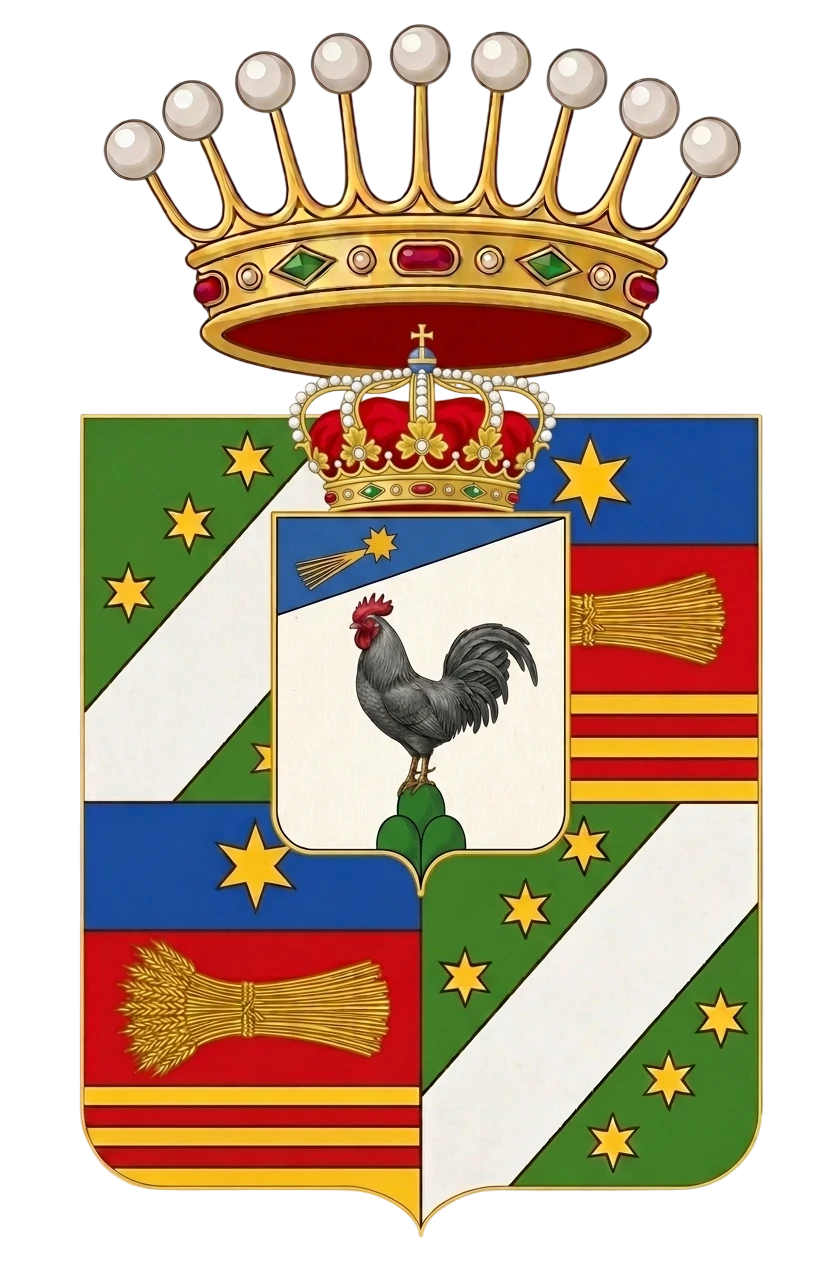
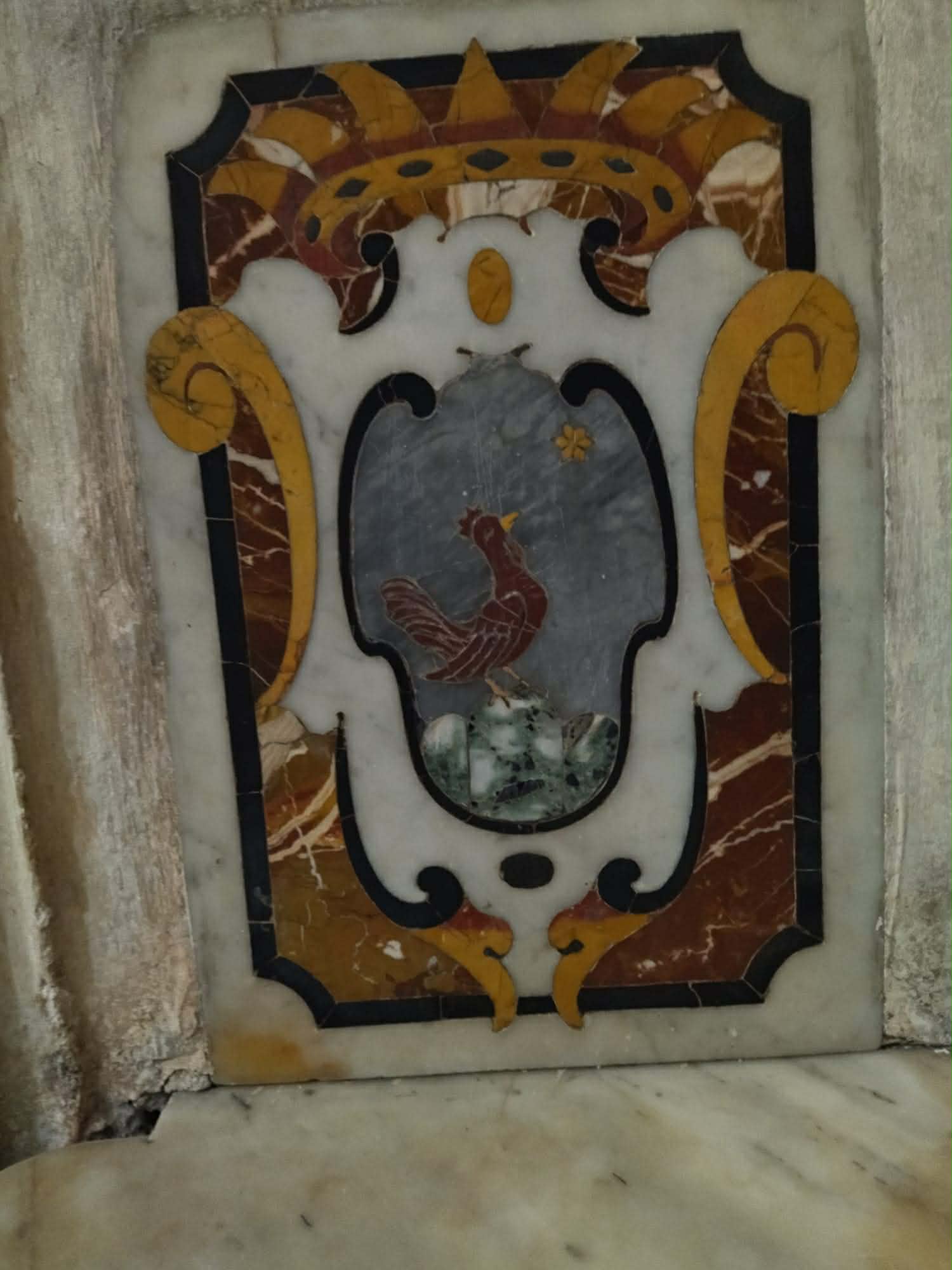
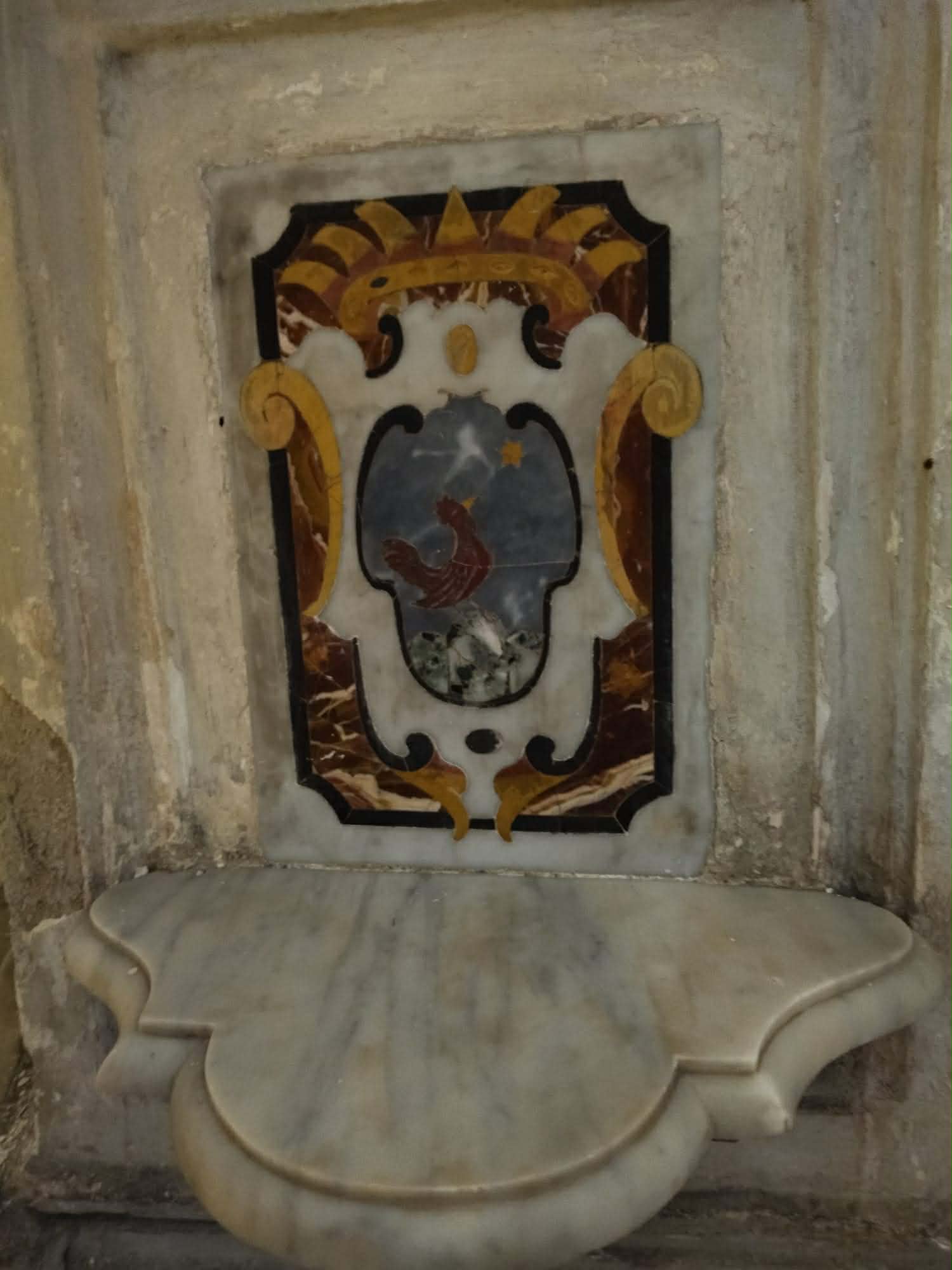
Widowed at about 31 in 1806 — her husband was forty — that same year her last-born Brigida died at about one year of age. Perhaps all these worries shortened her life: she died at 42 on 23 March 1818, in the Neapolitan villa of S. Maria degli Angeli, and was buried in the chapel of the Immaculate, under Gallone juspatronage, in the basilica of S. Pietro ad Aram, where the husband and the daughters lay and where a marble epitaph to her was later removed and left mutilated. At Tricase a memory survives in the two altars of the transept of the mother church, formerly under Gallone patronage and dedicated to the Virgin of Constantinople and to Saint Charles Borromeo, with the impaled Gallone-Pignatelli coat of arms in inlay of polychrome marbles.
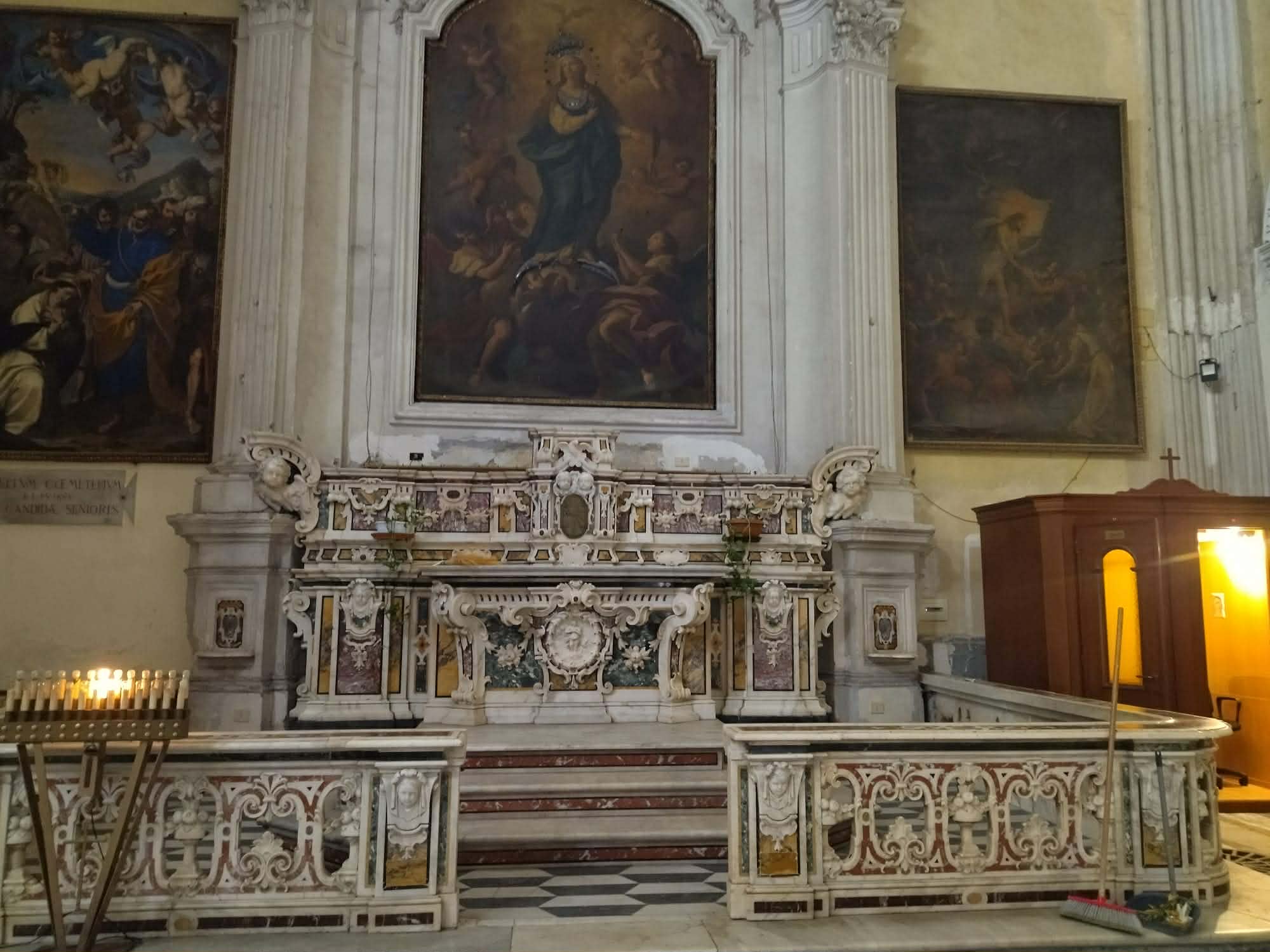
In the basilica of San Pietro ad Aram, one of the oldest churches in Naples, the Gallone family retains the right of patronage over a side altar, in inlaid polychrome marble, bearing the Gallone arms: a crowned cock, gules on a field azure, surmounted by a six-pointed star or and set upon a mount vert, framed by a baroque cartouche in yellow and red breccia marble. A holy-water stoup bearing the same arms accompanies the altar.
Altar patronage was a privilege of the most established noble families: for the Gallone it coincides with their Neapolitan rooting, intense from the time of Stefano II Gallone (1st Prince, 1601–1662), who maintained mercantile agencies there, and still more under Stefano III (3rd Prince, 1666–1733), who resided there from 1681 to 1703. The presence of Maria Emanuela in Naples — already the seat of her Pignatelli — perpetuates this patronage through the marriage of 1796: the two great Neapolitan branches converge in this place of worship, where the princess will be buried in 1818.
Family tree.
Gallery
The patronage altar at San Pietro ad Aram
Sources.
- 1 D. Lala De Giorgi, L'Archivio dei Principi Gallone. I documenti dello «stato» di Tricase, Tricase, Edizioni dell'Iride, 2001, p. 277.
- 2 E. Morciano, "Vestigia napoletane dei principi di Tricase", in Ne quid nimis. Studi in memoria di Giovanni Cosi, edited by M. Spedicato and L. Montonato, Edizioni Grifo, Lecce 2017, pp. 201–225.
- 3 E. Morciano, "Il viaggio della principessa di Tricase", in Il gallo, no. 19/2021, p. 22.
- 4 L. Russo, "Succivo nel Catasto Provvisorio", Rivista di Terra di Lavoro, State Archives of Caserta, 2007.
- 5 N. Cirillo, I Consulti Medici, Vol. I, Naples 1738, p. 325.