
Famous descent
Muhammad.
«THE PROPHET»
Muhammad is born in Mecca in 571. His father, ‘Abd Allah, dies a few weeks before his birth. At six he also lost his mother. Two years later the grandfather who had taken care of him died as well. The little Muhammad is taken in by his uncle, Abu Talib, a poor figure but much respected for his integrity and generosity. Mecca was a commercial, caravan centre, so Muhammad became a merchant and accom
History.
Muhammad is born in Mecca in 571. His father, ‘Abd Allah, dies a few weeks before his birth. At six he also lost his mother. Two years later the grandfather who had taken care of him died as well. The little Muhammad is taken in by his uncle, Abu Talib, a poor figure but much respected for his integrity and generosity. Mecca was a commercial, caravan centre, so Muhammad became a merchant and accompanied Abu Talib on his journeys to Syria and Palestine.
One day a merchant of Yemen had his merchandise taken from him by deceit by a group of Meccans. He then wrote a satirical poem and recited it in public so that all might hear it. The assembly of elders was convened and a chivalric order was instituted with the aim of protecting the oppressed of the city, whether inhabitants or visitors. The young Muhammad became an enthusiastic member of this organisation, which was called Hilf al-Fudul (591). Besides this, Muhammad often helped the inhabitants of Mecca to settle their disputes. Once the Kaaba caught fire and was completely destroyed by the fire. When it was rebuilt, all the clans of Mecca took part in its reconstruction, but when the time came to set the sacred black stone in the wall, a dispute arose among the chiefs: all claimed the honour of laying the stone. In the end they decided by common accord to choose an arbiter to settle the question. The young Muhammad was chosen. He spread a white cloth on the floor, placed the black stone at its centre and asked all the chiefs to take the cloth and carry the stone toward its place. There Muhammad set the stone in the wall (605). For his wisdom, integrity and honesty Muhammad was nicknamed al-amin «the trustworthy», «the reliable one».
One day, when Muhammad was 23 years old (594), his uncle Abu Talib sent him to lead into Syria a caravan of Khadijah, a rich widow. Muhammad's qualities aroused the admiration of Khadijah who, the following year, in 595, asked him to marry her and Muhammad accepted. The widow, in her forties, was 15 years older than him.
Muhammad spread his message, in secret, first among his intimate friends and then among the members of his clan. As the followers increased, he began to preach more freely in Mecca and in the neighbouring communities. But the Meccans did not accept the fact that anyone should attack their gods and their ancient beliefs. They thus set in motion a campaign of persecution against the Prophet and the small group of his followers. They forced the Muslims to lie down on the burning sand, placed enormous boulders on their chests and poured molten iron over them. Several of the first converts died, but none renounced the new faith. When the oppression became unbearable, Muhammad advised his faithful to leave Mecca for Abyssinia, which many did.
The Meccans tried to change tactics: did Muhammad perhaps want wealth or to become a chief? It was enough that he stop preaching. Muhammad answered firmly: «In the name of God, if they were to put the sun in my right hand and the moon in my left hand, I would not do it». Then the Meccans sought to remove from him the protection of Abu Talib and therefore of his clan. But Abu Talib refused to hand Muhammad over to the Meccans for them to kill him. The Meccan chiefs then decided to isolate Muhammad and his followers completely. No one was to speak or maintain business dealings with them. Even the tribes that lived around Mecca joined the boycott.
During this hard period two grave losses struck Muhammad: in 619 died Abu Talib, the uncle who had always protected him, and his much-beloved wife Khadijah. These events deprived Muhammad of fundamental supports, practical and emotional. But in 620 God granted Muhammad an exceptional experience: a meeting with God. The mystical «night journey» from Mecca to Jerusalem, followed by the ascension to heaven. Escorted by his celestial guide, Gabriel, Muhammad ascended one by one the seven heavens, meeting the principal prophets who had preceded him: Moses, Jesus, Abraham and Adam, who for Islam is the first prophet. Beyond the seventh heaven Muhammad passed the veils that cover what is hidden and saw what is neither expressible nor imaginable. From this journey Muhammad brought back the institution of the five daily prayers. All this came about in an instant.
Thus the Quran recalls the event: «Glory to him who by night transported his servant from the Sacred Temple to the most remote Temple, whose precinct we have blessed, to show him some of our signs. […] he drew near and remained suspended, he drew near to two bow-shots or closer still and revealed to his servant what he revealed to him. […] His gaze did not deviate nor turn elsewhere, and certainly he saw the greatest sign of his Lord» (XVII, 1/LIII, 8-18).
In 622 some converts of Yathrib, Medina, an important centre about three hundred kilometres from Mecca, offered Muhammad and his people to move to their city. Given the intolerable nature of the situation in Mecca, Muhammad accepted. Meanwhile the Meccans had decided to kill him. On the appointed day they entered his house with the intention of stabbing him in his sleep. But Muhammad had just left for Medina and, in his bed, to deceive the Meccans, Ali had lain down. A group of Meccans gave chase. Muhammad and Abu Bakr hid in a cave and afterward reached Medina safe and sound.
This emigration, the Hegira, marks the beginning of the Muslim calendar, which is a lunar calendar, based exclusively on the lunar phases. The Muslim year takes no account of seasonal changes. It is 11 days shorter than ours and consequently crosses all the solar seasons every thirty-two and a half years. Thus if the month of fasting, Ramadan, falls in high summer in one year, after thirty-two and a half years it will fall in the cold season. In Medina Muhammad instituted a city-state to which he gave the first known written constitution. In addition Muhammad also established accords and alliances with the communities that lived around the city.
The Meccans did not welcome this situation, for Muhammad and his Medinan community constituted a pole of attraction for the Meccans who wished to convert to Islam, and thus in 624, after meticulous preparation, an army of a thousand perfectly armed warriors, many of them on horseback, marched from Mecca on Medina. Muhammad decided to confront the enemy army outside the city, in the plain of Badr. 313 Muslims, poorly equipped, with two horses and seventy camels, clashed with the Meccans and, after a bloody and brief battle, the Meccans were defeated, leaving on the field seventy dead and seventy prisoners, besides a great part of their equipment. A few days after the battle Muhammad released the captured prisoners. The defeat of Badr increased among the Meccans the hatred for Muhammad and the Muslim community.
The following year they marched again against Medina, three thousand well armed. To confront them there were this time seven hundred Muslims at the slopes of Mount Uhud. This battle too was brief and bloody. The Meccan lines were broken and the combatants repulsed. A group of Muslim archers that was on the summit of Mount Uhud with the order not to move, seeing a victory take shape, abandoned the position. This allowed the Meccans to re-form the ranks and attack again. Thus a certain victory was transformed into a partial defeat. Seventy Muslims were killed and Muhammad himself was wounded, but the Meccan army was nonetheless halted at the foot of the height. At that point the Meccans decided to withdraw, promising to return the following year.
The year 626 was spent by the Meccans in the preparations for a great campaign that would lead to the definitive destruction of the Muslims. To this end they allied themselves with various tribes, including Jewish ones, settled around Medina and put together a powerful army of ten thousand allies. Muhammad summoned his companions to council to decide which strategy to follow and, on the advice of Salman al-Farsi, a Persian converted to Islam, they decided to defend the city by digging a ditch all around. For twenty days and twenty nights all the Muslims, including Muhammad himself, worked hard to surround the city with an immense ditch. The Meccan army remained bewildered before the ditch, for such a thing had never been seen in Arabia, and after thirty days and thirty nights of fruitless assaults they withdrew. Finally in 628 Muhammad convinced the Meccans to conclude a pact: the treaty of Hudaybiyyah. At this point Muhammad devoted himself more and more to spreading Islam, sending emissaries to the rulers of the neighbouring countries. Many of these emissaries were killed.
Meanwhile, despite the truce, the Meccans several times attacked the Muslims and raided their caravans. Thus in 630 Muhammad sent an ultimatum to the people of Mecca: either you respect the treaty concluded between us, or you consider it definitively void. The Meccans chose the second hypothesis and thus Muhammad, with an army of ten thousand Muslims, presented himself at the gates of Mecca. The frightened Meccans surrendered. Contrary to what all expected, Muhammad asked the chiefs of Mecca «What do you expect from me?». They did not answer and Muhammad said: «May God forgive you. Go in peace. To you I say what Joseph said to his brothers: today no responsibility will fall upon you. You are free».
In 631, after accomplishing his pilgrimage to Mecca, Muhammad gave his «farewell speech» to the 124,000 Muslims who had gathered in the valley of ‘Arafat: «I do not know whether, after this year, I shall still be among you. O people, just as you now consider sacred this month, this day, this city, in the same way you must consider as a sacred trust the life and property of every Muslim. Return the goods entrusted to you to their legitimate owners. Do no harm to anyone, so that no one may do harm to you. […] Help the poor and clothe them as you would clothe yourself. Remember! One day you will appear before God and you will have to answer for your deeds. So: beware! Do not stray from the path of righteousness, when I have gone. O people, no prophet nor apostle will come after me and no new faiths will be born […] It is true that you have certain rights regarding your women, but they too have rights over you. Treat them well, for they are your support. […] I leave two things behind me: the Quran and my example, and if you follow these two guides you will not fall into error. […] Worship God, recite your prayers, fast during the month of Ramadan and distribute your riches charitably. All believers are brothers, all have the same rights and the same responsibilities. To no one is it permitted to take from another what the latter does not offer him spontaneously. No one is superior to another except in virtue». At that point Muhammad turned toward heaven and said: «Be my witness, O God, that I have carried your message to my people». And the whole valley answered «In truth you have done so, my lord».
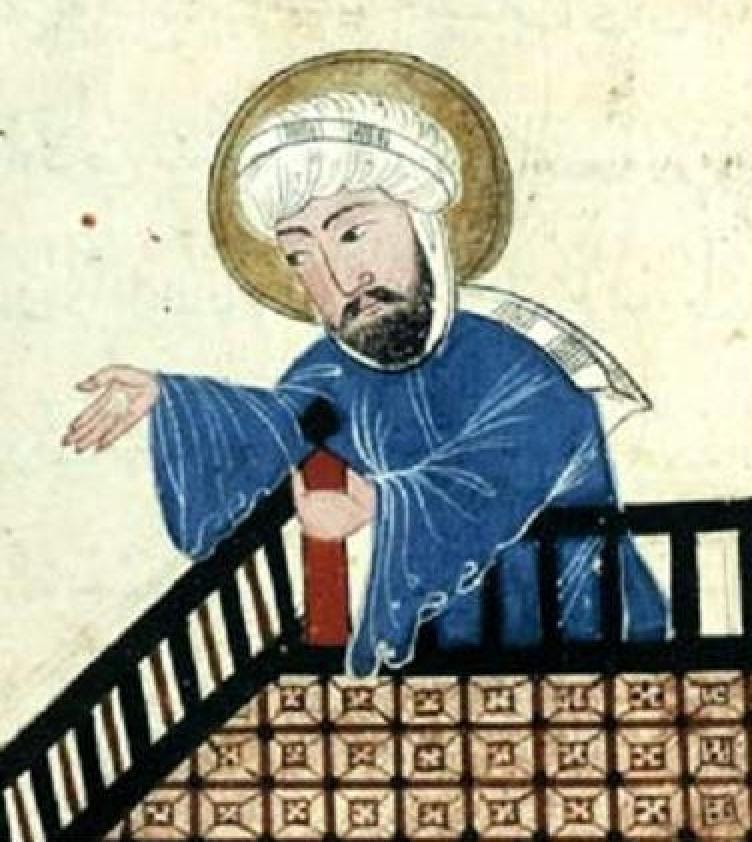
A few months after his last speech, Muhammad fell ill and in 632, at 61, died. The Muslim community and even the companions closest to Muhammad refused to acknowledge the death of the Prophet. Then Abu Bakr, one of the first and most faithful companions of Muhammad, as well as his father-in-law, came out of Muhammad's dwelling, climbed the steps of the mosque and said to the crowd «O people, in truth, whoever worships Muhammad, let him know that Muhammad is dead. But whoever worships God, let him know that God is ever living».
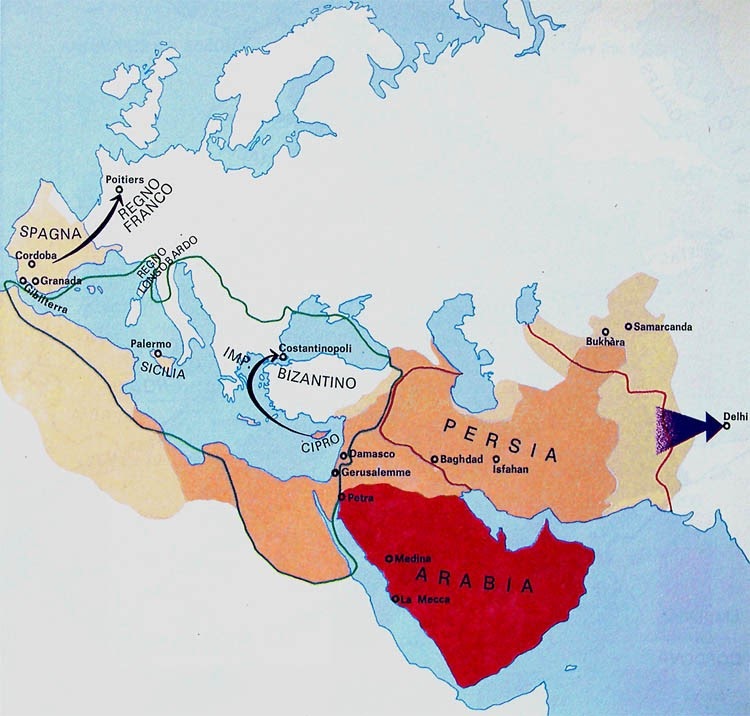
The successive stages of the Arab advance, in red up to the death of Muhammad (632), in orange during the age of the elective caliphs (632-661), in yellow under the dynasties of the Umayyads and the Abbasids. The green line indicates the limits of the Eastern Roman Empire when Islam began to expand out of Arabia, the red line the limits of the Persian Empire, then ruled by the Sasanids. The arrows turned toward Poitiers and Constantinople mark the moment (between 718 and 732) when Christendom seemed on the point of being overwhelmed. The largest arrow on the right indicates the direction toward which the Islamic world spread with new impetus after the advent of the Turks, turning above all toward Asia (1193).
Banu Quraysh (literally The sons of Quraysh), or simply Quraysh, is the name adopted by the Arab tribe settled in Mecca in the seventh century AD. The origins of the tribe are not known. The name Quraysh does not help us because it is not able to identify a real eponym, even if it will later be asserted that Quraysh was the nickname of a phantom Fihr. Another hypothesis speaks of a calling-together of heterogeneous elements pertaining to the lineage probably of the Kinâna, settled in the Hijāz. The merit of such a tribal constitution would be attributable to Qusayy, a figure of whom it seems more probable to trace a real existence. Nor is it known whether the Quraysh were of southern Arabian «Qahtanid» provenance (from the biblical Qahtan), or whether they were to be referred to that vast assemblage of Adnanid lineages (from the biblical Adnan), marked by nomadism and settled in the northern peninsular areas, which claimed a greater «nobility» compared with the southern lineages.
At an imprecise epoch, Mecca would have belonged to the Banu Jurhum. In their turn the Banu Jurhum would have had to accept the predominance of the Banu Khuzâ'a, subjugated later by the lineage of the Kinâna to which, as said, the Qurayshites perhaps belonged. In the pre-Islamic period the Qurayshites would have drawn great advantages from the management of the urban sanctuary of the Ka'ba, normally dedicated to the oracular divinity of Hubal but soon opened to the cult of the many other divinities venerated throughout the Arabian Peninsula. The specific activity of the Qurayshites was the caravan trade that linked, passing through Mecca, the Mediterranean coasts to the south of Arabia, and this thanks to the good warlike capacity of the tribe which, later, will have occasion to express itself amply in the Islamic age. Like every other tribe, the Quraysh were articulated into clans, lineages and nuclear families. At the time of the Prophet Muhammad, the principal and most powerful clans were the Banu Makhzūm and the Banu Abd Shams, but each clan had its visibility and enjoyed great respect.
The name of the Prophet
The Muhammadan descent is the census of the dynasties and families that claim to have Muhammad in their ancestry.
Certain Muslim authors deny that Muhammad had any descent, other than spiritual. But there exist numerous biographies of Muhammad, written by Muslim and non-Muslim historians, and in great majority it is said that only the daughter of Muhammad, Fatima Al Zahra, married to Ali, cousin of Muhammad, left two sons with a perfectly known descent, Al Husayn (whence the Husaynid Alids) and Al Hasan (whence the Hasanid Alids).
The term «sayyid» has been used to designate one who belongs to the family of the Prophet (the Ahl al-Bayt). In particular it is used to identify the male and female descent of Ali and Fatima.
In the Arab world, generally, the Hasanid Alids are called «sharifs». The Hasanid Alids constitute the totality of the «sayyids» of northern Africa and the great majority of those of the Hejaz; the Husaynid Alids the totality of those of Yemen and of the Hadhramaut, and of the Shiite «sayyids». In Morocco, the Idrissid, Saadian and Alawite dynasties are called sharifian. The Hashemite dynasty, an ancient sharifian dynasty of Mecca, in the Hejaz, is the former reigning dynasty in Iraq and in Syria and the present reigning dynasty in Jordan. The descendants of these lineages would have preserved their genealogical tree, learned by heart and transmitted from one generation to another.
As regards the western dynasties, the most probable descent from Muhammad passes through Zayda of the Abbadids (Banu Abbad), (b. c. 1063, † 1107). According to Iberian sources, Muslim and Christian, Zayda was the daughter of Mohammed III «Al Mutamid» «Benqbet», 3rd Emir of Seville (Taifa). After the taking of Seville, Zayda takes refuge with the King of Castile, Alfonso VI, whose mistress and then wife she becomes, and converts to Catholicism under the name of Isabella.
Other sources, Muslim, say that Zayda was the wife, then the widow, of the son of Mohammed III «Al Mutamid», but the true reason for the concealment of Zayda's origins is that a Muslim cleric, Al Tartushi, dictated a «fatwa» (Islamic opinion) so that the name of «Al Mutamid» should not be connected to the conversion of Zayda and to her marriage with a Christian!
Zayda was interred in the monastery of Sahagún, with the inscription: «H.R. Regina Elisabeth, uxor regis Adefonsi, filia Benabet Regis Sevillae, quae prius Zayda, fuit vocata». The tomb was then transferred to León, where the sepulchre and the inscription are still visible.
The connection between Muhammad «the Prophet» and Zayda of the Abbadids (Banu Abbad) is made either through the Hasanid Alids or through the Husaynid Alids (cf. Descents A and B).
There also exists the possibility, less plausible, of a Husaynid Alid descent that would lead to Ishar, supposed daughter of the 10th Shiite Imam of Iraq, Ali ibn Muhammad «Al Hadi», who would have married Muhammad I of the Umayyads, 5th Emir of Cordoba, from whom descends Zayra of the Umayyads who marries Lovesendo Ramirez «El cid de Leon», of the Kings of León. But Ishar is probably a slave! (cf. Descent C).
There remains one last possibility, which makes Lovesendo Ramirez, «El Cid de Leon», descend from Muhammad through the Moroccan Idrissid dynasty. In most of the usual genealogies, Lovesendo Ramirez turns out to be a natural son of Ramiro II King of León and of Ortiga of the Lords of Monterroso. Other versions say he is the son of Ramiro II and of Adosinda Gutierrez Osorio. But Lovesendo could also be the son of a first husband of Adosinda, the Idrissid Fethe (Fehr) Fikhri, then adopted by Ramiro II. (cf. Descent D).
Other hypotheses have been made, even less probable, all relating to the Umayyads, Caliphs of Damascus and then of Cordoba:
Descent from Kuttum Umm Kashim, daughter of Muhammad «the Prophet» and of Khadija, who would have married Yazid I of the Umayyads, 2nd Caliph of Damascus. But the existence of Kuttum Umm Kashim is more than doubtful! Descent from Ruqayyah, daughter of Muhammad «the Prophet» and of Khadija, married to Othman of the Umayyads, 3rd historical Caliph, and who would have had a daughter, Aisha, married to Marwan I of the Umayyads, 4th Caliph of Damascus. But Aisha is probably the daughter of Othman and of Naylah Bint Fraizah! * Descent from Umm Kulthum, daughter of Muhammad «the Prophet» and of Khadija, and of her first husband, Utayba Ibn Abu Lahab, through their daughter, Ayyub, married to Abd Al Malik of the Umayyads, 11th Caliph of Damascus. But the existence of Ayyub is more than doubtful!
The chains of descent.
- 1Quraysh (Fihr) Ibn Malikof the Qurayshites&Layla
- 2Ghalib Ibn Qurayshof the Qurayshites&Atika
- 3Luayy Ibn Ghalibof the Qurayshites&Mawya
- 4Kab Ibn Luayyof the Qurayshites
- 5Murrah Ibn Kabb. 337 · of the Qurayshites&Hind
- 6Kilab Ibn Murrahb. c. 365, † c. 400 · of the Qurayshites&Fatima Bint Saad
- 7Qusayy Ibn Kilab Zayd «Mujammi»b. c. 400, † c. 440 · of the Qurayshites, Governor of Mecca&Hubba Bint Hulayl, b. c. 405 · of the Khuzaidites
- 8Abd Al Mujira Al Menâf Ibn Qusayyb. c. 430 · of the Qurayshites&Atika, b. c. 444 · of the Banu Qays Aylan
- 9Hamr Hashim Ibn Abd Menafof the Qurayshites&Salma Bint Adi, Al Khazraji
- 10Abd El Muttalib Ibn Hashimb. c. 497, † 579 · of the Qurayshites&Fatima (Selma) Bint Amr, of the Banu Makhzum
- 11Abd Allahb. c. 554, † 571 · of the Qurayshites&Amina Bint Wahb, b. c. 542, † 577 · of the Qurayshites (Zuhrah)
- ★Muhammadb. 570, † 632 · of the Qurayshites · «the Prophet», Founder of Islam
- ★Muhammadb. 570, † 632 · of the Qurayshites · «the Prophet», Founder of Islam&Khadija bint Khuwaylid, b. 566, † 619 · of the Qurayshites
- 2Fatima Al Zahra bint Muhammadb. 606, † 632 · of the Qurayshites& 624Ali ibn Abu Talib, b. 599, † 661 · of the Qurayshites · 4th historical Caliph 656–659 (dep.), 1st Imam (Shiites) 656–659
- 3Al Hasan I ibn Alib. 625, † 669 · of the Qurayshites (Alids) · 5th historical Caliph 661–661 (dep.), 2nd Imam (Shiites) 661–669&Umm Eshaq Bint Talha
- 4Al Husayn «Al-Athram» ibn Al Hasanof the Alids (Hasanids)
- 5Zohra «Al Lakhmi» bint Al Husaynb. c. 700 · of the Alids (Hasanids)&Abu Farisi ibn Abu Abed Al Hirah, of the Lakhmids
- 6Nahim I ibn Abu Farisi Al Lakhmiof the Lakhmids
- 7Nahim II ibn Nahim Al Lakhmiof the Lakhmids
- 8Itaf ibn Nahimof the Lakhmids
- 9Amr ibn Itafof the Lakhmids
- 10Aslan ibn Amrof the Lakhmids
- 11Amr ibn Aslanof the Lakhmids
- 12Abbad ibn Amrb. c. 894 · of the Lakhmids
- 13Qasim (Qarais) ibn Abbadb. c. 924 · of the Abbadids · Imam of Seville&Fatima bint Ismael Al Mansour, of the Fatimids, of the Caliphs of Ifriqiya
- 14Ismael ibn Qasimb. c. 954, † 1019 · of the Abbadids · Famous jurist, Imam of Seville, Qadi of Seville
- 15Mohammed I «Al Qadi»b. c. 984, † 1042 · of the Abbadids · 1st Emir of Seville (Taifa) 1023–1042
- 16Mohammed II «Al Mutadid»b. 1014, † 1069 · of the Abbadids · 2nd Emir of Seville (Taifa) 1042–1069&F of the Balearics, b. c. 1019 · of the Lords of the Balearics and of Denia
- 17Mohammed III «Al Mutamid», «Benqbet»b. 1040, † 1095 · of the Abbadids · 3rd Emir of Seville (Taifa) 1069–1091 (dep.)&Itamid
- 18Zayda (then Isabella)b. c. 1063, † 1107 · of the Abbadids, of the Emirs of Seville (Taifa)& 1096Alfonso VI «the Brave» of Castile, b. 1040, † 1109 · 3rd King of Castile 1072–1109
- 19Albiera (Elvira) of Castileb. 1102, † 1145 · of the Kings of Castile& 1140Roger II «the Young» of Hauteville, b. 1095, † 1154 · 3rd Count of Sicily 1105–1127, 4th Duke of Apulia and of Calabria 1127–1130, 1st King of Sicily 1130–1141
- 20Roger III of Hautevilleb. 1119, † 1149 · of the Kings of Sicily, 5th Duke of Apulia 1131–1149&Emma of Hauteville, Countess of Lecce
- 21Tancred of Hautevillenat. s., b. 1141, † 1194 · Count of Lecce, 4th King of Sicily 1190–1194& 1184Sibilla «di Medania» d'Aquino, b. c. 1146 · of the Counts of Acerra
- 22Albiera (Elvira) of Hauteville† 1231 · of the Kings of Sicily, Countess of Lecce&Tegrimo VI dei Conti Guidi, † c. 1234 · Count of Porciano, Count Palatine
- 23Guido dei Conti Guidib. 1221, † 1293 · Count of Modigliana, Count of Porciano& 1254Adalasia da Panigo, † 1294 · of the Counts da Panigo
- 24Corrado dei Conti Guidi† 1291 · of the Counts of Porciano, Count of Val d'Ambra&Bartolomea di Mangona, of the Counts of Mangona
- 25Amerigo dei Conti Guidi† 1300 · of the Counts of Porciano, Count of Val d'Ambra&Cantina
- 26Guido «Zeffiro» dei Conti Guidi† 1348 · of the Counts of Porciano, Count of Val d'Ambra (loses all his possessions in 1336)&Costanza
- 27Giovanni dei Conti Guidi† 1363 · of the Counts of Porciano, of the Counts of Val d'Ambra&Orsa de' Pazzi, † 1361
- 28Pietro Guerra / Guerrae / De Guerris / GuerriCitizen of Siena (from him the patronymic «Guerri»)
- 29Giovanni «Tempesta» Guerra / GuerriCitizen of Siena
- 30Piero Guerra / GuerriCitizen of Siena
- 31Giovanni Battista Guerra / GuerriCitizen of Siena
- 32Domenico Guerra / GuerriCitizen of Siena
- 33Piero Guerra / Guerrifl. 1542 · Citizen of Siena
- 34Domenico Guerri† 1573 · Citizen of Siena
- 35Pietro Guerri† 1611 · Noble& 1573Anna del Marzaro, Noble
- 36Giovanni Battista Guerrib. 1589, † 1662 · Noble& 1611Maria de' Baroncelli, Noble
- 37Giuseppe Guerrib. 1633, † 1700 · Noble& 1662Maria di Livo
- 38Francesco Guerrib. 1671, † 1737 · Noble&Maria Vestri, b. 1671, † 1752 · Noble
- 39Anton Cesario Guerrib. 1706, † 1792 · Noble& 1739Maria Alessandra Tanzi, b. 1610 · Noble
- 40Francesco Maria Guerrib. 1740, † 1808 · Noble& 1763Maria Angela Vestri, b. 1742, † 1809 · Noble
- 41Pier Lorenzo Guerrib. 1784 · Noble& 1813Maria Domenica Papini, b. 1793 · Noble
- 42Pietro Giovanni Guerri dall'Orob. 1819, † 1880 · Noble, Officer at the Grand-Ducal Court of Tuscany (adds the surname Dall'Oro)& 1862Dejanira dall'Oro, b. 1835, † 1900 · Noble, last of her House
- 43Pietro Quinto Guerri dall'Orob. 1874, † 1944 · Noble, Colonel of the Carabinieri& 1908Elena Bisi, b. 1886, † 1960 · Noble
- 44Aldo Guerri dall'Orob. 1913, † 2004 · Count Guerri dall'Oro& 1939Simonetta della Posta, b. 1916, † 1986 · of the Dukes of Civitella Alfedena
- ★Muhammadb. 570, † 632 · of the Qurayshites · «the Prophet», Founder of Islam&Khadija bint Khuwaylid, b. 566, † 619 · of the Qurayshites
- 2Fatima Al Zahra bint Muhammadb. 606, † 632 · of the Qurayshites& 624Ali ibn Abu Talib, b. 599, † 661 · of the Qurayshites · 4th historical Caliph 656–659 (dep.), 1st Imam (Shiites) 656–659
- 3Al Husayn ibn Alib. 626, † 680 · of the Qurayshites (Alids) · 3rd Imam (Shiites) 669–680&Umm Ishac (Harar), of the Sasanids, of the Shahanshah of Persia
- 4Ali Zayn Al Abidin ibn Al Husaynb. 658, † 712 · of the Alids (Husaynids) · 4th Imam (Shiites) 680–712&Fatima bint Hasan, of the Alids (Hasanids)
- 5Muhammad Al Baqir ibn Alib. 676, † 743 · of the Alids (Husaynids) · 5th Imam (Shiites) 712–743&Umm Farwah bint Qasim
- 6Djafar Al Sadikh ibn Muhammadb. 702, † 765 · of the Alids (Husaynids) · 6th Imam (Shiites) 743–765&Fatima bint Al Husayn, of the Alids (Hasanids)
- 7Ismail Al Wafi Ibn Jafarb. c. 721, † c. 762 · of the Ismailis · (7th) Imam (Ismailis)
- 8Muhammad «Al Maktum» ibn Ismailof the Ismailis · 7th «hidden» Imam (Ismailis) 760–813
- 9Abd Allah ibn Muhammad «Al Wafi», «Ar Radi»b. 766, † 828 · of the Ismailis · 8th «hidden» Imam (Ismailis) 813–828
- 10Ahmad Ibn Abd Allah «Muhammad At Taqîy»b. 790, † 840 · of the Ismailis · 9th «hidden» Imam (Ismailis) 828–840
- 11Husayn Ibn Ahmad Abu Abd Allah «Az Zaki»b. 825, † 881 · of the Ismailis · 10th «hidden» Imam (Ismailis) 840–881
- 12Ubayd Allah Al Mahdib. 873, † 934 · of the Fatimids · Imam 881–911, 1st Caliph of Ifriqiya (North Africa) 911–934
- 13Al Qaim Bi-Amr Allahb. 894, † 946 · of the Fatimids · 2nd Caliph of Ifriqiya 934–946&Karima
- 14Ismail Al Mansurb. 913, † 953 · of the Fatimids · 3rd Caliph of Ifriqiya 946–953
- 15Fatima (Dinja) bint Ismael Al Mansourof the Fatimids, of the Caliphs of Ifriqiya&Qasim (Qarais) ibn Abbad, b. c. 924 · of the Abbadids · Imam of Seville
- 16Ismael ibn Qasimb. c. 954, † 1019 · of the Abbadids · Famous jurist, Imam of Seville, Qadi of Seville
- 17Mohammed I «Al Qadi»b. c. 984, † 1042 · of the Abbadids · 1st Emir of Seville (Taifa) 1023–1042
- 18Mohammed II «Al Mutadid»b. 1014, † 1069 · of the Abbadids · 2nd Emir of Seville (Taifa) 1042–1069&F of the Balearics, b. c. 1019 · of the Lords of the Balearics and of Denia
- 19Mohammed III «Al Mutamid», «Benqbet»b. 1040, † 1095 · of the Abbadids · 3rd Emir of Seville (Taifa) 1069–1091 (dep.)&Itamid
- 20Zayda (then Isabella)b. c. 1063, † 1107 · of the Abbadids, of the Emirs of Seville (Taifa)& 1096Alfonso VI «the Brave» of Castile, b. 1040, † 1109 · 3rd King of Castile 1072–1109
- 21Albiera (Elvira) of Castileb. 1102, † 1145 · of the Kings of Castile& 1140Roger II «the Young» of Hauteville, b. 1095, † 1154 · 1st King of Sicily 1130–1141
- 22Roger III of Hautevilleb. 1119, † 1149 · of the Kings of Sicily, 5th Duke of Apulia 1131–1149&Emma of Hauteville, Countess of Lecce
- 23Tancred of Hautevillenat. s., b. 1141, † 1194 · Count of Lecce, 4th King of Sicily 1190–1194& 1184Sibilla «di Medania» d'Aquino, b. c. 1146 · of the Counts of Acerra
- 24Albiera (Elvira) of Hauteville† 1231 · of the Kings of Sicily, Countess of Lecce&Tegrimo VI dei Conti Guidi, † c. 1234 · Count of Porciano, Count Palatine
- 25Guido dei Conti Guidib. 1221, † 1293 · Count of Modigliana, Count of Porciano& 1254Adalasia da Panigo, † 1294 · of the Counts da Panigo
- 26Corrado dei Conti Guidi† 1291 · of the Counts of Porciano, Count of Val d'Ambra&Bartolomea di Mangona, of the Counts of Mangona
- 27Amerigo dei Conti Guidi† 1300 · of the Counts of Porciano, Count of Val d'Ambra&Cantina
- 28Guido «Zeffiro» dei Conti Guidi† 1348 · of the Counts of Porciano, Count of Val d'Ambra (loses all his possessions in 1336)&Costanza
- 29Giovanni dei Conti Guidi† 1363 · of the Counts of Porciano, of the Counts of Val d'Ambra&Orsa de' Pazzi, † 1361
- 30Pietro Guerra / Guerrae / De Guerris / GuerriCitizen of Siena (from him the patronymic «Guerri»)
- 31Giovanni «Tempesta» Guerra / GuerriCitizen of Siena
- 32Piero Guerra / GuerriCitizen of Siena
- 33Giovanni Battista Guerra / GuerriCitizen of Siena
- 34Domenico Guerra / GuerriCitizen of Siena
- 35Piero Guerra / Guerrifl. 1542 · Citizen of Siena
- 36Domenico Guerri† 1573 · Citizen of Siena
- 37Pietro Guerri† 1611 · Noble& 1573Anna del Marzaro, Noble
- 38Giovanni Battista Guerrib. 1589, † 1662 · Noble& 1611Maria de' Baroncelli, Noble
- 39Giuseppe Guerrib. 1633, † 1700 · Noble& 1662Maria di Livo
- 40Francesco Guerrib. 1671, † 1737 · Noble&Maria Vestri, b. 1671, † 1752 · Noble
- 41Anton Cesario Guerrib. 1706, † 1792 · Noble& 1739Maria Alessandra Tanzi, b. 1610 · Noble
- 42Francesco Maria Guerrib. 1740, † 1808 · Noble& 1763Maria Angela Vestri, b. 1742, † 1809 · Noble
- 43Pier Lorenzo Guerrib. 1784 · Noble& 1813Maria Domenica Papini, b. 1793 · Noble
- 44Pietro Giovanni Guerri dall'Orob. 1819, † 1880 · Noble, Officer at the Grand-Ducal Court of Tuscany (adds the surname Dall'Oro)& 1862Dejanira dall'Oro, b. 1835, † 1900 · Noble, last of her House
- 45Pietro Quinto Guerri dall'Orob. 1874, † 1944 · Noble, Colonel of the Carabinieri& 1908Elena Bisi, b. 1886, † 1960 · Noble
- 46Aldo Guerri dall'Orob. 1913, † 2004 · Count Guerri dall'Oro& 1939Simonetta della Posta, b. 1916, † 1986 · of the Dukes of Civitella Alfedena
- ★Muhammadb. 570, † 632 · of the Qurayshites · «the Prophet», Founder of Islam&Khadija bint Khuwaylid, b. 566, † 619 · of the Qurayshites
- 2Fatima Al Zahra bint Muhammadb. 606, † 632 · of the Qurayshites& 624Ali ibn Abu Talib, b. 599, † 661 · of the Qurayshites · 4th historical Caliph 656–659 (dep.), 1st Imam (Shiites) of Iraq 656–659
- 3Al Husayn ibn Alib. 626, † 680 · of the Qurayshites (Alids) · 3rd Imam (Shiites) of Iraq 669–680&Umm Ishac (Harar), of the Sasanids, of the Shahanshah of Persia
- 4Ali Zayn Al Abidin ibn Al Husaynb. 657, † 713 · of the Alids (Husaynids) · 4th Imam (Shiites) of Iraq 680–712&Fatima bint Hasan, of the Alids (Hasanids)
- 5Muhammad Al Baqir ibn Alib. 676, † 743 · of the Alids (Husaynids) · 5th Imam (Shiites) of Iraq 712–743&Umm Farwah bint Qasim
- 6Djafar As Sadikh ibn Muhammadb. 702, † 765 · of the Alids (Husaynids) · 6th Imam (Shiites) of Iraq 743–765&Hamida Al Barbariyya
- 7Musa Al Kazim ibn Djafarb. 745, † 799 · of the Alids (Husaynids) · 7th Imam (Shiites) of Iraq 765–799
- 8Ali Ar Rida ibn Muzab. 766, † 818 · of the Alids (Husaynids) · 8th Imam (Shiites) of Iraq 799–818&Sabika (Khayzarun)
- 9Muhammad ibn Ali Al Taqi Al Jawadb. 811, † 835 · of the Alids (Husaynids) · 9th Imam (Shiites) of Iraq 818–835&Sumana
- 10Ali ibn Muhammad «Al Hadi»b. 828, † 868 · of the Alids (Husaynids) · 10th Imam (Shiites) of Iraq 835–868
- 11Isharb. c. 825 · of the Alids (Husaynids), of the Imams (Shiites) of Iraq&Muhammad I, b. 823, † 886 · of the Umayyads (Cordoba) · 5th Emir of Cordoba 852–886
- ★Muhammadb. 570, † 632 · of the Qurayshites · «the Prophet», Founder of Islam&Khadija bint Khuwaylid, b. 566, † 619 · of the Qurayshites
- 2Fatima Al Zahra bint Muhammadb. 606, † 632 · of the Qurayshites& 624Ali ibn Abu Talib, b. 599, † 661 · of the Qurayshites · 4th historical Caliph 656–659 (dep.), 1st Imam (Shiites) 656–659
- 3Al Hasan I ibn Alib. 625, † 669 · of the Qurayshites (Alids) · 5th historical Caliph 661–661 (dep.), 2nd Imam (Shiites) 661–669&Khawla Al Fazariya Bint Mansour
- 4Al Hasan II Al Muthannaof the Alids (Hasanids)&Fatima Bint Al Husayn, of the Alids (Husaynids)
- 5Abd Allah Al-Kamilof the Alids (Hasanids)
- 6Idris I Al Aqbar† 791 · of the Idrissids · 1st Emir of Morocco 789–791&Kenza bint Ishaq, of the Awarbas
- 7Idris II Abou Al Kassemb. 792, † 828 · of the Idrissids · 2nd Emir of Morocco 792–828&F Bint Muhammad, of the Alids (Husaynids), of the Emirs of Tlemcen
- 8Al Qasim Ibn Idrissof the Idrissids, of the Emirs of Morocco
- 9Muhammad Ibn Al Qasimof the Idrissids, of the Emirs of Morocco
- 10Al Hasan Al Hajjam Ibn Muhammad† 944 · of the Idrissids · 10th Emir of Morocco 925–927 (dep.)
- 11Ahmed ibn Al Hasan «Abeth Al Hasani»of the Idrissids, of the Emirs of Morocco
- 12Fethe (Fehr) Fikhri «Ramiro de Leon»of the Idrissids, of the Emirs of Morocco&Adosinda (Ausenda) Gutierrez Osorio
- 13Lovesendo Ramirez «El Cid de Leon»b. c. 920 · of the Idrissids, of the Emirs of Morocco&Zayra, b. c. 915 · of the Umayyads (Cordoba), of the Emirs of Cordoba
Timeline
Famous descent
Gallery.