Famous descent
Umayyad Caliphs.
«Dynasty of Damascus and of Cordoba»
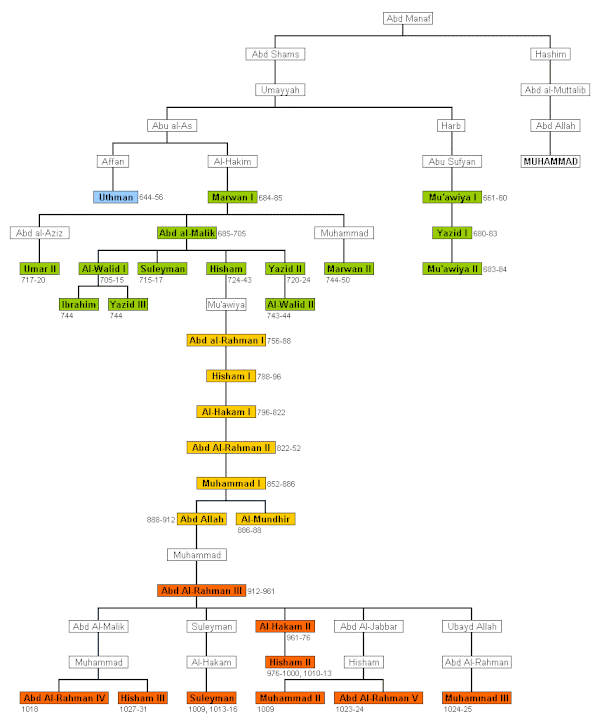
in blue the 3rd historical Caliph Othman in green the Caliphs of Damascus (Sufyanids and Marwanids) in yellow the Emirs of Cordoba in red the Caliphs of Cordoba
History.
in blue the 3rd historical Caliph Othman in green the Caliphs of Damascus (Sufyanids and Marwanids) in yellow the Emirs of Cordoba in red the Caliphs of Cordoba
Immediately after the death of Muhammad, on 8 June 632, three different orientations for the succession took shape: the first, that of the Companions of the Prophet, wanted the successor to be chosen among his first followers; the second, that of the legitimists, which rejected the principle of the election of the successor and wanted the closest relative of the Prophet to be chosen and a dynastic-hereditary criterion to be followed in the future; and the third, that of the powerful of Mecca, that is the Umayyads, who claimed for themselves the right of succession.
The Companions of the Prophet, the so-called «Emigrants» who had come to Medina with the Hegira, managed to ensure that the chosen one was one of them, Abu Bakr who, for having been the best friend of Muhammad (of whom he was a contemporary) and probably the first man converted to Islam, was greatly appreciated by all and therefore guaranteed a line of conduct not dissimilar to that put into effect by the Prophet. The expression used to designate him was «khalifat rasul Allah».
Caliph (khalifa) is therefore the term employed to designate the «Vicar» or «Successor» of Muhammad at the political and spiritual head of the Islamic Community (Umma). It should be noted that the supreme Islamic magistracy, which has an eminently political relevance, is provided for neither in the Quran nor even in the Sunna of Muhammad.
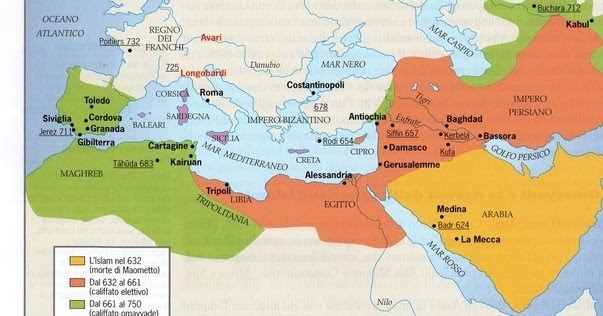
The first two elective Caliphs, Abu Bakr and Omar, belonged to the group of the Companions of the Prophet. Abu Bakr was succeeded by Omar who gave impetus to the conquests and laid the foundations of the Islamic State. He first attacked Syria, which belonged to the Semitic cultural area. The Byzantine emperor Heraclius tried to stop the Muslim advance by sending an army into Palestine, which suffered a defeat, in 636 AD on the river Yarmuk. The turbulent and aggressive Arab tribes then began the penetration into Sasanid Iraq.
The Muslim expansion toward the east continued with the conquest of Persia, of Baluchistan and of Armenia, stopping at the borders with India. Omar also conquered Egypt, and from here expanded in the direction of Cyprus, Crete and Rhodes, defeating the fleet of the Byzantine Emperor Constans II. Omar died in 664 AD.
The third elective Caliph, Othman (Uthman), was instead a member of the aristocratic Meccan family of the Umayyads. Othman was assassinated and Ali (cousin and son-in-law of Muhammad) obtained power by becoming the fourth elective Caliph. A part of the Muslim community, convinced that Ali himself had had the predecessor killed, immediately appointed an anti-Caliph, Muawiya (who belonged to the Umayyad family). A series of armed struggles began between the two groups until Muawiya managed to have himself recognised as the new Caliph. It was thus that the principal schism within Islam came about, that between Sunnis and Shiites (from shi'a, that is «party of Ali»).
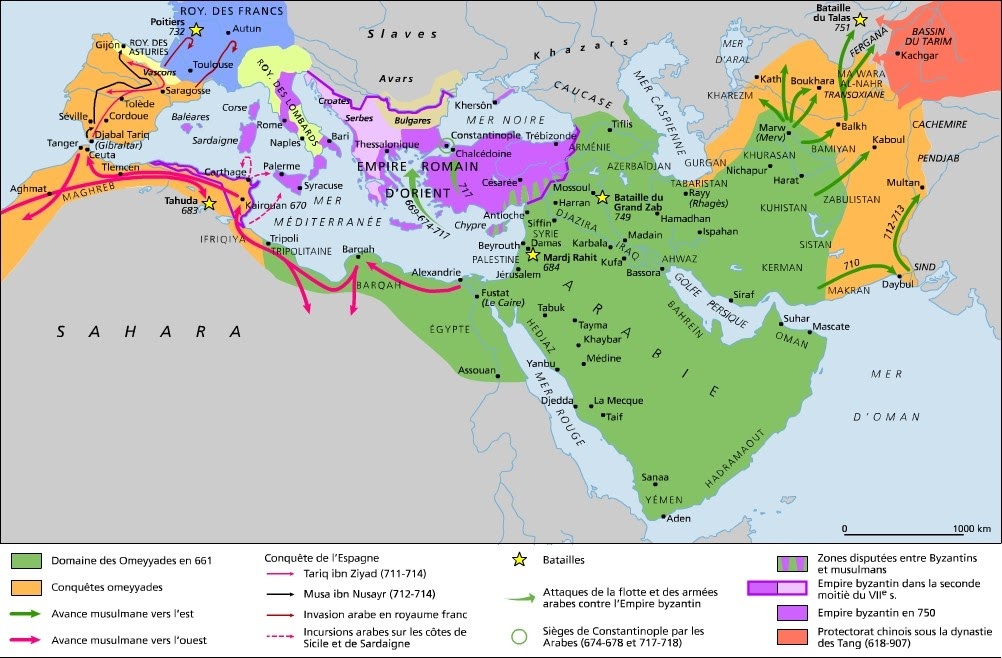
The Umayyad dynasty (661-750) gave the start to a new era. The Caliph lived in luxury and continued the policy of expansion begun by the first Caliphs, until reaching to the west Spain (Andalusia) and to the east China. The expansion made it necessary to move the capital to a city less isolated from the rest of the empire: the choice fell on Damascus, a city where the Umayyads had many followers. But the dynasty was soon accused by the faithful of being too secular and worldly.
Umayyad, in Arabic Banu Omayya («descendants of Omayya»), is a Qurayshite clan of Mecca, formed of many great families. Among these, that of the descendants of Abu Sufyan (Sufyanids), and that of the descendants of Marwan (Marwanids), are the most famous and successively held the Caliphate (with capital at Damascus) from 661 to 750.
The first member of the dynasty and its founder was Muawiya I, a representative of the principal branch of the family of the Banu Omayya, the Sufyanids. His father, Abu Sufyan, had been one of the adversaries of Muhammad but had then converted to Islam, securing for the family new prestige and influence within the framework of the new state and of the new social organisation of Islam. Muawiya I governed for about twenty years, from 661 to 680, laying the foundations for dynastic power and securing as his successor his son Yazid I. Under Muawiya I, Islamic dominion expanded into eastern Iran and into North Africa.
In 683, power passed to another branch of the Umayyads, the Marwanids, and from this branch came all the other Caliphs of the dynasty. Abd al Malik (685-705), son of Marwan I, having defeated the Kharijites and the Shiites, re-established the unity of the State with the annexation of Khorasan and of Oman, consolidated the settlement in North Africa by stifling the indigenous resistance led valiantly by the Kahina and proclaimed Jerusalem «Holy City». Walid I (705-715) and Suleyman (715-717) pursued the policy of expansion: Transoxiana, banks of the Indus, invasion of Spain (711). Under the reign of Walid I the Great Umayyad Mosque was built in Damascus. The Caliphate of Omar II († 720), son of Abd al Aziz, distinguished for religious piety, marked the culmination of the expansion, and the beginning of the reaction of the subjugated peoples, then favoured by the mediocrity of the successors.
In short the Empire was in revolt, from Khorasan to North Africa, from Arabia to Mesopotamia (Kharijites), to Syria itself. Hisham (724-743) abandoned Damascus, settling in the desert, at Rusafa, while the anarchy, provoked by fiscal oppression, increased fearfully. Marwan II, the last of the Umayyads, did not manage to prevent the proclamation of the Abbasid Caliphate at Kufa (750) and was defeated (751) on the Great Zab, a tributary of the Tigris. The Abbasid victory was followed by the hunt and the massacre of all the members of the family.
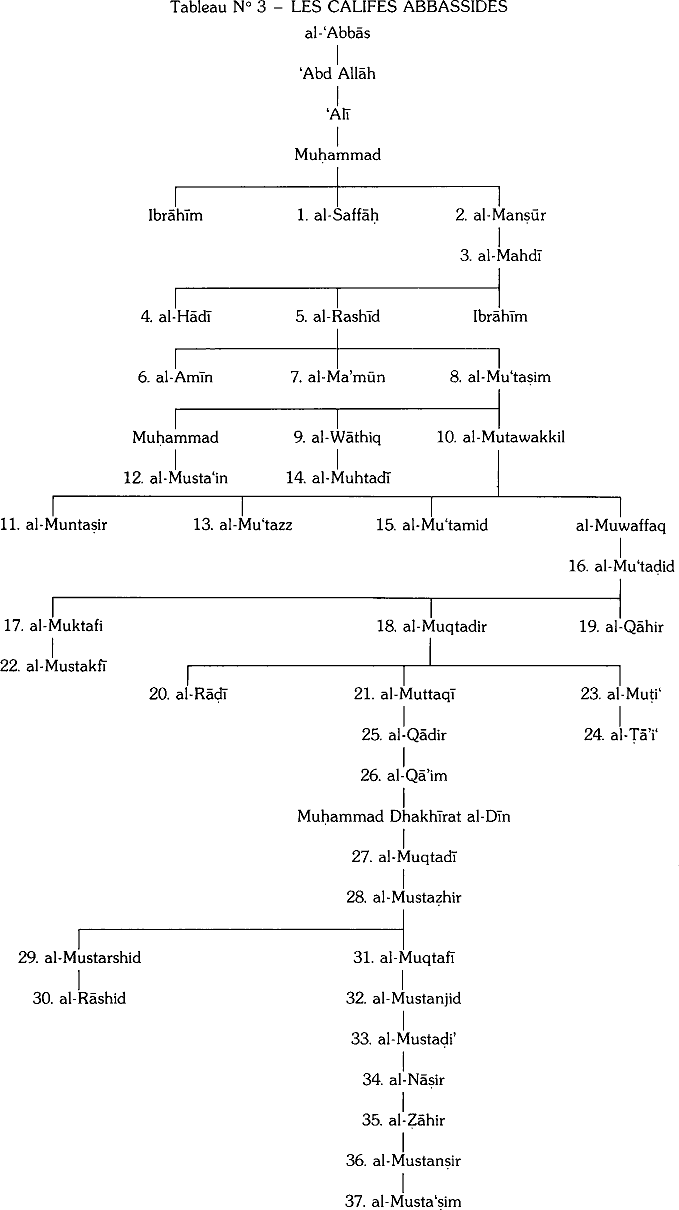
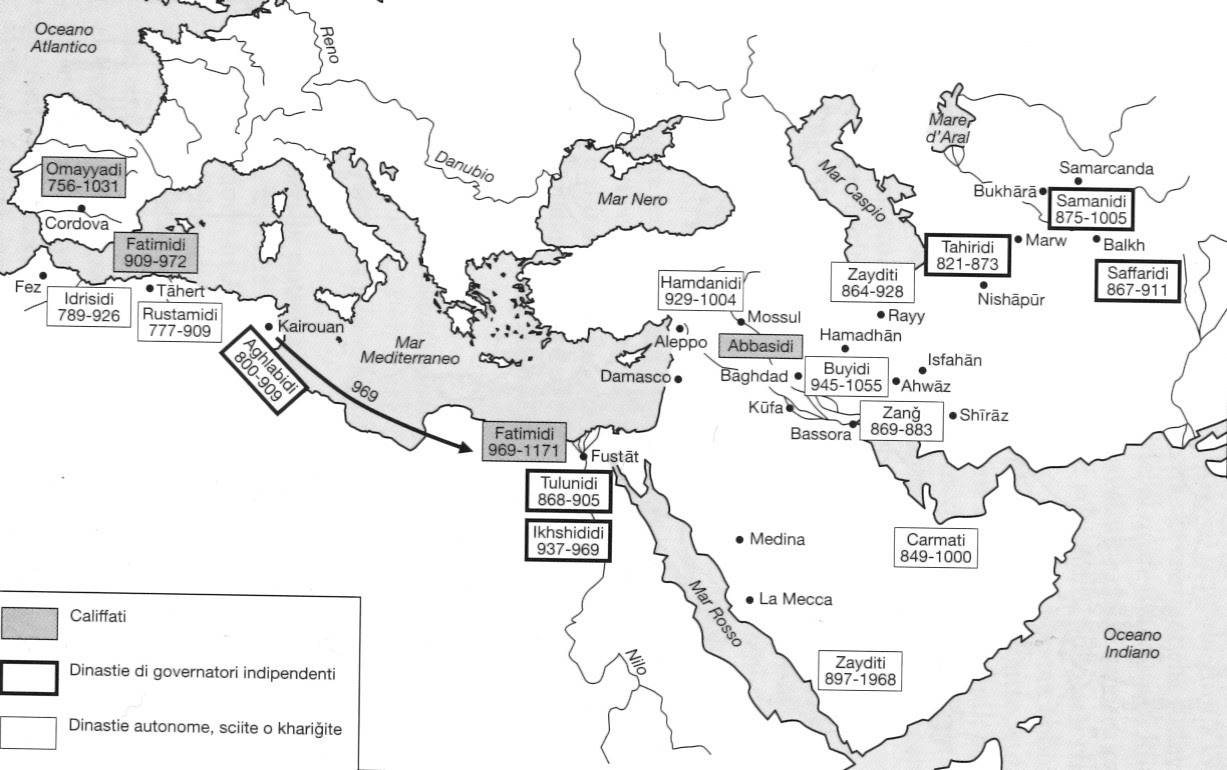
The second great dynasty of Muslim history, that of the Abbasids, held power until 1258 (the year in which Baghdad was occupied by the Mongols). Under the Abbasids, the capital was transferred from Damascus to Baghdad. But the territory was too large to be controlled, and power was increasingly entrusted to small dynasties of princes (the emirs) who, while always depending on the central power, gained a greater independence. After 1258, Muslim history became the history of small (although sometimes important) dynasties.
Abd al Rahman I († 788), a grandson of Hisham, having escaped his adversaries, took refuge in the Maghreb and, some years later, having landed in Spain, conquered Cordoba (756), founding there an Umayyad emirate. For long years he had to struggle against the Arab and Berber chiefs, and in the end his reign extended over all of Andalusia. Abd al Rahman III (912-961), having further consolidated and unified the State, proclaimed himself Caliph (929), thereby claiming before the Abbasids his spiritual authority and increasing before his subjects his own prestige.
Cordoba became a great capital, and the point of departure of every expedition against the meagre part of the Iberian peninsula (Navarre, León) that remained Christian. At the end of the 10th century, the Caliphate reached its apogee under the reign of Hisham II (976-1013), especially after the chamberlain (hagib) Muhammad Ibn Abu Amir, having defeated the coalition of the Christian sovereigns, seized Santiago de Compostela (997), for which he styled himself Al Mansur («the Victorious»). Islamic dominion then extended as far as the Douro, surrounded and protected by «marches», border territories governed by military chiefs.
The Arab population was a minority, but strongly concentrated in the cities with numerous fiefs and/or domains in the countryside.
More numerous the Berbers who were however diluted in the more abundant mass of autochthonous population (among whom the Mozarabs who remained Christian) and the «slaves», mercenaries, prisoners of war. All this governed by a court, typically oriental, sumptuous like that of Baghdad, and equally organised, as was the administration. Solemn the ceremonial, sumptuous the residences. Cordoba was adorned with a magnificent alcázar and with the Great Mosque. Splendid the poetic flowering, as much as that of the religious studies, favoured by the constitution of an immense library (by the will of Al-Hakam II, 961-976).
The decadence began with the death of Al-Mansur (1002). In the space of thirty years, Umayyad power foundered in the conspiracies, revolts and defections that prepared the great anarchy, known under the name of the period of the «Reyes de Taifas» from 1031.
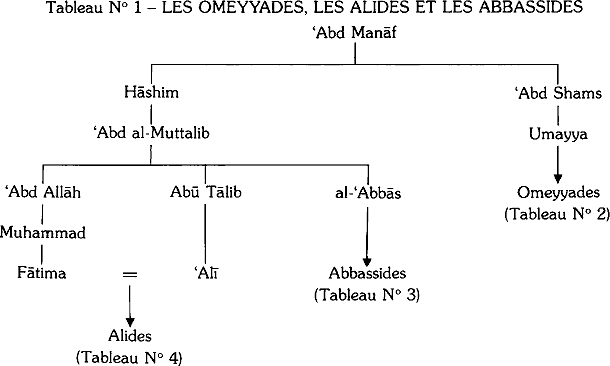
The Umayyads and Muhammad the Prophet share a common ancestor among the Qurayshites: Abd Al Mujira (b. c. 430). His two sons, Abd Shams and Hashim, are at the origin of the two lines.
Below, the three principal chains of descent of the Umayyads rendered in structured format. Branches A and B close on the points of internal convergence (Aisha bint Othman ∞ Marwan I for A; Walada bint Yazid ∞ Abd Al Malik for B), both belonging to branch C — the only one that continues down to the confluence with the Gallone line (Moncada × Gallone marriage, 1925).
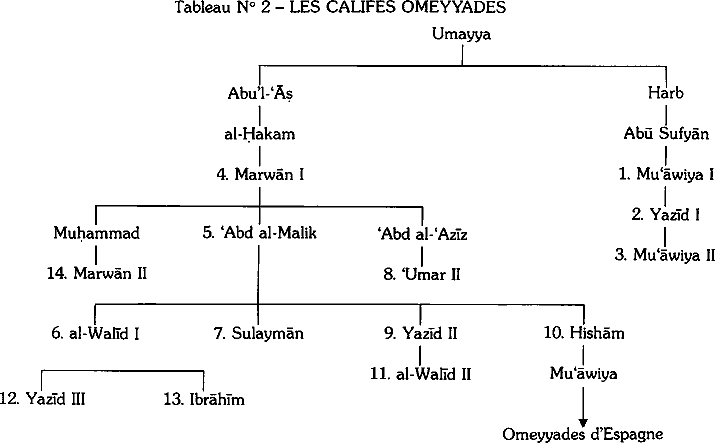
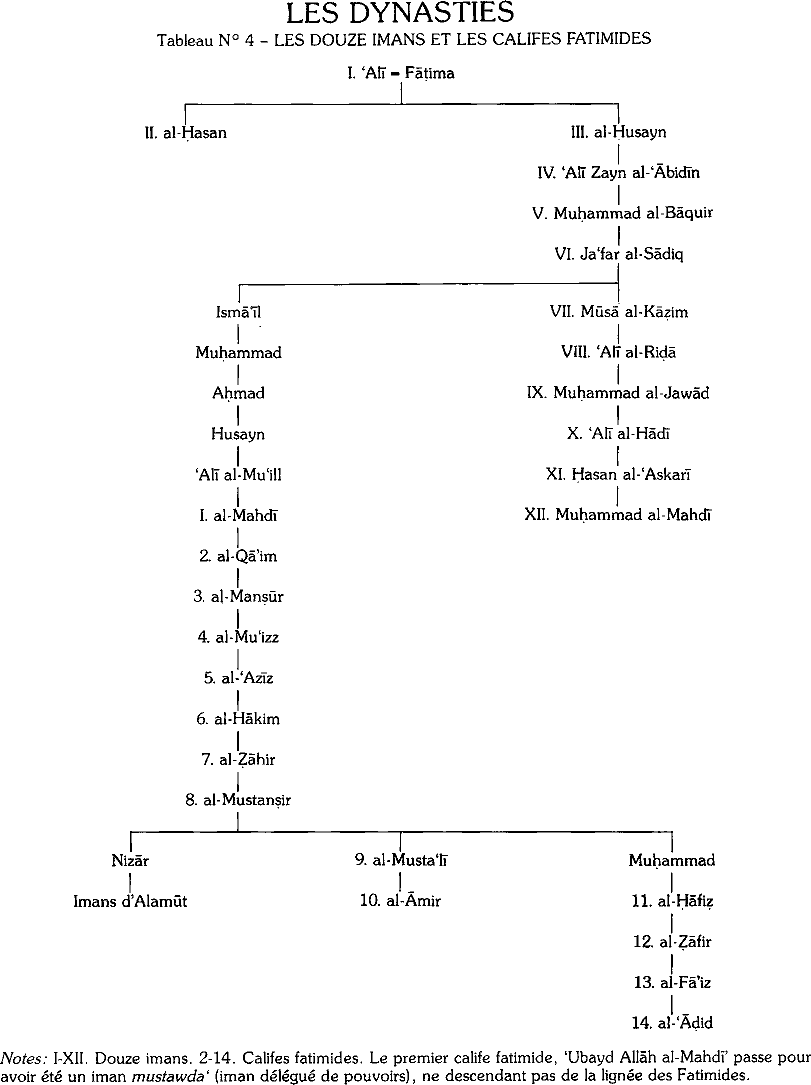
Historical genealogical tables of the Arab dynasties («Les Dynasties»), which situate the Umayyads within the broader framework of the Qurayshite houses — Umayyads, Alids, Abbasids and Fatimids. They refer to one another (Tableau N° 1 → 4).
The chains of descent.
- ★Abd Al Mujira Al Menâf Ibn Qusayyb. c. 430 · of the Qurayshites, Governor of Mecca&Atika, b. c. 444 · of the Banu Qays Aylan
- 2Abd Shamsof the Qurayshites
- ★OmayyahEponym of the Umayyad dynasty. The complete descent follows below.
- ★Abd Al Mujira Al Menâf Ibn Qusayyb. c. 430 · of the Qurayshites, Governor of Mecca&Atika, b. c. 444 · of the Banu Qays Aylan
- 2Hashimof the Qurayshites (Banu Hashim)
- 3Abd Al Muttalibof the Banu Hashim
- 4Abd Allahof the Banu Hashim
- ★b. c. 570, † 632 · Founder of Islam — dedicated page.
- ★Abd Shams Ibn Abd Menafb. c. 480 · of the Qurayshites&Ablah Bint Ubayd
- 2Omayya (Umayya) (Al-Asghar) Ibn Abd Shamsb. c. 533, † 569 · of the Umayyads&Amina
- 3Abu Al As Ibn Omayyaof the Umayyads&Ruqayya
- 4Affan Ibn Abu Al Asof the Umayyads&Urwa / Awra Bint Kariz, of the Qurayshites (Banu Abd Shams)
- 5Othman Ibn Affanb. c. 579, † 656 · of the Umayyads · 3rd historical Caliph 644–656&Naylah Bint Fraizah
- 6Aisha bint Othmanb. c. 623 · of the Umayyads, of the historical Caliphs&Marwan I, b. c. 623, † 684 · of the Umayyads (Marwanids) · 4th Caliph of Damascus 683–684 (abd.)
- ★Aisha bint Marwanb. c. 660 · of the Umayyads (Marwanids), of the Caliphs of Damascus&Musa Ibn Nusair «Al Bekir» Al Makkiyya, b. c. 623, † 684 · Emir of Ifriqiya 698–714, Conqueror of Spain, Wali (Governor) of Al-Andalus 712–716
- ★Abd Shams Ibn Abd Menafb. c. 480 · of the Qurayshites&Ablah Bint Ubayd
- 2Omayya (Umayya) (Al-Asghar) Ibn Abd Shamsb. c. 533, † 569 · of the Umayyads&Amina
- 3Harb Al Anabis Ibn Omayyaof the Umayyads
- 4Abu Sufyan Ibn Harbb. c. 564, † 652 · of the Umayyads (Sufyanids)&Hind Bint Utbah
- 5Muawiya Ib. c. 603, † 680 · of the Umayyads (Sufyanids) · 1st Caliph of Damascus 661–680&Maysun Bint Vahadla, of the Banu Haritha
- 6Yazid Ib. 647, † 683 · of the Umayyads (Sufyanids) · 2nd Caliph of Damascus 680–683& 660Hayyat Bint Abu Hashim, of the Banu Abd Shams
- ★Walada bint Yazidb. c. 665 · of the Umayyads (Sufyanids), of the Caliphs of Damascus&Abd Al Malik, b. c. 646, † 705 · of the Umayyads (Marwanids) · 5th Caliph of Damascus 684–705
- ★Abd Shams Ibn Abd Menafb. c. 480 · of the Qurayshites&Ablah Bint Ubayd
- 2Omayya (Umayya) (Al-Asghar) Ibn Abd Shamsb. c. 533, † 569 · of the Umayyads&Amina
- 3Abu Al As Ibn Omayyaof the Umayyads&Ruqayya
- 4Al Hakam Ibn Abu Al Asof the Umayyads&Amina Bint Alkama Al Kinanayya
- 5Marwan Ib. c. 623, † 684 · of the Umayyads (Marwanids) · 4th Caliph of Damascus 683–684 (abd.)&Aisha Bint Muawiya, b. c. 630
- 6Abd Al Malikb. c. 646, † 705 · of the Umayyads (Marwanids) · 5th Caliph of Damascus 684–705&Walada bint Yazid, b. c. 665 · of the Umayyads (Sufyanids), of the Caliphs of Damascus
- 7Hisham I Mansourahb. c. 691, † 743 · of the Umayyads (Marwanids) · 10th Caliph of Damascus 724–743
- 8Muawiya ibn Hishamb. c. 715, † 736 · of the Umayyads (Marwanids), of the Caliphs of Damascus&Rah, of the Nafza
- 9Abd Al Rahman Ib. 731, † 788 · of the Umayyads (Cordoba) · 1st Emir of Cordoba 756–788&Khazraf (Zeibra) «the Berber», b. c. 735
- 10Hisham Ib. 757, † 796 · of the Umayyads (Cordoba) · 2nd Emir of Cordoba 788–796&Zokhrouf
- 11Al Hakam Ib. 770, † 822 · of the Umayyads (Cordoba) · 3rd Emir of Cordoba 796–822&Halawah (Adjab), b. c. 770
- 12Abd Al Rahman IIb. 792, † 852 · of the Umayyads (Cordoba) · 4th Emir of Cordoba 822–852&Buhair, b. c. 800
- 13Muhammad Ib. 823, † 886 · of the Umayyads (Cordoba) · 5th Emir of Cordoba 852–886&Ishar, b. c. 825
- 14Abd Allah (Aboail)b. 844, † 912 · of the Umayyads (Cordoba) · 7th Emir of Cordoba 888–912& 863Onecca of Navarre (Iñiguez), b. c. 855 · of the Kings of Pamplona
- 15Zaydb. c. 870 · of the Umayyads (Cordoba), of the Emirs of Cordoba
- 16Zaydanb. c. 890 · of the Umayyads (Cordoba), of the Emirs of Cordoba&Aragonta Fromariguez
- 17Zayrab. c. 915 · of the Umayyads (Cordoba), of the Emirs of Cordoba&Lovesendo Ramirez «El Cid de Leon», b. c. 920 · natural son, of Asturias and León, of the Kings of León
- 18Abu Nazar Lovesendezb. c. 940 · of Asturias and León, of the Kings of León&Unisco Godinez, b. c. 940
- 19Hermigio Abu Nazarb. c. 975 · of the Kings of León, Lord of Tavora&Vivili Trutesendez de Paiva
- 20Adosinda Abu Nazarof the Kings of León&Pelayo da Silva, b. c. 1070, † c. 1141 · 2nd Lord of Quinta da Silva, 2nd Lord of Alderete
- 21Ferdinando da Cunha (D'Acuña)† c. 1180 · 1st Lord of Acuña, 1st Lord of Taboa&Mayor Rendufez Soleima
- 22Lorenzo da Cunha (D'Acuña)b. c. 1180, † 1225 · 2nd Lord of Acuña, 2nd Lord of Taboa&Sancia de Maceira, b. c. 1165
- 23Vasco da Cunha (D'Acuña)b. c. 1210 · 3rd Lord of Acuña, 3rd Lord of Taboa&Teresa de Portel, b. c. 1210, † 1291 · of the Lords of Portel
- 24Martino I «il Vecchio» da Cunha (D'Acuña)b. c. 1235, † 1305 · 4th Lord of Acuña, 4th Lord of Taboa&Giovanna de Nomães, of the Lords of Silvaescura and of Revinhade
- 25Vasco «il Secco» da Cunha (D'Acuña)† 1325 · 5th Lord of Acuña, 5th Lord of Taboa&Geronima Chancinho, † 1330
- 26Martino II da Cunha (D'Acuña)b. c. 1265, † 1333 · 6th Lord of Taboa& 1325Violante Pacheco, b. 1310, † 1365 · Lady of Mafra and of Ericeira
- 27Vasco II «il Vecchio» da Cunha (D'Acuña)b. 1328, † 1407 · 7th Lord of Taboa, Alcalde Mayor of Lisbon& 1356Beatrice Suarez de Albergaria, of the Lords of Albergaria
- 28Martino III da Cunha (D'Acuña)b. 1357, † 1417 · 8th Lord of Taboa, Alcalde Mayor of Lisbon, 1st Count of Valencia de Campos&Teresa Tellez Giron, b. c. 1360, † 1397 · Lady of El Frechoso
- 29Eleonora da Cunha (D'Acuña)b. 1357, † 1417 · of the Lords of Taboa and Counts of Valencia de Campos&Giovanni de Castro, 2nd Lord of Cadaval
- 30Giovanna de Castrob. c. 1407, † 1479 · 3rd Lady of Cadaval& 1429Ferdinando I di Portogallo Braganza, b. 1404, † 1478 · 2nd Duke of Braganza
- 31Alfonso di Portogallo Braganzab. c. 1435, † 1483 · of the Dukes of Braganza, 1st Count of Faro, 2nd Count of Odemira& 1465Maria Enriquez de Noroña, b. 1440, † 1523 · Heiress of the County of Odemira
- 32Sancio I di Portogallo Noroñab. c. 1470, † 1520 · 2nd Count of Faro, 3rd Count of Odemira& 1510Angela de Fabra, b. c. 1480, † 1533 · of the Lords of Barrigadu
- 33Giovanna di Portogallo Noroñab. c. 1520, † 1568 · of the Counts of Faro and of Odemira& 1541Giovanni II de la Cerda, † 1575 · 4th Duke of Medinaceli, Viceroy of Sicily, Governor of the Netherlands
- 34Maria de la Cerdab. 1542, † 1575 · of the Dukes of Medinaceli& 1562Antonio II d'Aragona, b. 1543, † 1583 · 4th Duke of Montalto, 5th Count of Collesano
- 35Maria d'Aragonab. c. 1560, † 1610 · 5th Duchess of Montalto, 6th Countess of Collesano& 1584Francesco II Moncada, b. 1572, † 1595 · 3rd Prince of Paternò, 4th Duke of Bivona, 7th Count of Collesano
- 36Antonio Moncadab. 1589, † 1631 · 4th Prince of Paternò, 5th Duke of Bivona, 6th Duke of Montalto, 8th Count of Collesano, Knight of the Golden Fleece 1607& 1612Giovanna de la Cerda, b. 1591 · of the Dukes of Medinaceli
- 37Ignazio Moncada† 1689 · of the Princes of Paternò, Governor of Flanders, Viceroy of Sicily& 1636Anna Gaetani, 3rd Marchioness of Sortino, 3rd Princess of Cassaro
- 38Ferdinando (Ferrante) Moncadab. 1649, † 1710 · of the Princes of Paternò, 6th Duke of San Giovanni, General of the galleys of Sicily, Viceroy of Sardinia& 1669Gaetana Maria Branciforte, † 1680 · 5th Duchess of San Giovanni
- 39Luigi Guglielmo Moncadab. 1670, † 1743 · 7th Prince of Paternò, 7th Duke of San Giovanni& c. 1692Giovanna di Ventimiglia, † 1734 · of the Marquises of Geraci and Princes of Castelbuono
- 40Francesco Rodrigo Moncadab. 1696, † 1763 · 8th Prince of Paternò, 8th Duke of San Giovanni&Giovanna Giuseppa Ruffo di Calabria, † 1786 · of the Princes of la Scaletta
- 41Gianluigi Moncadab. 1745, † 1827 · 9th Prince of Paternò, 9th Duke of San Giovanni& 1761Agata Branciforte, b. 1740, † 1782 · of the Princes of Scordia
- 42Francesco Rodrigo Moncadab. 1762, † 1816 · of the Princes of Paternò and Dukes of San Giovanni, Count of Caltanissetta& 1781Maria Giovanna Beccadelli di Bologna, b. 1765, † 1814 · of the Princes of Camporeale
- 43Pietro Moncadab. 1789, † 1861 · 10th Prince of Paternò, 10th Duke of San Giovanni& 1816Giuseppina Bajada, b. 1794, † 1855 · of the Marquises Bajada
- 44Corrado Moncadab. 1820, † 1895 · 11th Prince of Paternò, 11th Duke of San Giovanni& 1859Stefania Starrabba, b. 1835, † 1903 · of the Marquises of Rudinì
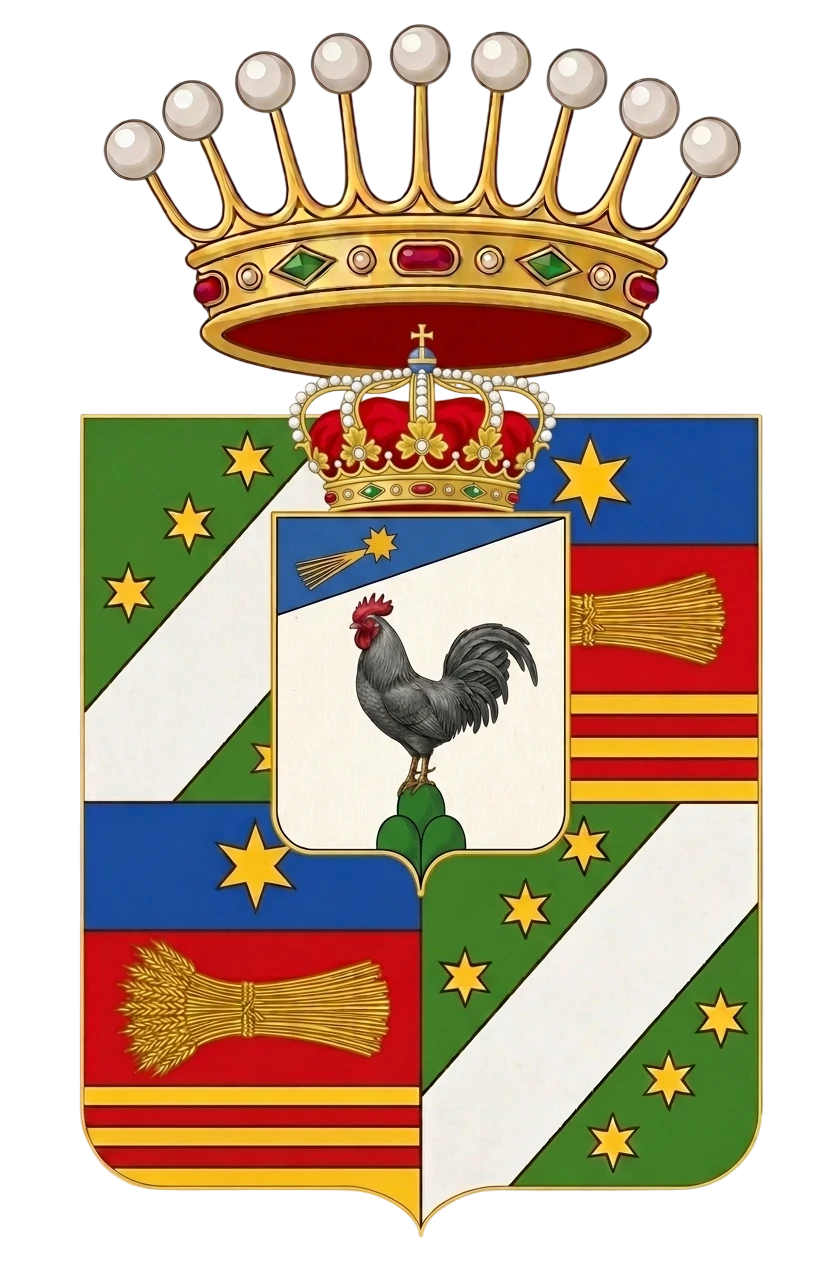
- 45Giuseppina Moncadab. 1860, † 1946 · of the Princes of Paternò and Dukes of San Giovanni& 1925Pietro Giovanni Battista «Gino» Gallone, b. 1855, † 1931 · 9th Prince of Tricase, 6th Prince of Moliterno, 8th Prince of Marsiconovo, Count of Nociglia
Timeline
Famous descent
Gallery.