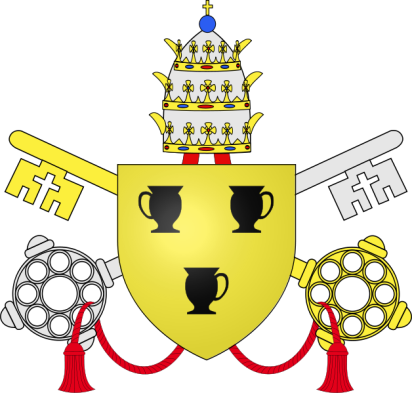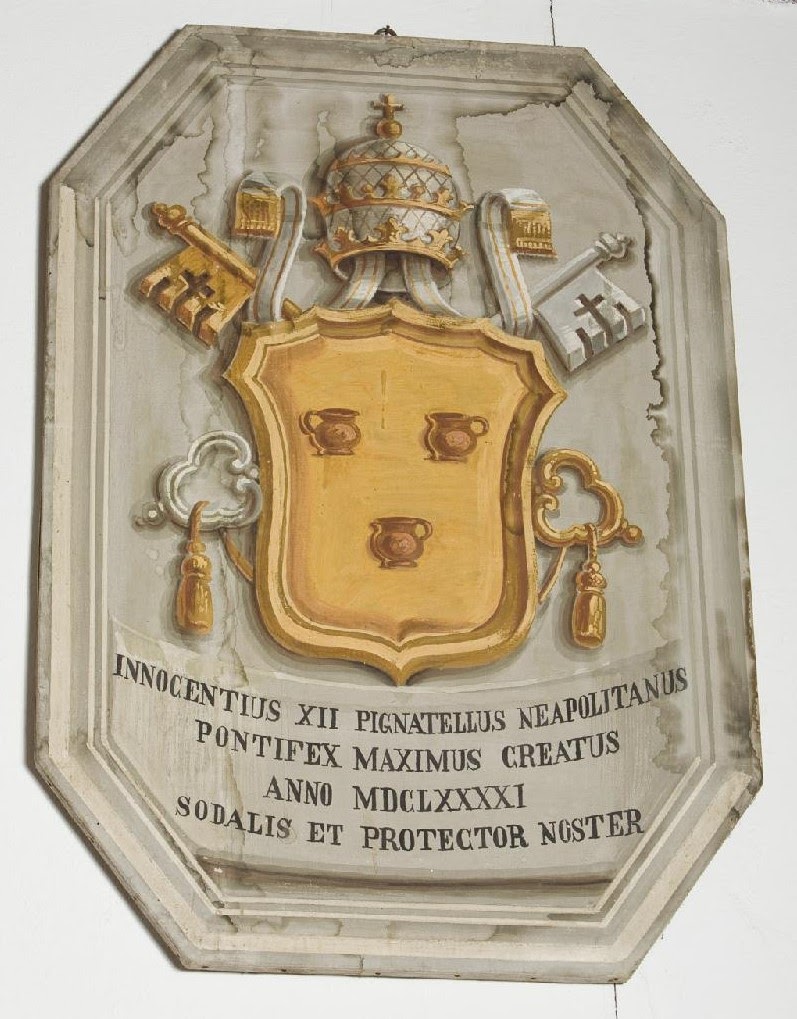
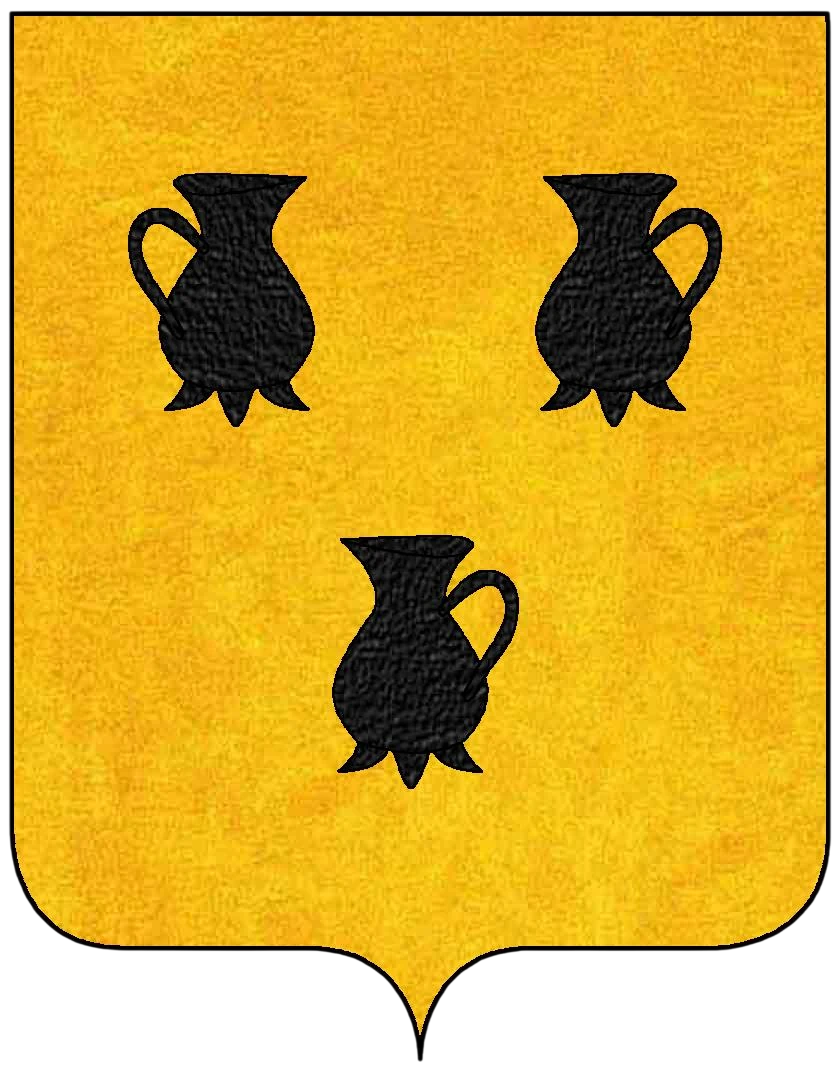
Or, three cooking-pots (pignatte) sable.
Lineage · Stage 4
Pignatelli.
Princes of Moliterno and Marsiconovo, 11th – 1796.
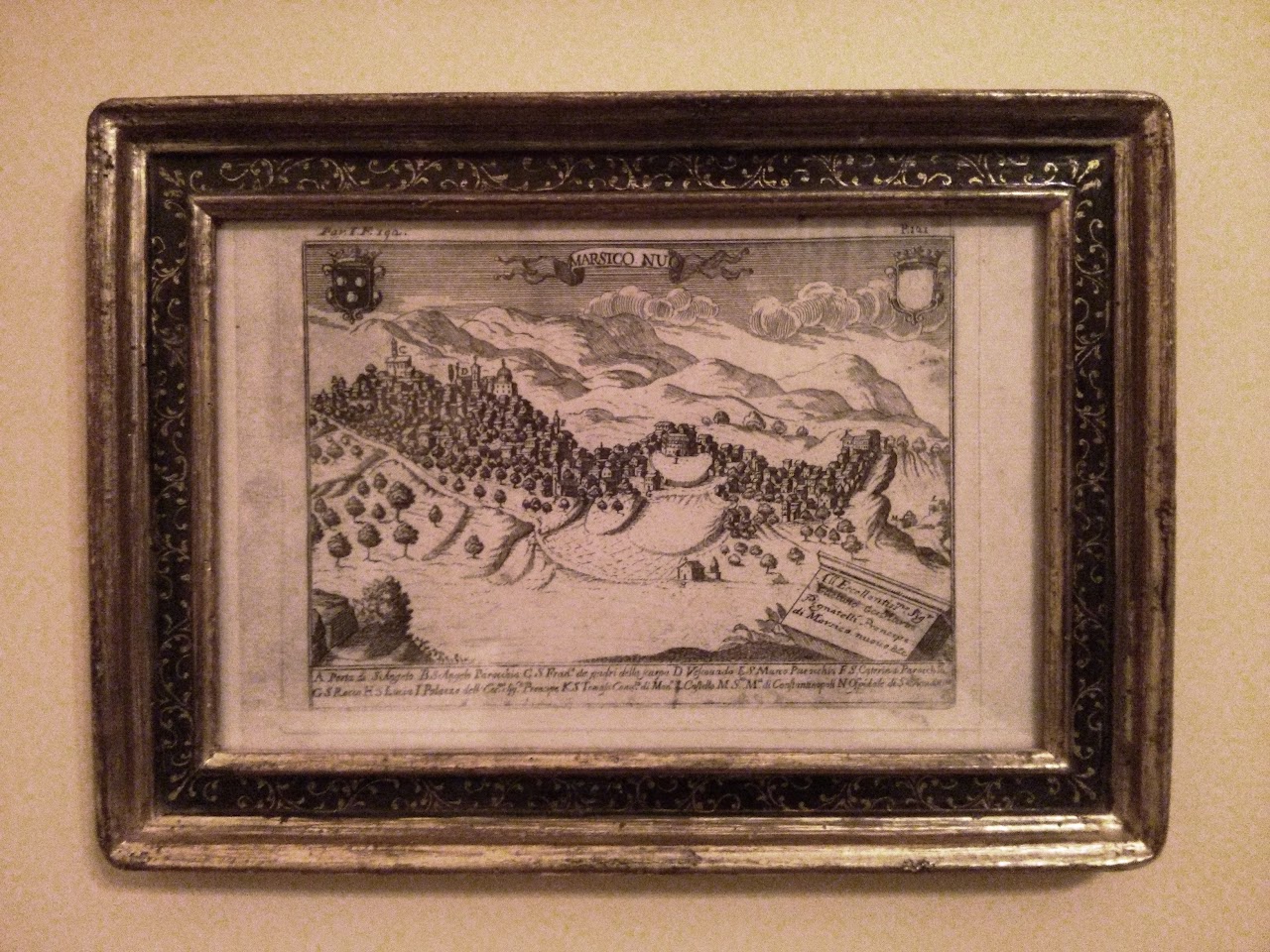
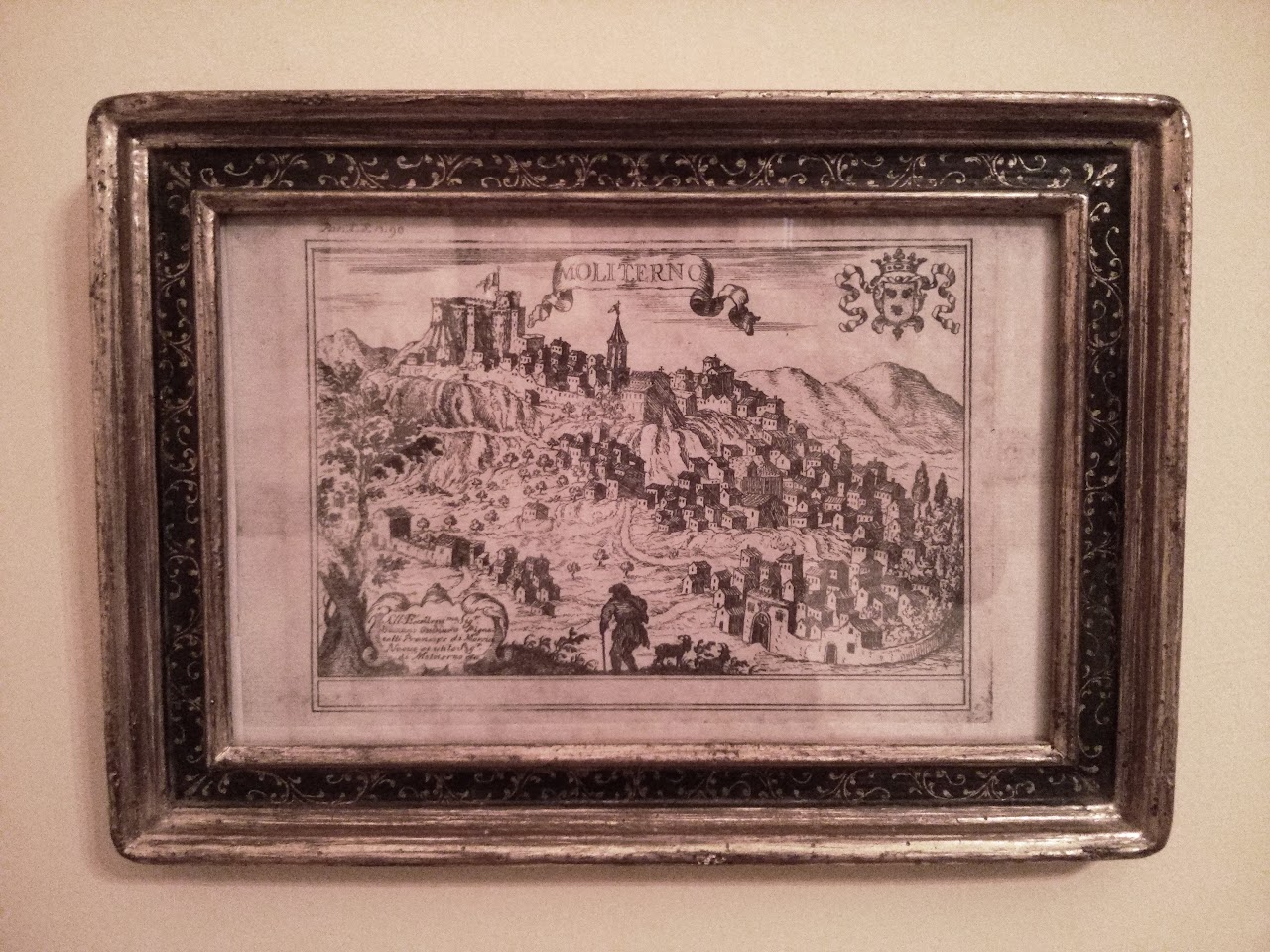
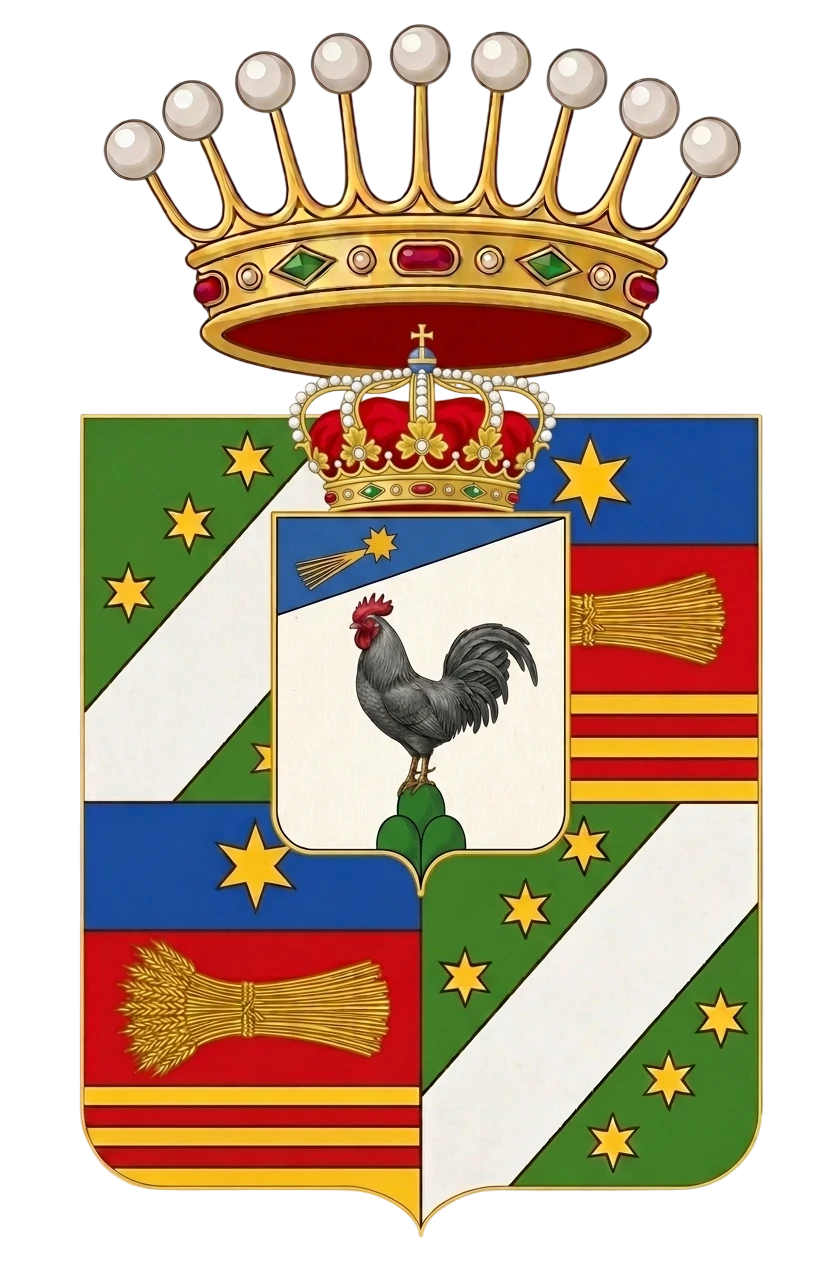
An ancient Neapolitan patriciate, among the most powerful Houses of the Kingdom of Naples: over 179 fiefs, 14 Principalities, 17 Duchies, 22 Marquisates and 18 Counties, Princes of the Holy Roman Empire, the Golden Fleece and the Grandeeship of Spain, and a Pope, Innocent XII. Through the 1796 marriage between Maria Emanuela Pignatelli, heiress, and Giuseppe Gerardo Gallone, the Principalities of Moliterno and Marsiconovo pass to the Gallone House.
History of the house.
The Pignatelli form a noble Sicilian, Neapolitan and Apulian family, among the most powerful of the Kingdom of Naples. The house draws its origin, according to the ancient genealogies, from the De Domna Maria, documented at Naples from the 11th century, from Sergio through Giovanni and Landolfo «Pignatello»: a nickname from which, following the exploits in the East for King Roger the Norman, derives the surname Pignatelli, definitively adopted from his son's generation.
To justify the arms and the name, some scholars relate that, at the assault on the Imperial Palace of Constantinople, a Landolfo came out with three vases or pignatte (pots) of silver skewered on his pike, taking them as his arms (the «right of pillage»); others would have a Gisulfo victorious at Negroponte by fire hurled at the enemy, enclosed in pots. Of this historic House there are records documented from 1102 with Lucio Pignatelli, Constable of Naples.
From a Riccardo, living in 1250, descended in direct line Tommaso, Governor of Atri in 1431, and from his three sons — Carlo, Stefano and Palamede — were born the three main Lines.
The line of Carlo (1421–1476) became extinct with Geronima (1599–1667), Princess of the Holy Roman Empire, 5th Duchess of Monteleone, Vicereine of Aragon in 1655; it merged into the Line of Cerchiara and Noja through Geronima's marriage to Fabrizio Pignatelli, who inherited the Duchy of Monteleone, the County of Borrello and the Barony of Mesiano.
The descent of Stefano gave rise to the Marquesses of Casalnuovo, the Dukes of Montecalvo and the Princes of Monteroduni; the «Colonel of the House» is today Giovanni Pignatelli della Leonessa (b. 1920), 8th Prince of Monteroduni, 4th Prince of Sepino, Duke of Castoria, Neapolitan Patrician. From Palamede, with Giacomo († 1539), began the Line of Cerchiara and Noja: the Marquisate of Cerchiara was granted in 1556 to Fabrizio I, Viceroy of Calabria, and the Principality of Noja in 1600 to Fabrizio II.
The firstborn branch of the Line of Cerchiara and Noja prefixed the name and arms «Aragona Cortez» under the marriage pacts of 1639, in which it was established that the descent of Ettore Pignatelli, Marquess of Vaglio, and of Giovanna Tagliavia Aragona Cortez should be called «Aragona Pignatelli Cortez». Thus entered the succession the Marquisate of Avola, the Principality of Castelvetrano, the Duchy of Terranova and the County of Borghetto.
Giovanna Tagliavia, through the succession of her mother Stefania Carrillo Cortez — great-niece of Hernán Cortés, Conqueror of Mexico — inherited the titles of Marquise of the Valle di Oaxaca and Countess of Priego. Through the marriage of Nicolò Pignatelli (1648–1730), Viceroy of Sardinia and Sicily, to his great-niece Giovanna II Aragona Pignatelli Cortez (1677–1723), all the titles were inherited by the firstborn Diego.
The Pignatelli held the rank of Nobles at Rome, Venice, in Sicily, Spain and Mexico, wore the habit of Malta from 1420 and held high offices in the Church and the State. They were invested with the Golden Fleece (Monteleone-Terranova, Strongoli) and the Grandeeship of Spain of the first class (Monteleone-Terranova, Belmonte, Strongoli, Fuentes), and Princes of the Holy Roman Empire (Belmonte 1723, Monteleone-Terranova, Strongoli, Fuentes, Cerchiara 1648).
Their patrimony comprised over 179 fiefs, 18 Counties, 22 Marquisates, 17 Duchies and 14 Principalities, from Sicily to Apulia, from Calabria to Basilicata and even to the Mexican Lordships of the Valle di Oaxaca. The complete list is given below.
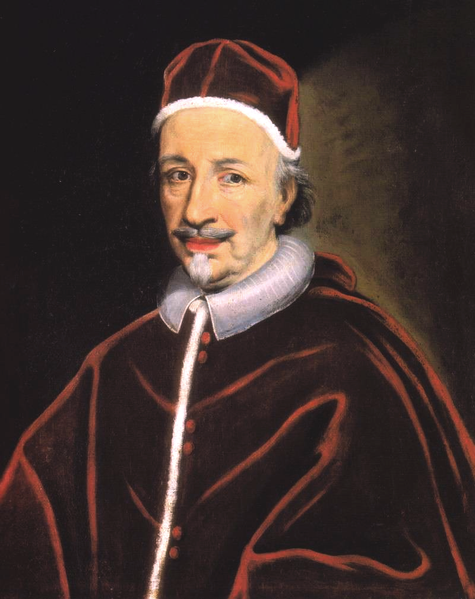
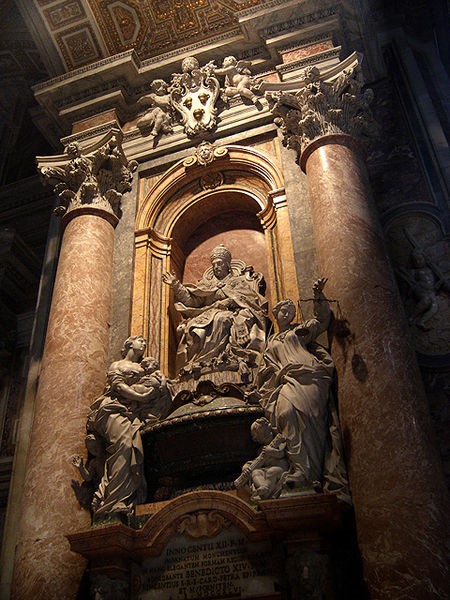
To this House belongs the Pontiff Innocent XII, in the world Antonio Pignatelli of the Marquesses of Spinazzola (Spinazzola 1615 – Rome 1700), 242nd Pope of the Catholic Church (1691–1700). His line descends from the founder of Cerchiara, Fabrizio I, through his son Marzio I (1st Marquess of Spinazzola 1586) and his grandson Francesco (1st Prince of Minervino), father of Antonio.
Educated by the Jesuits, he was Vice-legate of Urbino, Inquisitor at Malta (1642–1649), Governor of Viterbo, titular Archbishop of Larissa, Nuncio in Poland and at Vienna, Archbishop of Lecce, then of Faenza, Legate of Bologna and Archbishop of Naples (1685); created Cardinal in 1681. On the death of Alexander VIII the conclave lasted five months: he was elected Pope as a compromise candidate between the French cardinals and those of the Empire, on 12 July 1691.
By the bull Romanum decet Pontificem (1692) he took a stand against nepotism, forbidding Popes to grant goods, offices or the cardinalate to relatives; «the poor are my nephews», he said. He fought the sale of offices, instituted the Congregation for the reform of the Regular Orders (1694) and the Forum Innocentianum for the administration of justice; he restored the port of Anzio. In foreign policy he inclined toward France. He died on 27 September 1700, the last pontiff to wear a beard and moustache habitually; he was succeeded by Clement XI.
The line that converges in the Princes of Tricase descends through the female line from the Pignatelli, Princes of Marsiconovo (from 1677) and of Moliterno (from 1743). The central figures are Giovanni Battista I (Prince of Marsiconovo 1677), Girolamo I and Giovanni Battista III (1740–1805), Prince of Moliterno and Marsiconovo, ambassador of the Kingdom of Naples in France, married to Maria Luisa d'Avalos of the Princes d'Aquino d'Aragona.
From him are born Girolamo III (1773–1848), a cavalry general, protagonist of the Neapolitan Republic of 1799, who died without issue, and Maria Emanuela Pignatelli (1775–1818), last heiress of the double princely inheritance. It was she who carried the Principalities of Moliterno and Marsiconovo into the Gallone House, by marrying in 1796 Giuseppe Gerardo Gallone, 6th Prince of Tricase. From their five children descends the line down to Maria Bianca Gallone and the Guerri dall'Oro Gallone.
The three main lines.
From Tommaso, Governor of Atri (1431), and his three sons spring the three main Lines of the House. From that of Palamede descends, through Cerchiara and Noja, the branch that converges in the Princes of Tricase.
From the Line of Cerchiara (Palamede), through the Spinazzola branch, descends also the Pontiff Innocent XII. It is rather from the branch of Marsiconovo and Moliterno that, through the female line with Maria Emanuela, the princely inheritance flows into the Gallone House.
Family tree of the house.
The titles of the line and the great dignities
Princes of the Kingdom and of the Holy Roman Empire.
The principal fiefs
Over 179 fiefs in the Kingdom.
The possessions of the House — complete list
14 Principalities, 17 Duchies, 22 Marquisates, 18 Counties.
14 Principalities — Belmonte (1619), Castelvetrano (1564), Marsiconovo (1677), Minervino (1624), Moliterno (1743), Monasterace, Montecorvino (1650), Monteroduni (1702), Muro Leccese (1798), Noja (1600), Racale, Supino (1627), Valle, and the Principality of the Holy Roman Empire.
17 Duchies — Acerenza (1593), Alliste, Bellosguardo, Bisaccia (1600), Caivano, Castoria (1715), Corigliano d'Otranto (1798), Girifalco, Montecalvo (1611), Monteleone (1533), Rocca Mondolfa, San Demetrio (1735), San Marco, San Martino (1621), San Mauro, Terranova (1561), Tolve (1678).
18 Counties — Acerra, Borghetto (1564), Borrello (1506), Cerinola, Cerignola, Copertino (1557), Egmont, Fuentes, Melissa, Mesagne, Montavano, Monteleone, Priego, San Giovanni Lappione (1618), Sant'Angelo de' Lombardi (1508), San Valentino, Tuehgl (1715), Vaglio.
22 Marquisates — Argensola, Avola, Caronia, Casalnuovo (1630), Cerchiara (1556), Collelongo (1735), Colletorto (1712), Favara (1559), Galatone (1562), Lauro, Moio, Padula, Paglieta (1603), Sambuca, San Giovanni, San Vincenzo, Spinazzola (1586), Tertiveri, Trentola, Tufara, Vaglios, Valle de Oaxaca (1547).
Lordships in Mexico (under the Valle di Oaxaca) — Caro, Cotaxilla, Coyocan, Cuernavaca, Etla, Nico, Sancta Maria, Sant'Anna, Tambaya, Tapulia, Tuxilla.
Dignities — Nobles at Rome, Venice, in Sicily, Spain and Mexico; habit of Malta from 1420; Golden Fleece (Monteleone-Terranova, Strongoli); Grandeeship of Spain of the first class (Monteleone-Terranova, Belmonte, Strongoli, Fuentes); Princes of the Holy Roman Empire (Belmonte 1723, Cerchiara 1648, and other branches).
Documents and images
Possessions, views and Innocent XII.