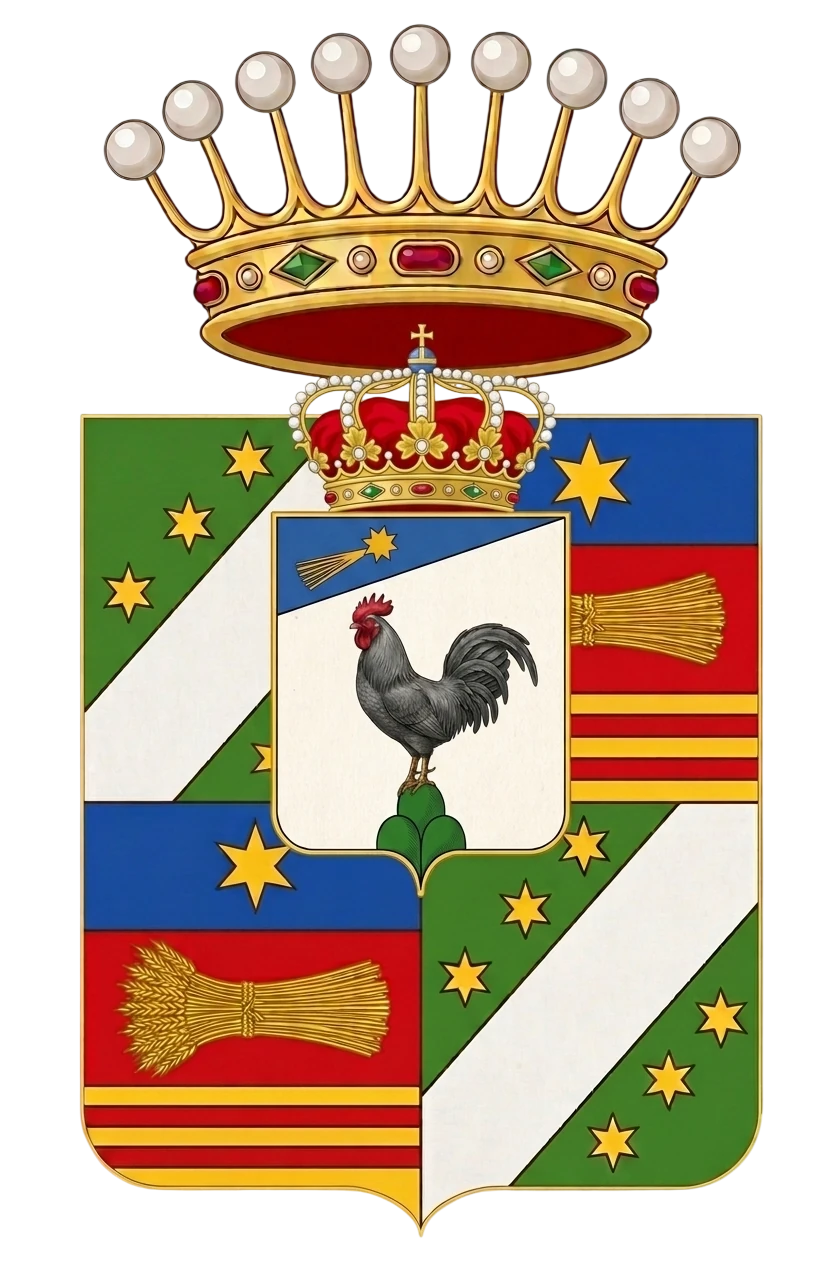
Heraldic & nobiliary terms
Glossary
Glossary of the heraldic and nobiliary terms used on the site, with their definitions.
Blazon
- accantonato
- Said of a central charge surrounded by charges placed in the cantons (corners) of the shield. English equivalent: cantoned.
- accompagnato
- Said of a charge flanked by other secondary charges arranged around it. English equivalent: between (or accompanied by).
- aquila
- Heraldic figure of the eagle, normally displayed (with wings spread). Aquila bicipite (double-headed eagle): an eagle with two heads facing in opposite directions, an imperial symbol.
- argento
- Heraldic metal, represented by white. D'argento: of the colour of silver, argent. English equivalent: argent.
- azzurro
- Heraldic colour (blue). D'azzurro: of the colour blue, azure. English equivalent: azure.
- banda
- Diagonal ordinary running down from the upper dexter corner (the viewer's left) to the lower sinister corner. English equivalent: bend.
- blasone
- The coat of arms itself; by extension, the codified heraldic description of a coat of arms. Blasonare (to blazon): to describe arms in heraldic language. English equivalent: blazon.
- bordura
- Charge running along the inside of the whole edge of the shield; often used as a mark of cadency (difference) or to denote the union of houses. English equivalent: bordure.
- campo
- The surface, i.e. the background of the shield, on which the charges are placed. In campo d'argento: on a field argent. English equivalent: field.
- capo
- Ordinary formed by the horizontal band at the top of the shield, about one third of its height. English equivalent: chief.
- caricato
- Said of an ordinary or charge on which another charge is placed (e.g. banda d'oro caricata di tre stelle: a bend Or charged with three stars). English equivalent: charged.
- cimiero
- Ornament placed above the helm, at the top of the achievement; the figure that crowns the heraldic composition. English equivalent: crest.
- corona
- External ornament placed above the shield, indicating the holder's noble rank; each title has its own coronet (of prince, duke, marquis, count, baron). English equivalent: coronet.
- croce
- Ordinary formed by the crossing of a fess and a pale. Croce potenziata (cross potent): a cross whose ends terminate in a T shape. Croce di Sant'Andrea (saltire): an X-shaped cross (decussata).
- fascia
- Ordinary formed by a horizontal band crossing the centre of the shield. English equivalent: fess.
- fasciato
- Shield covered by an even number of horizontal bands of alternating tinctures (usually six). English equivalent: barry.
- giglio
- Stylised figure of the heraldic lily (fleur-de-lis). Seminato di gigli (semé of fleurs-de-lis): a field strewn with an indefinite number of fleurs-de-lis.
- inquartato
- Shield divided into four quarters by a vertical and a horizontal line, each quarter bearing a distinct charge; typical of the union of several houses. It is blazoned by stating the contents of the 1st, 2nd, 3rd and 4th quarters. English equivalent: quarterly.
- lambello
- Charge placed in the chief of the shield, formed by a horizontal strip with pendants (usually three); the traditional mark of cadency of the eldest son during his father's lifetime. English equivalent: label.
- leone
- Heraldic figure of the lion. Rampante (rampant): standing on its hind legs, in profile, with the forelegs raised — the most common posture of the heraldic lion.
- nero
- Heraldic colour (black). Di nero: of the colour black, sable. English equivalent: sable.
- oro
- Heraldic metal, represented by yellow. D'oro: of the colour of gold, Or. English equivalent: Or.
- palo
- Ordinary formed by a vertical band in the centre of the shield. In palo: arranged vertically (in pale). English equivalent: pale.
- partito
- Shield divided by a vertical line into two equal parts. English equivalent: per pale.
- rampante
- Attribute of an animal charge standing on its hind legs, facing dexter (the viewer's left), in the act of attacking. English equivalent: rampant.
- rosso
- Heraldic colour (red). Di rosso: of the colour red, gules. English equivalent: gules.
- sbarra
- Diagonal ordinary opposite to the bend: it runs down from the upper sinister corner (the viewer's right) to the lower dexter corner. English equivalent: bend sinister.
- scaglione
- Ordinary shaped like an open pair of compasses or an inverted V, with its apex towards the chief of the shield. English equivalent: chevron.
- scudo
- The principal support of the arms, of variable shape, on which the blazon is depicted. English equivalent: shield (escutcheon).
- seminato
- A field strewn with the same charge repeated an indefinite number of times, some of them cut off by the edges (e.g. seminato di gigli, semé of fleurs-de-lis). English equivalent: semé.
- smalto
- Generic term for the colours of heraldry, divided into metals (Or, argent) and colours (gules, azure, vert, sable, purpure). Fundamental rule: metal is never placed on metal, nor colour on colour. English equivalent: tincture.
- stella
- Figure of the star, which in Italian heraldry normally has six points (unless otherwise specified).
- stemma
- The set of charges and tinctures that, according to heraldic rules, identify a family, a person or an institution. Common Italian synonyms: arme, blasone. English equivalent: coat of arms.
- sul tutto
- Smaller escutcheon placed at the centre of a quartered or composite shield, over the meeting point of the partition lines; it usually bears the principal or dynastic arms of the house. English equivalent: inescutcheon (over all).
- tagliato
- Shield divided by a diagonal line running down from the upper sinister corner (the viewer's right) to the lower dexter corner; the opposite direction to trinciato. English equivalent: per bend sinister.
- trinciato
- Shield divided by a diagonal line running down from the upper dexter corner (the viewer's left) to the lower sinister corner. English equivalent: per bend.
- troncato
- Shield divided by a horizontal line into two equal parts. English equivalent: per fess.
- verde
- Heraldic colour (green). Di verde: of the colour green, vert. English equivalent: vert.
Variants: arme, blasone
Variants: spaccato
Nobility & law
- Barone
- Noble title below that of count; historically tied to the possession of a fief (barony). English equivalent: baron.
- casata
- A noble family considered in its dynastic continuity across the generations. English equivalent: house.
- Cavaliere
- Title of the lowest rank in the noble hierarchy, often linked to an order of chivalry. English equivalent: knight.
- cessione di titolo
- Transfer of a noble title from its holder to another member of the house.
- concessione di titolo
- Act by which the sovereign authority confers a noble title on a person or a house.
- Conte
- Noble title below that of marquis and above that of baron. English equivalent: count.
- Conte Palatino
- Comital title of special dignity, originally linked to the imperial or sovereign palace, which carried special prerogatives (sometimes including the right to confer degrees or legitimations). English equivalent: count palatine.
- Duca
- Noble title immediately below that of prince and above that of marquis. English equivalent: duke.
- eversione della feudalità
- Abolition of the feudal system: in the Mezzogiorno (southern Italy), it was enacted by the Napoleonic legislation of 1806, which suppressed fiefs and feudal jurisdictions, turning titles into honours with no feudal basis.
- feudo
- Real property (land, castle, jurisdiction) granted by a sovereign or lord to a vassal in exchange for service and fealty; the economic and legal basis of the feudal noble title. Feudale (feudal): relating to the fief. English equivalent: fief.
- investitura
- Solemn act by which the sovereign formally conferred a fief or a title on the new holder. English equivalent: investiture.
- juspatronato
- Right of patronage: a set of prerogatives (including the presentation of the incumbent) belonging to the founder or benefactor of a church, chapel or ecclesiastical benefice.
- lettere patenti
- Solemn public instrument issued by the sovereign (in the Italian period, as regie lettere patenti, RR.LL.PP.), by which noble titles and privileges are conferred or recognised. English equivalent: letters patent.
- lignaggio
- Line of descent linking the members of a house; stock. English equivalent: lineage.
- Marchese
- Noble title below that of duke and above that of count; historically tied to the government of a march (border territory). English equivalent: marquis.
- nobiltà
- The legal and social status proper to families invested with noble titles and recognitions.
- patriziato
- Civic noble class of certain Italian cities (e.g. the Venetian patriciate), distinct from the feudal nobility. Patrizio (patrician): a member of the patriciate. English equivalent: patriciate.
- predicato
- Territorial designation accompanying a noble title and indicating its feudal origin (e.g. di Tricase, di Moliterno).
- primogenitura
- Rule of succession reserving the title to the firstborn son. Primogenitura maschile (male-preference primogeniture): a woman succeeds only in the absence of living brothers and of their descendants. English equivalent: primogeniture.
- Principe
- Noble title of the highest rank. English equivalent: prince.
- Regio Assenso
- The sovereign's assent required for the validity of certain acts concerning fiefs and titles; not needed for the mere transmission of a title that has become purely honorific, stripped of its link to a feudal property.
- Senatore del Regno
- Member of the Senate of the Kingdom of Italy, an upper house appointed by the King (not elected), from 1861.
- Successione femminile napoletana
- Succession regime of the Kingdom of Naples which allowed, under certain conditions, the transmission of the title through the female line.
Variants: giuspatronato
Variants: RR.LL.PP.