Famous descent
Sir William Wallace.
"BRAVEHEART".
1272 – 1305
History.
1272 – 1305
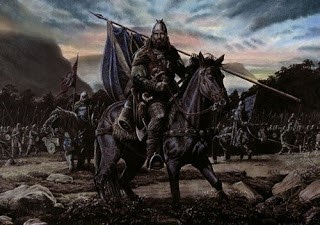
Sir William Wallace, nicknamed «Braveheart», «the Patriot», a Scottish knight born in 1272 at Elderslie and died in 1305 in London, is a national hero for Scotland.
He led the Scots' struggle against the occupation by the English under King Edward I of England (Plantagenet dynasty). His role during the Scottish wars of independence was so decisive for the fate of his country that his life took on a legendary dimension.
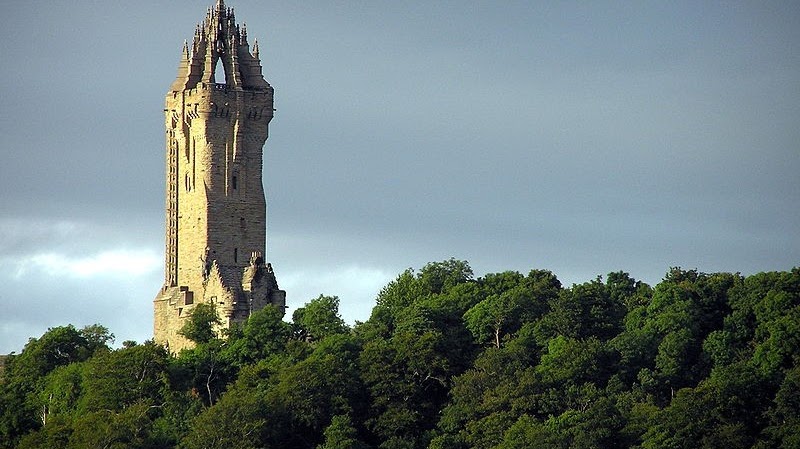
The Scots of today have forgotten his acts of cruelty and violence. His monument, proudly raised on the hill, at the site of the battle of Stirling Bridge, remains the symbol of resistance to English oppression, and his name has become legendary as that of a Scottish national hero.
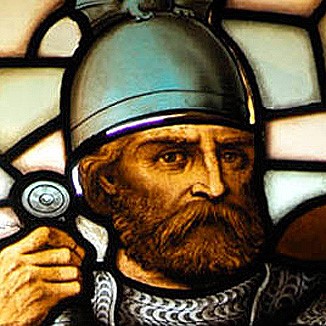
Sir William Wallace
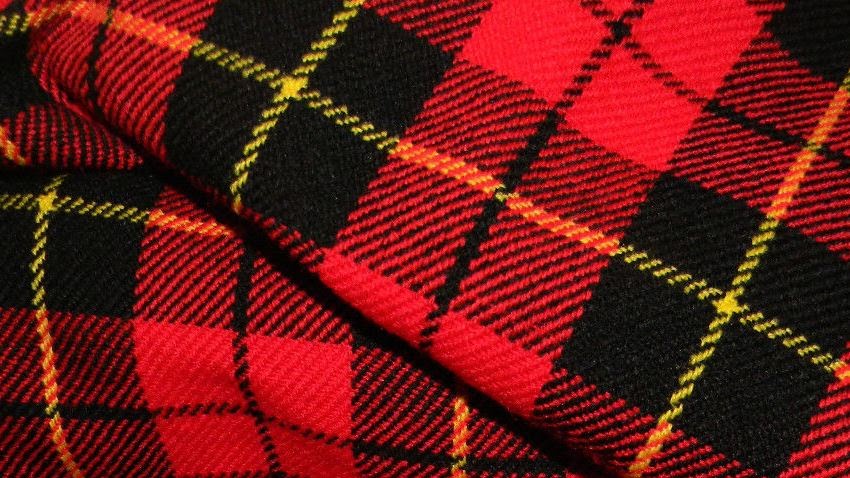
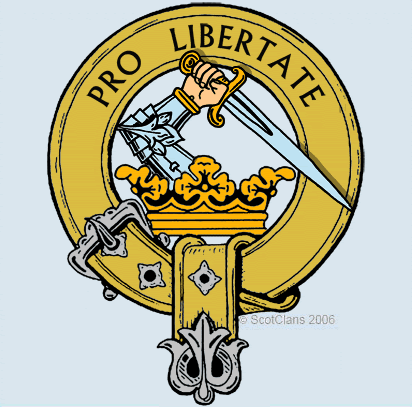
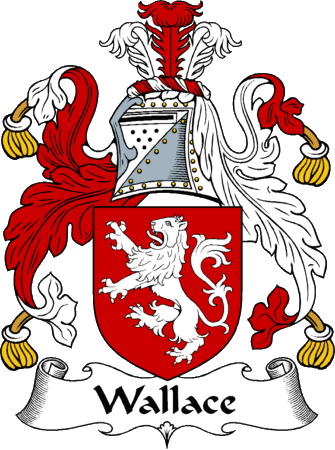
Wallace Clan Crest
William Wallace appeared to be a «man of the people», in contrast with his companion, Robert the Bruce (the future King Robert I of Scotland), who came from the high nobility. Wallace's family belonged to the minor nobility, descended from Richard Wallace (Le Waleis or Welshman), a landowner, vassal of one of the early members of the Stewart family (which would later become the royal line of the Stuarts).
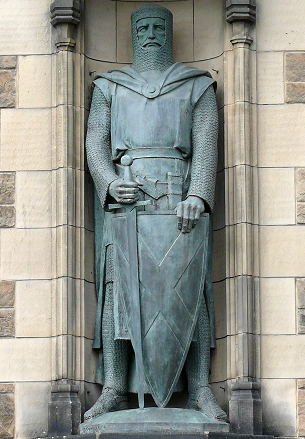
William Wallace was born at Elderslie (Renfrewshire) around 1272, which made him still a young man in his years of glory in 1297 and 1305. He received a good education and thus became well instructed by the standards of the time, speaking Latin and French. Witnesses describe him as a very tall man (about 2 metres), athletic, quarrelsome, intrepid and pitiless.
According to tradition, Sir Malcolm Wallace of Elderslie was the father of three sons, Malcolm, John and William Wallace. However, a seal of William Wallace, discovered in 1999, identifies the latter as the son of Alan Wallace of Ayrshire.
At the time of William Wallace's birth, King Alexander III (Dunkeld dynasty) had reigned over Scotland for 20 years. His reign had been a period of peace and economic stability, and he had successfully repelled the incessant demands of the English. In 1286, Alexander III dies from a fall from his horse; none of his children had survived him. The Scottish Lords proclaimed his little granddaughter Margaret, then aged 3, queen.
Because of her age, they set up a regency, the Guardians of Scotland, to ensure the administration of Scotland until she was of an age to govern. The English king, Edward I, took advantage of the potential instability to sign with the lords the Treaty of Birgham, promising to marry his son Edward to Margaret, on condition that Scotland remain an independent nation. But Margaret fell ill and died in 1290, aged 8, on her way back from her native Norway toward Scotland. Thirteen claimants to the throne came forward almost immediately, among them John Balliol.
However, the Scots wanted an outside arbiter to decide the question, so as to avoid accusations of partiality and, quite unreasonably, appealed to King Edward I to decide. Instead of presenting himself as an independent arbiter, he came to the Anglo-Scottish border with a great army, and announced that he had come as overlord to settle a dispute in a vassal state, forcing all the potential kings to do him homage. After hearing each oath, Edward chose John Balliol in 1292 to reign over the «vassal state of Scotland».
In March 1296, Balliol renounced his oath and war with England began with the sack of Berwick by Edward I, again in March 1296, followed by the Scottish defeat at the battle of Dunbar and the abdication of John Balliol in July. Scotland is subdued but not vanquished.
William Wallace appears in history by assassinating the English sheriff of Lanark to avenge the death of his beloved (Marion Braidfute). On account of this crime, he is outlawed and takes refuge in the woods, where he is soon joined by some thirty companions with whom, in May 1297, he massacres the English garrison of Lanark.
It is the signal for the rebellion, and harassing operations against the English multiply. Great lords are not slow to join him: William Douglas «the Bold», who becomes his lieutenant, Robert Wishart, bishop of Glasgow, who manages to bring James Stewart to the cause, and soon Robert Bruce the Younger, thereby breaking the Bruce family's reputation for Anglophilia.
And it is with a true army that Wallace lays siege to Dundee in August 1297. The Earl of Surrey and Hugh Cressingham, treasurer, whom the scale of the resistance movement was beginning to worry, react and place their troops at Stirling, thus cutting Wallace off from his rear.
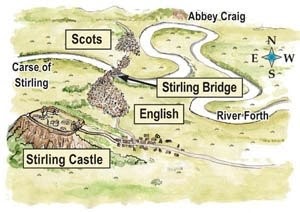
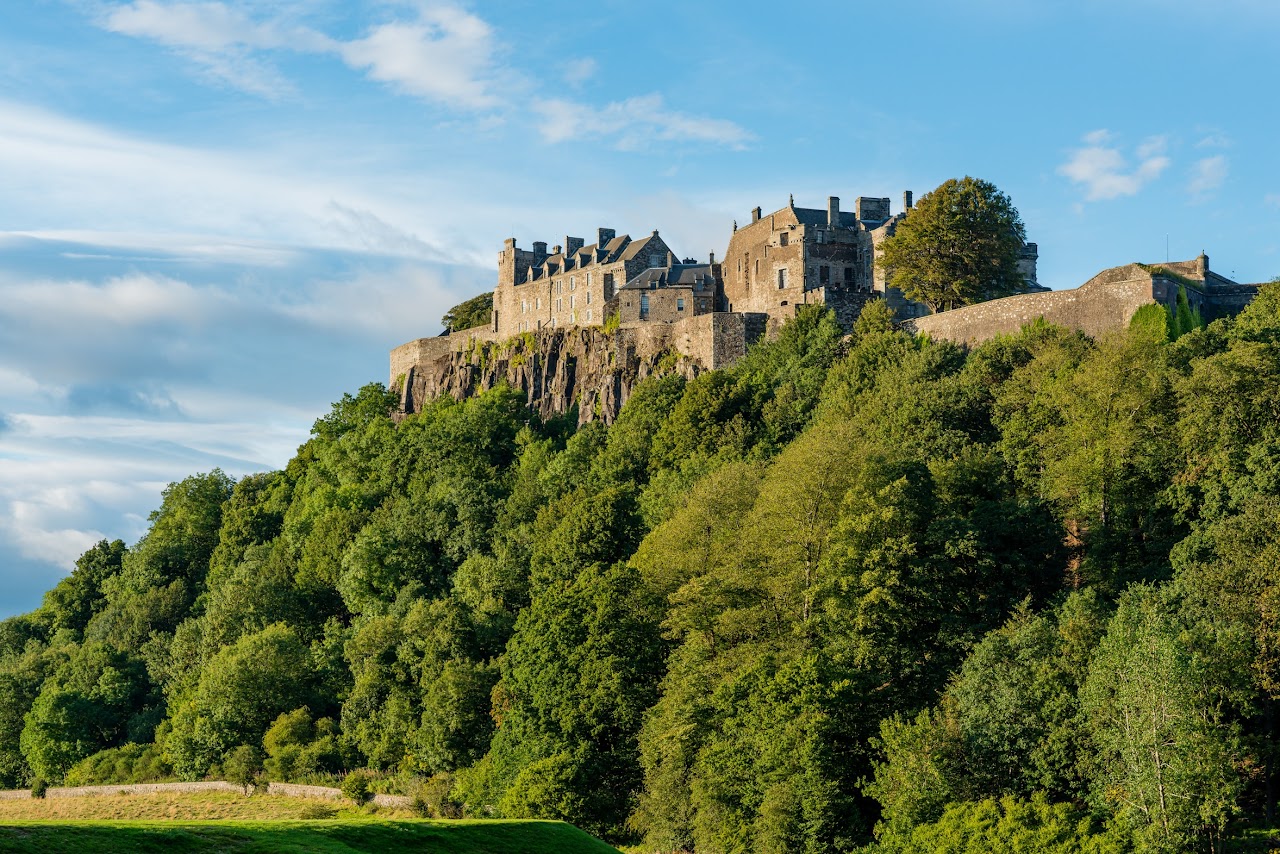
The fortress of Stirling dominates the marshy plain of the Forth at the point where, at the time, stood the last wooden bridge allowing passage of the river before its estuary.
Wallace understands the danger and returns in haste, abandoning the siege of Dundee, but the English are already installed on the right bank of the Forth, blocking the bridge. Wallace then camps on the left bank. The English are more numerous (10,000 foot and 300 horse) than Wallace's men (4,000 foot and 180 horse), and the defeat of the Scots seems inevitable.
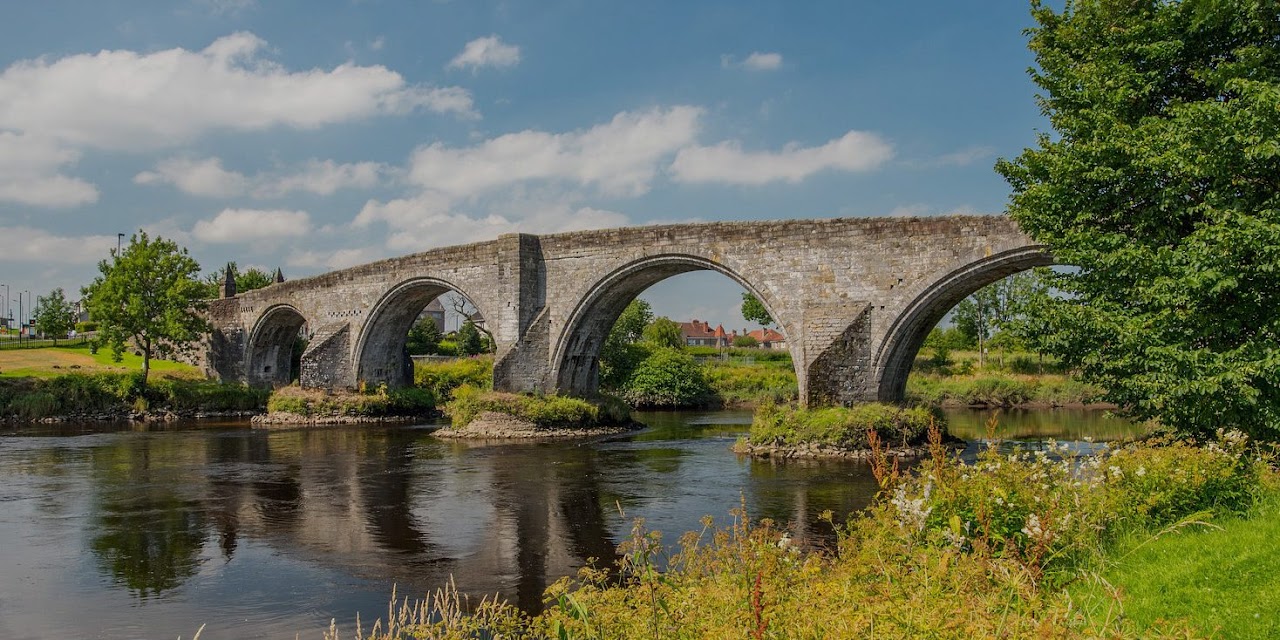
The site is, in appearance, unfavourable to Wallace. The river, surrounded by marshes, is crossable only by the narrow wooden bridge on which two horsemen could not pass abreast (it is this bridge, Stirling Bridge, that gave the battle its name). It was therefore enough for the English, well backed against the hill of Stirling Castle, not to move in order to block Wallace and prevent any retreat.
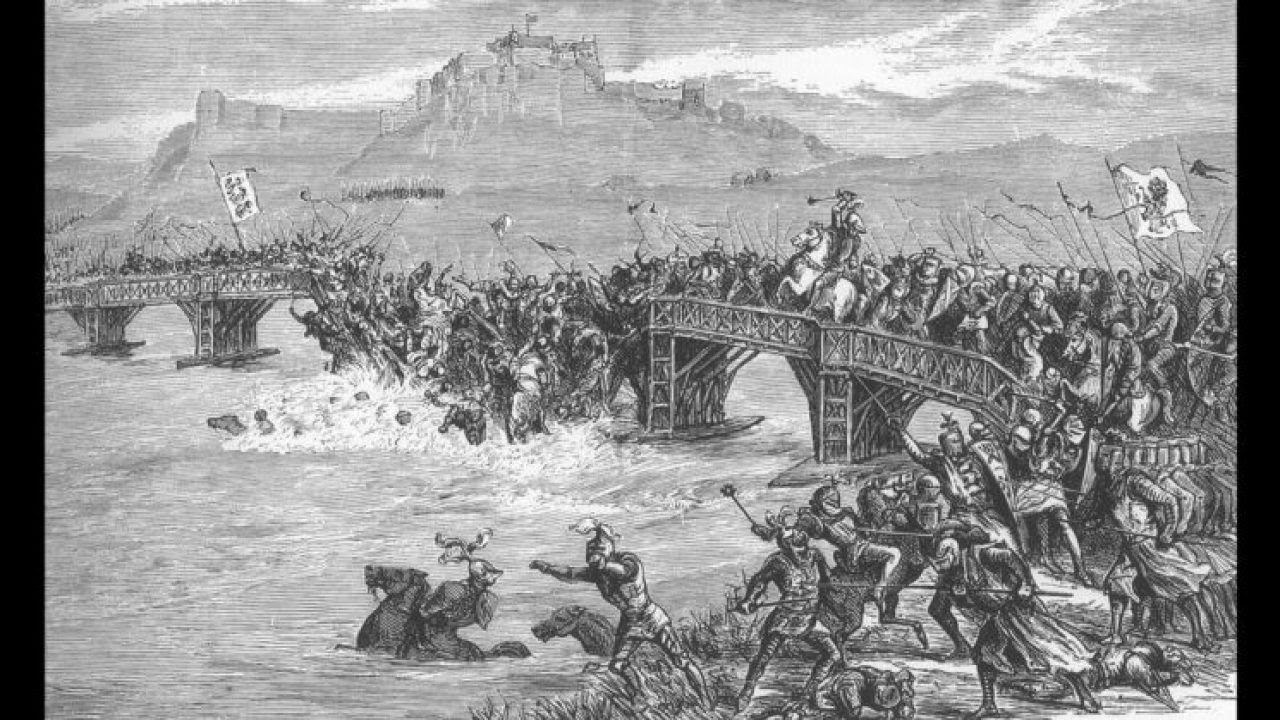
On the morning of 11 September 1297, an English knight, Marmaduke Tweng, decides to attack prematurely: standard at the fore, he ventures onto the bridge, without meeting resistance, followed by the first part of the English army. As the English cross the bridge, led by Hugh de Cressingham, they meet marshy ground and advance with difficulty toward the Scots.
Wallace's tactic is then to wait until a sufficient number of English have crossed the bridge before ordering two charges: the first against the bulk of the English troops and the second with the aim of cutting off any retreat. The Scottish troops trap and annihilate the English vanguard; the cavalry, proving ineffective on the marshy soil, is also decimated.
The wooden bridge, sabotaged by a Scottish carpenter, collapses at the passage of the second Scottish charge, causing the flight of the remaining English troops.
The English, caught by surprise before they had had time to get the whole army across the bridge, are cut to pieces: the part that had crossed the bridge was exterminated while the other could only contemplate the carnage before taking flight.
The English lose 3,000 men, including more than 100 knights; the Scots suffer rather limited losses, but the death of De Moray from his wounds has a negative impact on William Wallace's forces.
Sir William Wallace
For Wallace it was a dazzling and unexpected victory! Several towns are not slow to open their gates to him, among them: Aberdeen, Dundee, Perth, Stirling, Edinburgh, Roxburgh, Berwick. The Scottish Lords recognise Wallace's authority and proclaim him «Guardian of the Kingdom of Scotland».
In the months that follow, Wallace immediately conducts campaigns that take him as far as Cumberland and Northumberland, while at the same time making order reign in the territories under his power.
Edward I must intervene in person, abandoning for a time the continent (where he was supporting the Flemings against France) to regain control of Scotland. He moves north with a considerable army and, as early as July 1298, recaptures Berwick then Roxburgh. Wallace regroups his forces and tries to withdraw westward but Edward manages to cut off his road at Falkirk.
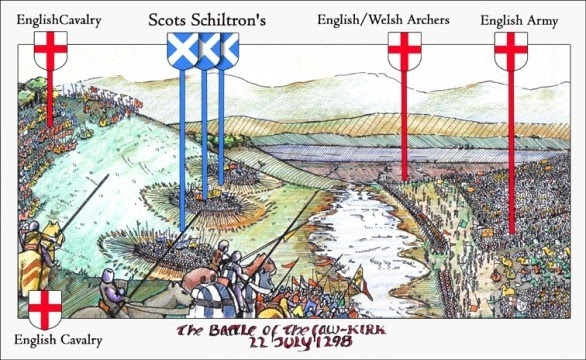
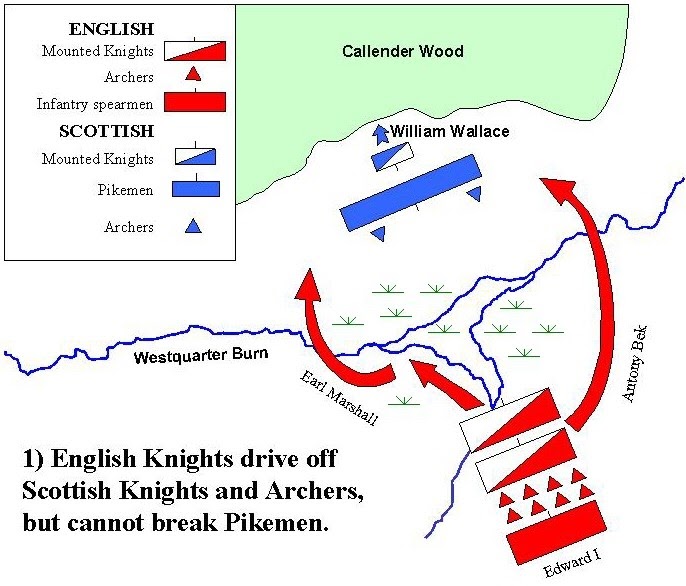
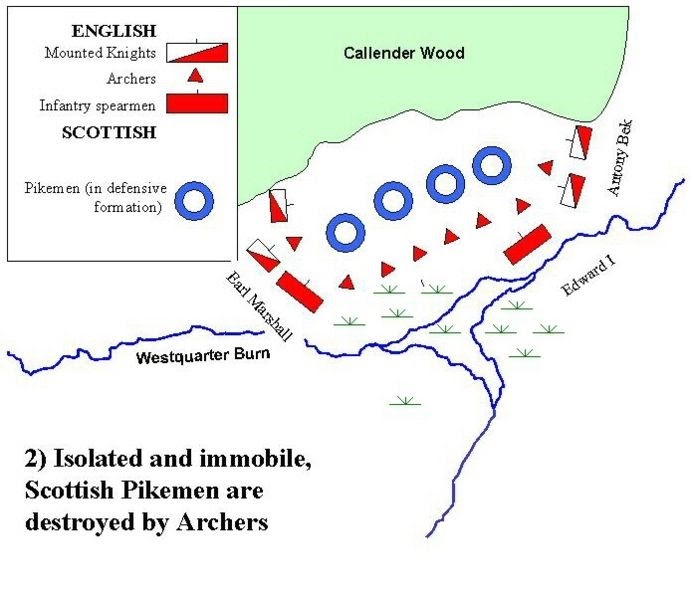
Instead of dispersing his men in the surrounding forests and exhausting the English army with guerrilla tactics, Wallace decides to entrench himself and await the frontal attack of Edward I.
He organises his men into «schiltrons», formations of soldiers that formed a wall of spears in order to prevent the English cavalry from crushing his men as it had done at Dunbar two years earlier.
However, the tactic proves ineffective, because the English archers are the first to fight: they loose a volley of arrows that breaks up the Scottish «schiltrons».
Scattered, William Wallace's men are at the mercy of the English cavalry: by the end of the day of 22 July 1298 the Scottish army is crushed and leaves 2,000 dead on the field. Wallace himself is in flight; it is the end of his epic.
After the disaster of Falkirk, William Wallace gives up his title of Guardian of the Kingdom of Scotland and takes refuge in France. His fate between 1298 and 1304 is poorly known, but we find him again in Scotland, around 1303–1304, where he resumes his guerrilla actions against the English. Militarily, the English king triumphs, but in fact his authority does not really impose itself on Scottish territory, where the resistance movement, initiated by Wallace, continues, actively supported by the clergy.
The new Guardians of the Kingdom of Scotland (John Comyn, Robert the Bruce, William de Lamberton, bishop of Saint Andrews) win a few successes, but the fine unity achieved around William Wallace crumbles, and the quarrels between John Comyn (supporter of the restoration of John Balliol) and Robert the Bruce grow ever sharper.
Robert the Bruce resigns from his office of Guardian and on 16 February 1302, with an unexpected about-face, makes his submission to the king of England! And on the continent, the Treaty of Paris of 20 May 1303 marks the reconciliation between the king of France and the king of England, thus depriving the Scots of French support. From then on Edward I has no more obstacles on his road in Scotland.
In the course of the summer of 1303, at the head of his army, the king of England crosses the river Forth on a bridge of boats. The fortress of Stirling, last bastion of independence and lock on the road to the Highlands, capitulates in July 1304. In their turn, the Comyns, long the soul of the resistance, make their submission.
Edward I promulgates a promise of pardon for all the Scots who would abandon the struggle, excluding however William Wallace, who was to «place himself at the mercy of the king our sovereign lord, who will act toward him as he shall see fit». Following this proclamation, the submissions multiply and, with few exceptions, Scotland submits.
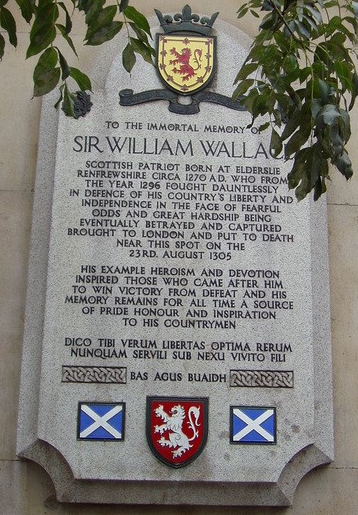
As for the unfortunate William Wallace, he is captured at Glasgow on 5 August 1305, brought to England and condemned to death for high treason. He dies executed («Hanged, drawn and quartered») in London on 23 August 1305, at the age of 33.
The fate reserved for William Wallace was iniquitous, for he could not be considered a «traitor» as the sentence specified, since he was not English and Edward I of England, better known by the name of Edward «Longshanks», was not king of Scotland.
The torment of William Wallace was atrocious: dragged by horses by the feet over several kilometres, half hanged, disembowelled and his entrails set on fire. Finally, he was beheaded, then cut to pieces and, to «set an example», King Edward I has the various parts of William Wallace's body displayed at the four corners of the kingdom of England, to make sure that no tomb sees the light of day.
This ignoble execution, devised to humiliate Scottish pride, perhaps did more for the posthumous glory of William Wallace than did his military exploits in the time of his ephemeral triumphs. This execution will revive Scottish nationalist sentiment and other men will rise up against England. Robert the Bruce, who had rallied the nobles to his cause and had proclaimed himself king, defeats the English army at Bannockburn in 1314, and Scotland finally wins, in 1328, its independence.
##
Edinburgh
The line down to the family.
- ★Elmerus Galeius (Eimerus de Wallense)b. c. 1100
- 2Richard «Wallense», «The Welshman» Wallaceb. c. 1117, † c. 1180&Emma
- 3Richard «Wallense», «The Welshman» Wallaceb. c. 1143, † c. 1204&Janet Catcarth, b. c. 1145
- 4Richard (Henry) Wallaceb. c. 1172, † c. 1197 · 1st Laird of Riccarton& c. 1196Margaret Buckingham, b. c. 1175, † 1221
- 5Adam Wallaceb. c. 1197, † c. 1247 · 2nd Laird of Riccarton& c. 1230Euphemia Stewart, b. c. 1205, † c. 1267 · of the High Stewarts of Scotland
- 6Malcolm Wallaceb. c. 1245, † c. 1296 · 1st Laird of Elderslie& c. 1265Margaret Crawford, b. c. 1251, † c. 1291 · of the Lairds of Loudun
- 7William «Braveheart», «The Patriot» Wallaceb. c. 1272, † 1305 · 2nd Laird of Elderslie, Guardian and Protector of Scotland& 1297Marion Braidfute, b. c. 1267, † 1297 · Heiress of Lamington
- 8Elizabeth (Marion) Wallaceb. c. 1295, † 1340 · Heiress of Lamington& 1314William Baillie, b. c. 1297, † c. 1357 · 2nd Laird of Hoprig and of Penston
- 9William Baillieb. c. 1320 · 1st Laird of Lamington
- 10William Baillieb. c. 1355 · 2nd Laird of Lamington&Isabel Seton, b. c. 1365 · of the Lords Seton
- 11William Baillieb. c. 1390, † 1423 · 3rd Laird of Lamington&Catherine Hamilton, b. c. 1395 · of the Lairds of Cadzow
- 12Marion (Mariota) Baillieb. c. 1428, † 1506 · of the Lairds of Hoprig and of Lamington& c. 1455John Somerville, b. c. 1425, † 1491 · 3rd Lord Somerville of Carnwath
- 13John «Red Bags» Somervilleb. 1457, † 1513 · 1st Lord Somerville of Cambusnethan& 1489Elizabeth Carmichael, b. c. 1473, † 1540 · of the Lairds of Balmedie
- 14Helen Somervilleb. c. 1495, † c. 1536 · of the Lords Somerville of Cambusnethan& 1517Robert Boyd, b. c. 1485, † 1558 · 4th Lord Boyd of Kilmarnock
- 15Robert Boydb. 1517, † 1589 · 5th Lord Boyd of Kilmarnock& 1535Margaret Colquhun, b. c. 1525, † 1601 · of the Lairds of Glens
- 16Thomas Boydb. c. 1547, † 1611 · 6th Lord Boyd of Kilmarnock& c. 1565Margaret Campbell, b. c. 1550, † 1597 · of the Lairds of Loudoun
- 17Marion Boydb. c. 1568, † 1632 · of the Lords Boyd of Kilmarnock& 1595James Hamilton, b. 1575, † 1618 · 2nd Lord Paisley, 1st Earl of Abercorn
- 18Anne Hamiltonb. 1592, † 1620 · of the Earls of Abercorn& 1611Hugh Semphill, b. 1578, † 1632 · 5th Lord Semphill
- 19Marion Semphillb. c. 1617, † 1668 · of the Lords Semphill& 1634George Preston, b. 1614, † 1679 · 6th Laird of Valleyfield
- 20Anne Prestonb. c. 1643 · of the Lairds of Valleyfield& 1678James Hay, b. 1639 · 3rd Laird of Pitfour
- 21Patrick Hayb. 1681 · 4th Laird of Pitfour&Barbara Nairn, b. 1673 · of the Lairds of Seggieden
- 22John Hayb. c. 1720, † 1754 · 4th Laird of Seggieden& 1736Lilias Hay, b. 1673 · of the Lairds of Pitfour
- 23Anne Hayb. 1741, † 1773 · of the Lairds of Seggieden& 1764William Chalmers, b. 1742, † 1817 · Town Clerk of Dundee, Laird of Glenericht
- 24Euphemia Chalmersb. 1766 · of the Lairds of Glenericht& 1788William Pitcairn, b. 1763, † 1831 · Laird of Innernethy
- 25Anne Pitcairnb. 1794, † 1875 · of the Lairds of Innernethy&David Carnegie, b. 1767, † 1818 · Senior Surgeon in Bengal Army
- 26John William Carnegieb. 1814, † 1874 · Major in Bengal Army&Jane Scott, b. c. 1813, † 1907
- 27Anne Pitcairn Carnegieb. 1839, † 1922& 1860Joseph Arnould, b. 1814, † 1866 · Judge at the Supreme Court at Bombay, Baronet 1859
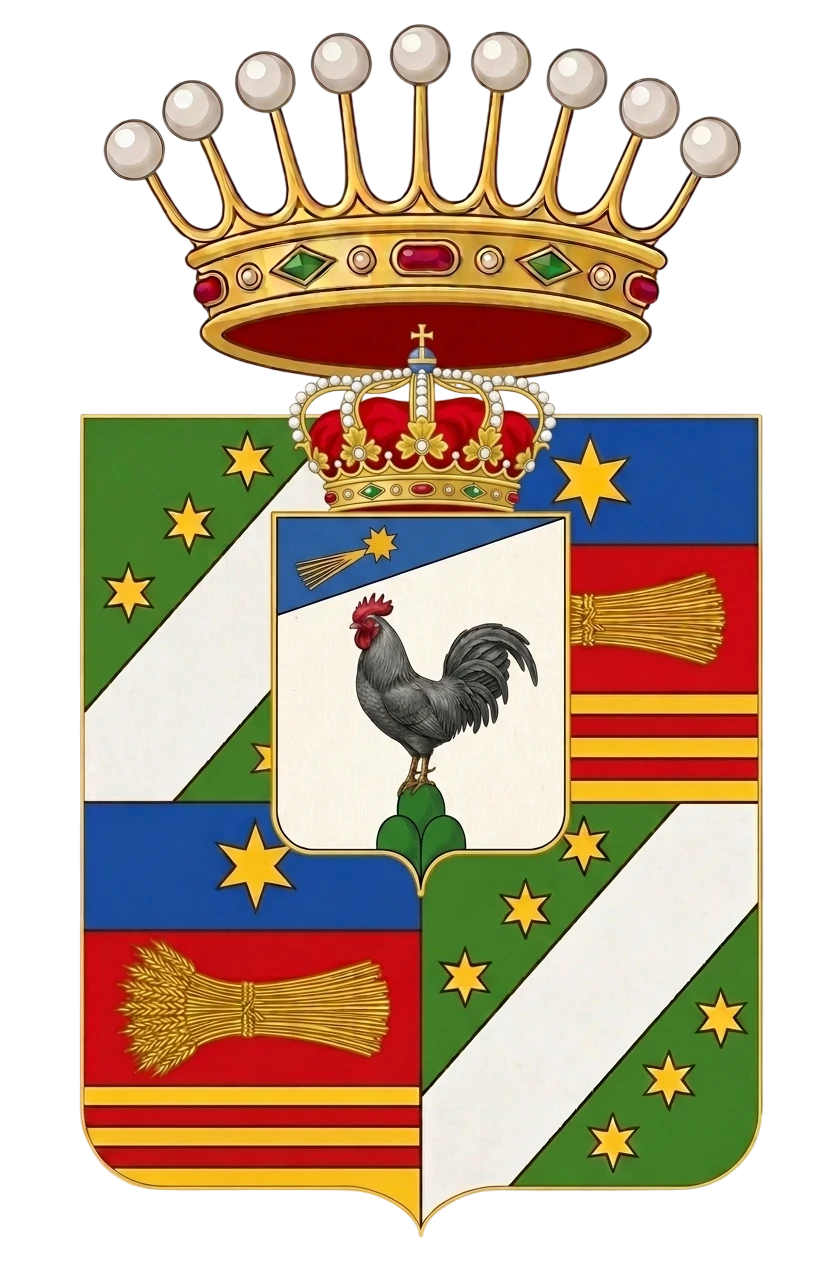
- 28Beatrice Arnouldb. 1861, † 1942 · of the Arnould Baronets& 1884Augusto II della Posta, b. 1849, † 1917 · 5th Duke of Civitella Alfedena
Chronology of the wars of independence.
Famous descent
Gallery.