Famous descent · Antiquity
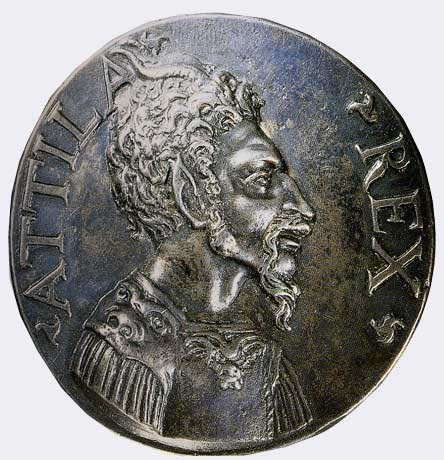
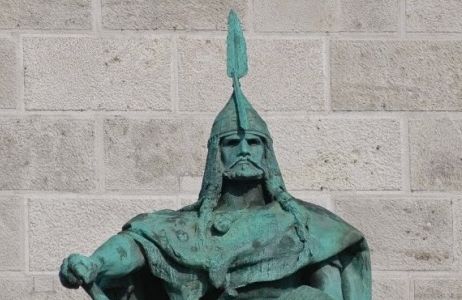
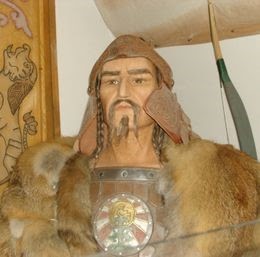
Attila.
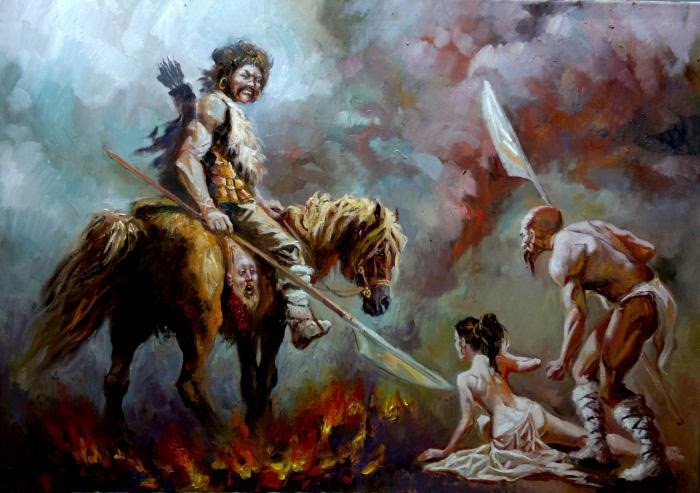
«The Scourge of God».
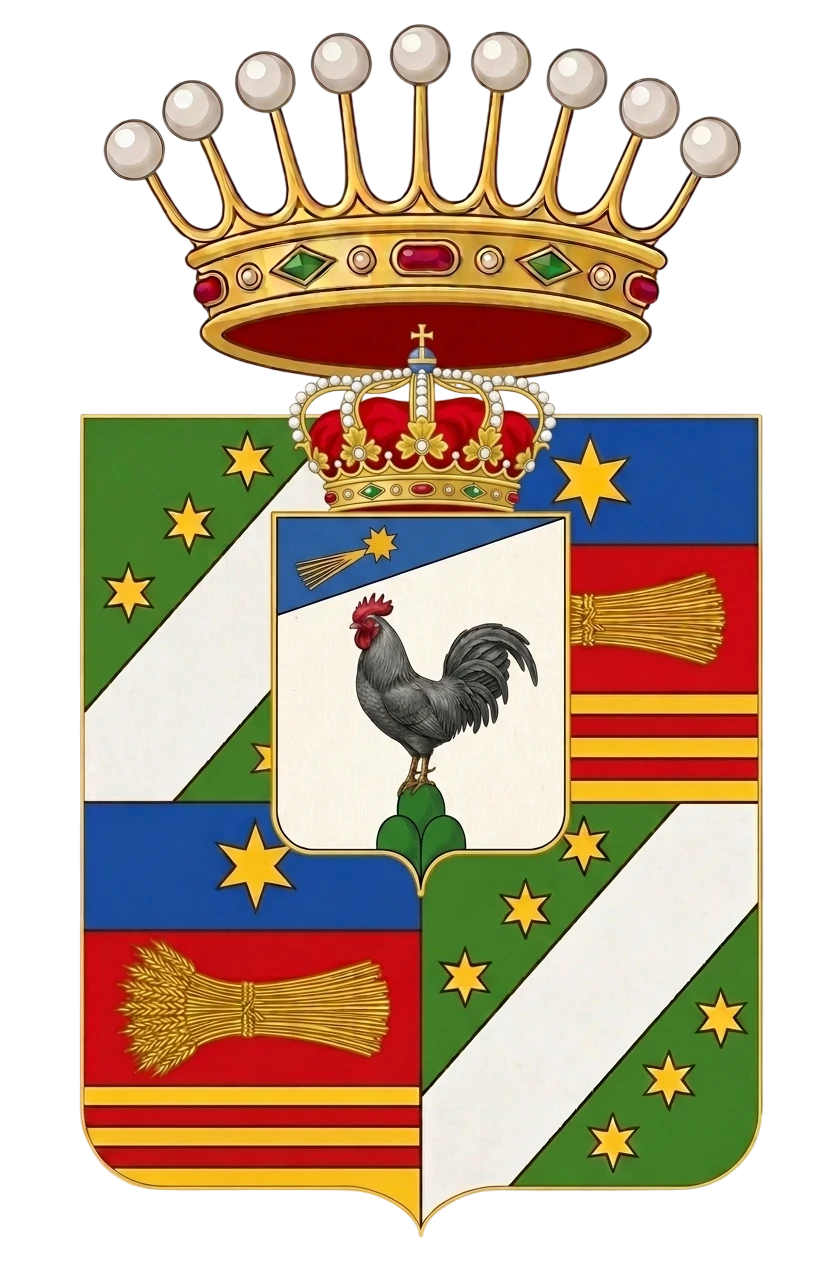
Below, the two principal chains rendered in structured form: the branch of the <strong>ancestors</strong> (chiefs of the Huns from the first century down to Attila's father), and the branch of the <strong>descendants</strong> which, via the Magyars, the Árpáds, the House of Anjou, the d'Avalos and the Pignatelli, leads down to the confluence with the Gallone line through the marriage Maria Emanuela Pignatelli ∞ Giuseppe Gerardo Gallone (1796). The subsequent continuation is documented on the dedicated pages.
Ancestors of Attila.
- 1Zemturb. c. 20 · of the Huns · Chief of the Huns
- 2Bolug† 123 · of the Huns · Chief of the Huns
- 3Bolchu† 156 · of the Huns · Chief of the Huns
- 4Zoltanb. c. 110 · of the Huns · Chief of the Huns
- 5Berendb. c. 140 · of the Huns · Chief of the Huns
- 6Kadchab. c. 170 · of the Huns · Chief of the Huns
- 7Oposchb. c. 210 · of the Huns · Chief of the Huns
- 8Ethelb. c. 245, † c. 300 · of the Huns · Chief of the Huns
- 9Szemenb. c. 267, † c. 335 · of the Huns · Khagan of the Huns
- 10Turda «the Hunchback»b. c. 310, † c. 386 · of the Huns · Khagan of the Huns&Enga, b. c. 315 · of the Khagans of the Huns
- 11Moundzoukb. c. 360, † 408 · of the Huns · Prince of the Huns
- ★Attila «the Scourge of God»b. c. 395, † 453 · 9th King of the Huns 437–453
Attila — vita e regno.
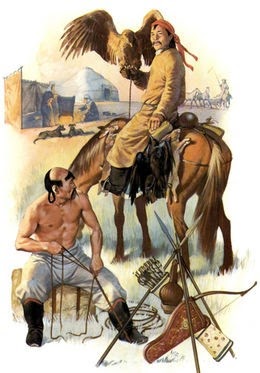
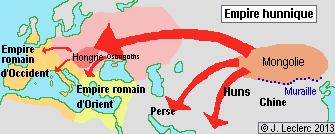
In 375 occurred the clash of the Huns against the Germanic Ostrogoths, who lived north of the Black Sea between the Danube and the Dnieper (Ukraine). The Huns were warrior tribes driven out of Mongolia by the Chinese four centuries earlier; settled in present-day Hungary, they had decided to set out westward, subjugating the Ostrogoths. It is this year 375 that is considered to mark the beginning of the great invasions and the start of the dislocation of the Roman Empire, threatened on every side along its frontiers.
After defeating the Ostrogoths, the Huns resumed their march westward and attacked the Visigoths, the Burgundians, the Alans, setting off cascading displacements: Goths, Ostrogoths, Visigoths, Vandals, Franks, Saxons, Burgundians, Alemanni, etc., collided with one another from one corner of Europe to the other and poured upon the Western Roman Empire. It is the first time that the West is invaded by Asian peoples and is threatened with seeing a civilisation foreign to its own become established.
Born around 395, Attila was the son of the king of a Hun tribe, Moundzouk, who died in war in 408. Orphaned, he is adopted and raised together with his elder brother Bleda by his uncle, the Hun king Rugas. In 434, before dying, Rugas divides the Hunnic Empire between his two nephews, Attila and Bleda.
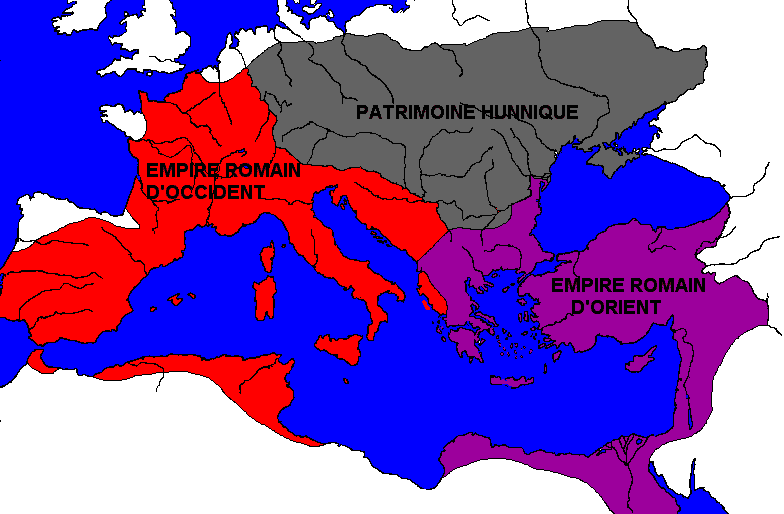
From 435 to 440, Bleda's reign is marked by the triumph of the Huns against the Eastern Roman Empire. This triumph is above all diplomatic, and Bleda's policy toward the Romans is peaceful. The doubling of the tribute paid by the Eastern Roman Empire of Constantinople and the imperial promise no longer to ally with the barbarian enemies of the Huns (with the Germanic peoples that remained independent) leave Bleda's hands free. Thus the Huns extend their empire as far as the Alps, the Rhine and the Vistula.
Yet, as early as 440, taking advantage of the opportunity offered by the invasion of Roman Armenia by the Sasanian Persians — an invasion that momentarily diverts Constantinople's attention from the Huns — Bleda again attacks the Eastern Roman Empire. At that moment, Attila helps his brother only in extremis, having for his part entered into negotiations with the Empire. He no doubt does so to avoid being shortchanged in the division of the spoils. Attila's autonomous policy during the war of 441–442 is mainly explained by his will to negotiate with the Romans the surrender of the Hun heir-princes who had taken refuge in the empire at the death of Rugas, as early as 435. These would have inherited the kingdom in the event of his brother's death.
Between late 444 and early 445, aided by his Germanic vassals, Attila has his elder brother Bleda assassinated and becomes the sole king of the Huns. Two Germans subject to the Huns, the king of the Sciri, Edika, and the king of the Gepids, Ardaric, in fact supplied the forces necessary for the assassination of Bleda, which took place in the latter's «ordu» (tent). Having ousted and killed his brother Bleda, Attila succeeded in 446 in regrouping under his command all the tribes of the Huns.
At the time, the empire of the Huns was immense. This people lived initially east of the Volga, but managed to forge an empire stretching from the Caspian Sea to the Alps, passing through present-day Hungary. Its centre lay in the environs of Győr.
Attila's reign lasts eight years and is marked, at his death, by a collapse of the power of the Huns, until then patiently built on the military alliances between the Hunnic empire and the Eastern Roman empire and on the financial windfall of the tributes and ransoms paid by Constantinople.
In reality, it seems that from the assassination of Bleda onward, Attila's Germanic allies had influenced him by encouraging the propensity he had to believe himself destined to reign over the entire universe. Thus Attila has himself styled «Europæ Orbator» (emperor of Europe) and seizes, as early as 445–446, the Roman province of Pannonia Savia (the rest of Pannonia being already held by the Huns). To maintain the fiction of Roman administration, he is even appointed magister militum by the Roman emperor Valentinian III.
From the Danubian basin where he is durably settled, Attila then threatens the Roman empire. On 27 January 447, an earthquake destroys a large part of the Theodosian walls of Constantinople and causes a severe famine. This weakness of the Eastern Roman empire allows the Western Roman empire to be momentarily spared from Attila's designs.
Attila, taking advantage of the event, hurls his army against the Eastern Roman empire but becomes bogged down there: in reality the empire does not pay its tribute and the payments of the sums previously owed are interrupted. The peace negotiations last several years, without any benefit to the Huns.
Now, at the very moment when they are about to succeed, the tributes paid by the East dry up definitively. The emperor Theodosius II dies in a riding accident and the «party of the blues» (party of the senators and aristocrats) triumphs: it is fiercely opposed to the idea of paying the barbarians to buy peace.
Having been unable to invade or subjugate the East, Attila finds himself caught in the diplomatic game of the West in 450. The episode concerns Honoria, co-empress of the West, who wishes to marry Attila in order to ally herself with him and whom her younger brother Valentinian III forces to take the veil to preserve imperial unity. In 449, a scandal breaks out and Honoria is sent to Constantinople to a Christian convent so that her «virginity» may be better guarded. Honoria then sends her ring to Attila to ask him for help. Attila takes the matter seriously and accepts the jewel as a «dowry», before claiming Gaul as the imperial inheritance owed to his «betrothed». His demands naturally meet with a refusal.
Blocked in the East, faced with Valentinian's refusal and Honoria's disappearance, Attila finds himself compelled in the autumn of 450 to declare war on the Western Roman empire, which also puts an end to the tribute paid by the West.
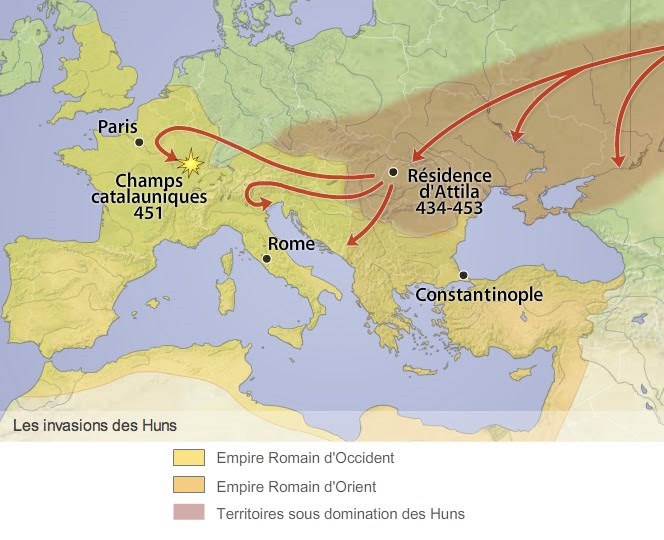
At the head of a coalition Hunno-Germanic army, Attila launches in the spring of 451 a campaign against Gaul. This army gathers the Gepid peoples (the most numerous), Visigoths (led by 3 brother-kings, among them the father of the future Theodoric I (Theodoric the Great)), Sciri, Suebi, Alemanni, Heruli, Thuringii, Franks, Burgundians, Alans, Sarmatians; it is for the most part Germanic, and the Huns make up only a minute part of it. The tactics that had previously made their success against the «civilised» are therefore no longer the order of the day.
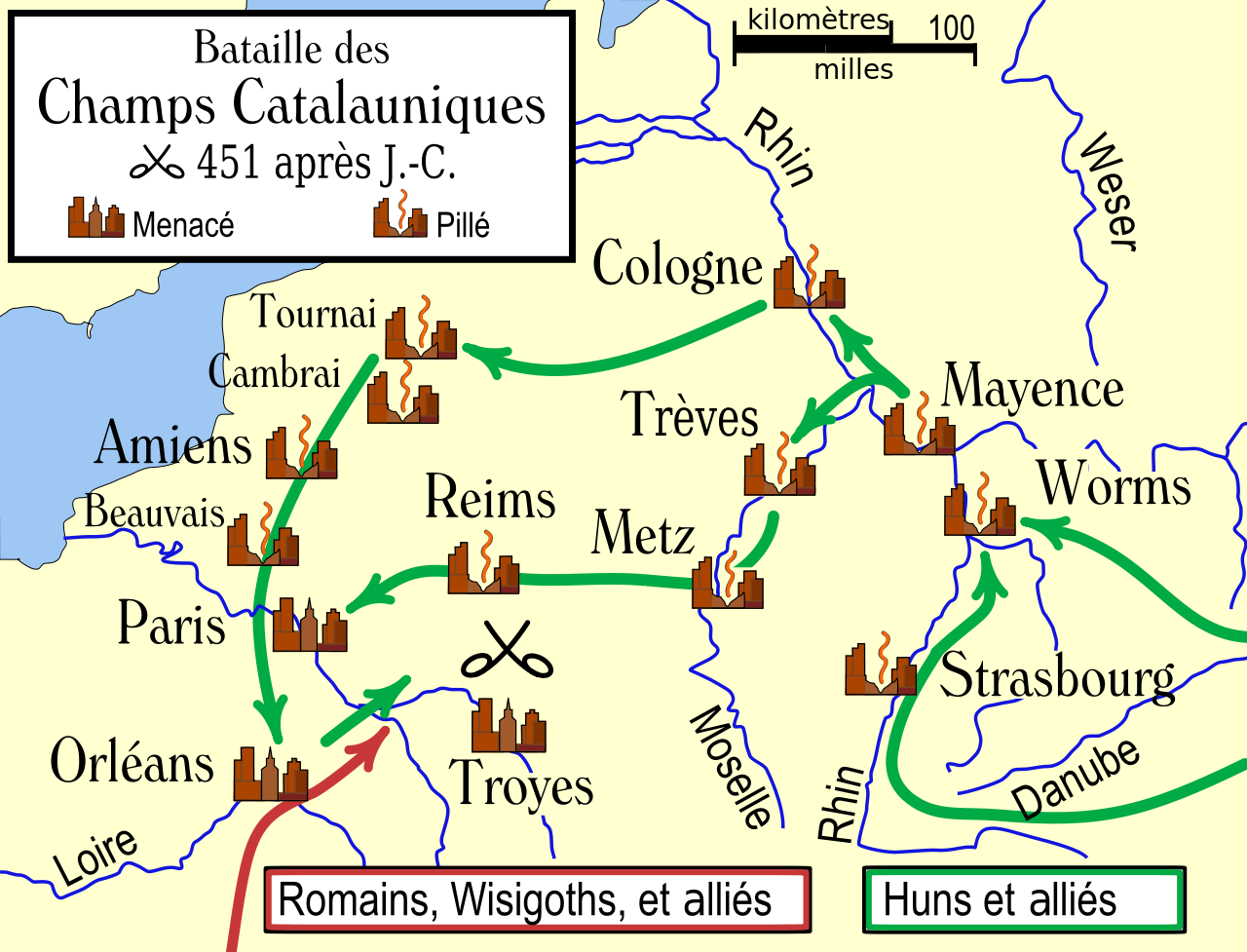
On 7 April, Attila burns Metz, but Gaul resists him, first at Paris under the impulse of Saint Genevieve, then at Orléans, at the instigation of Saint Aignan of Orléans with the support of the Roman legions of Flavius Aetius. During the siege of the capital, Saint Genevieve uttered the famous words: «Let the men flee, if they will, if they are no longer able to fight. We women shall pray to God so much and so long that He will hear our supplications.»
At Orléans, where he intends to cross the Loire, Attila fights against the Visigoths of Theodoric I and the Roman legions of Flavius Aetius, in reality composed of all the peoples settled in Gaul at that time: Alans, Franks, Burgundians, Sarmatians, Saxons, Laeti (barbarian colonists), Armoricans and even Britons come from across the Channel.
The Huns emerge victorious, and it is in Champagne that the final battle of the Catalaunian Fields takes place, probably less than a fortnight later. Some authors locate this battle 5 Roman miles (7.5 km) from Troyes in fields near the village of Maurica or Mauriacus («campus mauriacus»). Others, older, locate it near Châlons-en-Champagne, the ancient Catalaunum from which derives the adjective attributed to the «Catalaunian Fields», at the site of the Gallic oppidum of La Cheppe, improperly called «Attila's camp». After the carnage, Attila remains for a time in Gaul, then withdraws toward the Rhine.
In the spring of 452, he attacks again in Italy. His army takes Aquileia, Padua, Verona, Milan, Pavia and heads toward Rome. The emperor Valentinian III decides to negotiate. Led by Pope Leo I, by the prefect Trigetius who had already treated with the Vandals of Genseric, and by the consul Avienus, a Roman delegation goes to meet the king of the Huns and obtains a truce. Meanwhile, the troops of the new Eastern emperor, Marcian, have crossed the Danube and threaten the heart of the Hunnic empire. After a meeting with the supreme pontiff at Mantua, the «Scourge of God» therefore returned to Pannonia.
Back in his «ordu», the great king dies suddenly, in the spring of 453, perhaps poisoned, probably of a haemorrhage following a banquet given at his court for his wedding to a new bride, Ildiko, for his harem. Attila receives a royal funeral and is buried in a triple coffin, probably under the bed of the river Tisza in present-day Hungary, temporarily diverted for the occasion. It was in the utmost secrecy that he was interred. Even the slaves who had dug his grave were slaughtered… His sons Ellac then Attila II succeed him.
His succession degenerates into conflict among the numerous sons and grandsons of his numerous wives (battle of the Nedao in 454). His empire breaks up and the tribes of the Huns disunite and re-establish chiefs from among their dominant aristocracy.
Steven Runciman gives a descent starting from Attila's youngest son, Ernak, down to Kubrat, because the tsars of the Bulgars claimed to descend from Attila.
Christian Settipani proposes a more plausible descent, even if some passages from one generation to another remain hypothetical.
Numerous genealogists accept the thesis according to which a daughter of Attila would have been one of the numerous wives of Ardaric, king of the Gepids. As a result, the entire descent of the kings of the Gepids from the seventh century onward would also be a descent of Attila.
The most certain datum is the well-documented union between the Gepid princess Austrigusa and Waccho, king of the Lombards. Now, according to Christian Settipani, Waccho and Austrigusa would be ancestors of the mother and father of Charlemagne… but this thesis too implies a certain amount of speculation…
Descendants of Attila.
- ★Attila «the Scourge of God»b. c. 395, † 453 · of the Huns · 9th King of the Huns 437–453
- 2Ernakb. c. 432, † 476 · of the Huns · 13th King of the Huns 469–476
- 3Chaba (Chola)b. c. 470 · of the Huns · Prince of the Huns
- 4Edusb. c. 502 · of the Magyars · Chief of the Magyars
- 5Kadihab. c. 532 · of the Magyars · Chief of the Magyars
- 6Chazewb. c. 560 · of the Magyars · Chief of the Magyars
- 7Kulchugb. c. 502 · of the Magyars · Chief of the Magyars
- 8Edurof the Magyars · Chief of the Magyars
- 9Vergerusof the Magyars · Chief of the Magyars
- 10Elendusof the Magyars · Chief of the Magyars
- 11Avariusof the Magyars · Chief of the Magyars
- 12Venedobelof the Magyars · Chief of the Magyars
- 13Ugyekof the Magyars · Chief of the Magyars
- 14Almusb. c. 819, † 895 · of the Magyars · Chief of the Magyars (Hungarians)
- 15Árpádb. c. 845, † 907 · Árpáds · 1st Prince of Hungary 895–907
- 16Zoltánb. c. 886, † 948 · Árpáds · 2nd Prince of Hungary 907–928
- 17Taksonyb. c. 931, † 972 · Árpáds · 4th Prince of Hungary 955–972
- 18Michaelb. c. 955, † c. 978 · Árpáds · of the Princes of Hungary
- 19Basil (Vasul)b. c. 976, † 1037 · Árpáds · of the Princes of Hungary
- 20Béla I «the Champion»b. 1016, † 1063 · Árpáds · 6th King of Hungary 1060–1063
- 21Géza Ib. c. 1044, † 1077 · Árpáds · 8th King of Hungary 1074–1077
- 22Álmosb. c. 1068, † 1127 · Árpáds · of the Kings of Hungary · Duke of Croatia
- 23Béla II «the Blind»b. c. 1109, † 1141 · Árpáds · 12th King of Hungary 1131–1141, King of Croatia
- 24Géza IIb. c. 1130, † 1162 · Árpáds · 13th King of Hungary 1141–1162, King of Croatia
- 25Béla IIIb. 1148, † 1196 · Árpáds · 18th King of Hungary 1172–1196, King of Croatia
- 26Andrew IIb. 1176, † 1235 · Árpáds · 21st King of Hungary 1205–1235, King of Croatia
- 27Béla IVb. c. 1206, † 1270 · Árpáds · 22nd King of Hungary 1235–1270, King of Croatia
- 28Stephen Vb. c. 1240, † 1272 · Árpáds · 23rd King of Hungary 1270–1272, King of Croatia
- 29Mary of Hungaryb. 1257, † 1323 · Árpáds · Heiress of the Kingdom of Hungary&Charles II «the Lame» of Anjou (Capetians), b. 1248, † 1309 · Count of Provence, King of Naples 1285–1309
- 30Margaret of Anjou (Capetians)b. 1273, † 1299 · of the Kings of Naples&Charles I of Valois (Capetians), b. 1270, † 1325 · Count of Valois
- 31Philip VI of Valois (Capetians)b. 1293, † 1350 · Count of Valois, King of France 1328–1350
- 32John II «the Good» of Valois (Capetians)b. 1319, † 1364 · Count of Valois, King of France 1350–1364
- 33Louis I of Anjou (Valois Capetians)b. 1339, † 1384 · Duke of Anjou, Count of Provence, King of Sicily
- 34Louis II of Anjou (Valois Capetians)b. 1377, † 1417 · Duke of Anjou, Count of Provence, King of Sicily, King of Naples
- 35René I «the Good King René» of Anjou (Valois Capetians)b. 1409, † 1480 · Duke of Anjou, Count of Provence, King of Sicily, King of Naples, Duke of Lorraine, Duke of Bar
- 36Yolande of Anjou (Valois Capetians)b. 1428, † 1483 · Heiress Duchess of Lorraine and of Bar&Ferry VI of Vaudémont, b. 1417, † 1470 · Count of Vaudémont, Count of Guise
- 37Marie Marguerite of Vaudémontb. 1463, † 1521 · of the Counts of Vaudémont and Counts of Guise&René of Alençon (Valois Capetians), b. 1454, † 1492 · 3rd Duke of Alençon
- 38Anne of Alençon (Valois Capetians)b. 1492 · of the Dukes of Alençon&William VIII Palaiologos, b. 1493, † 1518 · 23rd Marquess of Montferrat
- 39Margherita Palaiologosb. 1510, † 1566 · Marchioness of Montferrat&Federico II Gonzaga, b. 1500, † 1540 · 1st Duke of Mantua, Marquess of Montferrat
- 40Isabella Gonzagab. 1537, † 1579 · of the Dukes of Mantua&Ferrante Francesco II d'Avalos, b. 1531, † 1571 · 2nd Prince of Francavilla, 2nd Prince of Montesarchio, 3rd Marquess of Vasto, 4th Marquess of Pescara
- 41Alfonso II d'Avalosb. 1564, † 1593 · 3rd Prince of Francavilla, 3rd Prince of Montesarchio, 4th Marquess of Vasto, 5th Marquess of Pescara
- 42Isabella d'Avalosb. 1585, † 1648 · 4th Princess of Francavilla, 5th Marchioness of Vasto, 6th Marchioness of Pescara&Iñigo III d'Avalos, b. 1578, † 1632 · 4th Prince of Francavilla
- 43Francesca d'Avalos† 1676 · of the Princes of Francavilla&Marino II Caracciolo Rosso, b. 1586, † 1630 · 3rd Prince of Avellino, 4th Duke of Atripalda
- 44Francesco Marino I Caracciolo Rossob. 1631, † 1674 · 4th Prince of Avellino, 5th Duke of Atripalda
- 45Giovanna Caracciolo Rossob. 1672 · of the Princes of Avellino and Dukes of Atripalda&Nicola d'Avalos, b. c. 1665, † 1729 · 6th Prince of Montesarchio, 3rd Prince of Troia
- 46Diego I d'Avalosb. 1697, † 1764 · 9th Prince of Francavilla, 8th Prince of Montesarchio, 5th Prince of Troia
- 47Maria Luisa d'Avalosb. 1748, † 1781 · of the Princes of Francavilla, Montesarchio and Troia&Giovanni Battista III Pignatelli, b. 1740, † 1805 · 2nd Prince of Moliterno, 4th Prince of Marsiconovo
- 48b. 1775, † 1818 · Princess of Marsiconovo and of Moliterno (heiress)& 1796Giuseppe Gerardo Gallone, b. 1766, † 1806 · 6th Prince of Tricase1796 · confluence into the Gallone line
Timeline
Chiefs of the Huns · from the 1st century
Gallery.